
ASPAC III Acquisition Corp.: Timing Pressures and Uncertainties Surround the Bioserica Deal
With its trust account nearly depleted and a looming deadline, ASPAC III’s future now hinges on closing the Bioserica merger. The company faces existential risks from delisting and liquidation, making the next steps decisive for both sponsor and public shareholders.
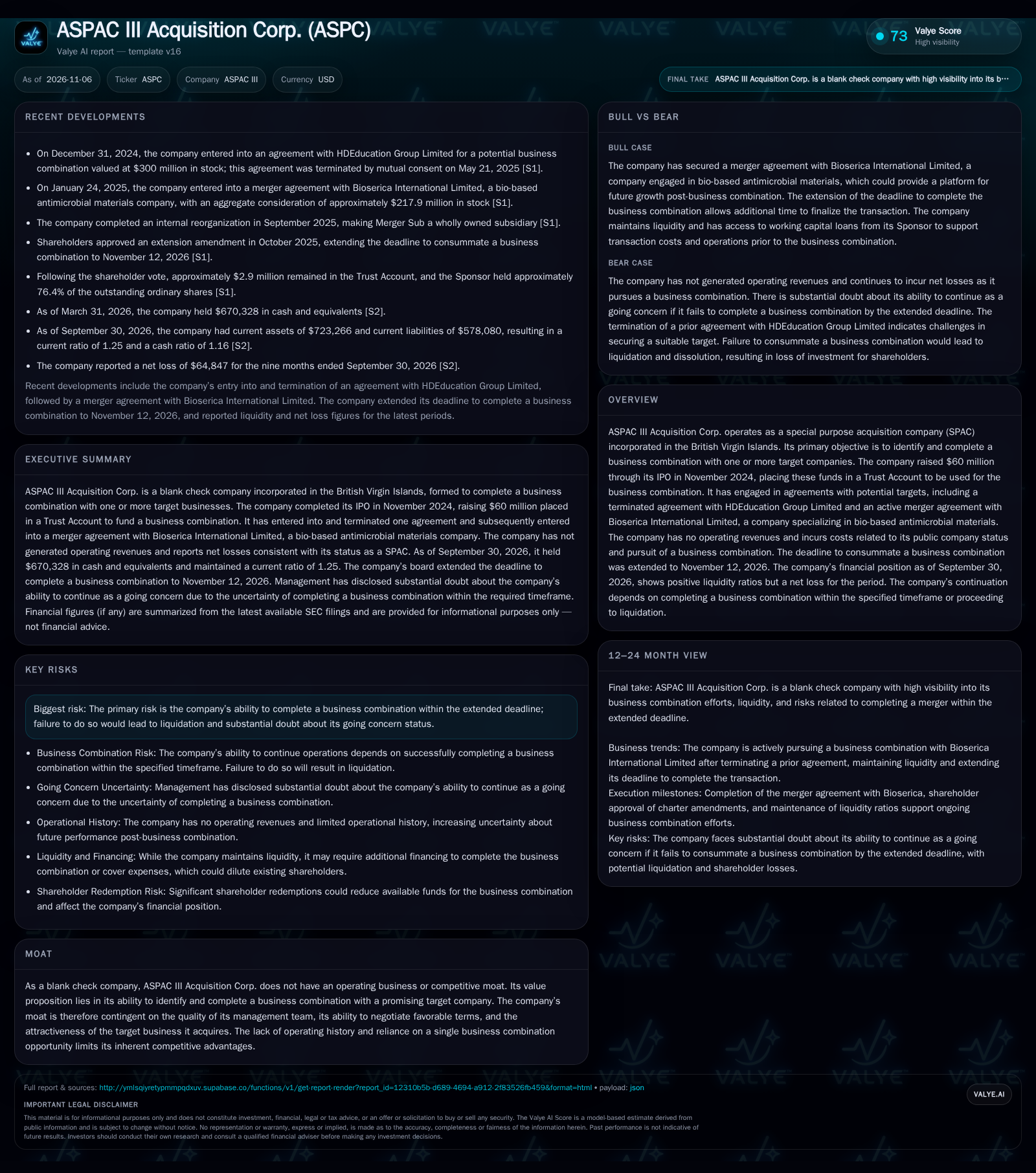
ASPAC III Acquisition Corp., a SPAC, has a pending merger with Bioserica International Limited but only $2.9 million left in its trust account following shareholder redemptions. The company’s extension to finalize a deal expires on November 12, 2026, and management cites substantial doubt about its ability to continue as a going concern if the merger fails. Nasdaq has flagged the company for insufficient equity, raising the stakes for a timely and successful transaction. ASPAC III’s outcome now depends almost entirely on the execution and closure of the Bioserica deal within the next year. [S1] [S2]
ASPAC III Acquisition Corp. is now a classic SPAC race against the clock. With shareholder redemptions having drained its trust account to just $2.9 million, and a Nasdaq delisting warning hanging overhead, the company’s only viable path is to close its $217.9 million stock-based merger with Bioserica International Limited before the extended November 2026 deadline. The situation underscores how late-stage SPACs can become high-stakes binary bets, where execution risk, sponsor incentives, and shareholder dilution collide. The forthcoming year will determine whether ASPAC III can transform into an operating company or face liquidation, with little room for error. [S1] [S2]
Liquidity Challenges and Merger Timing Shape ASPAC III’s Current Outlook
ASPAC III Acquisition Corp. has entered into a definitive merger agreement with Bioserica International Limited, a bio-based antimicrobial materials company, for an aggregate consideration of approximately $217.9 million in stock. However, the company’s trust account has dwindled to just $2.9 million after significant shareholder redemptions, and it reported only $670,328 in cash as of March 31, 2026. The deadline to close a business combination was extended to November 12, 2026, but management has flagged substantial doubt about ASPAC III’s ability to continue as a going concern if the merger is not completed in time. In addition, Nasdaq has notified the company of non-compliance due to insufficient stockholders’ equity, further raising the stakes for a successful and timely transaction. [S1] [S2]
Understanding SPAC Economics: Dilution Effects and Sponsor Roles in Post-Merger Structure
ASPAC III’s business model is typical of late-stage SPACs: it earns no operating revenues prior to a merger, incurs ongoing public company expenses, and depends on trust account funds for deal execution. The economics are now defined by the extreme reduction in available cash—only $2.9 million remains after redemptions, which will limit the cash consideration available to Bioserica and may require creative structuring (such as additional PIPE financing or sponsor backstops) to close the deal. The sponsor, holding approximately 76.4% of outstanding ordinary shares, has strong incentives to consummate a transaction, as sponsor economics can be wiped out by liquidation. Post-merger, the combined company’s value will depend on Bioserica’s operating prospects, capital needs, and ability to execute in the bio-based materials market. The risk of further dilution for public shareholders is high, especially if new capital must be raised to supplement the depleted trust. [S1]
Operating leverage is not relevant pre-merger, but after a successful transaction, the economics will shift to Bioserica’s revenue model, cost structure, and scalability. If Bioserica’s business is capital-intensive, further fundraising could be required soon after closing, potentially impacting the share base and future returns.
Market Realities for SPACs: Structural Hurdles and Difficulties in Securing Quality Targets
As a blank check company, ASPAC III has no intrinsic competitive moat—its sole asset is the ability to deliver a public listing and capital to a private business. This model faces increasing competitive headwinds, as high redemption rates and regulatory scrutiny have diminished SPAC appeal. The terminated prior agreement with HDEducation Group Limited suggests difficulty in securing compelling targets and negotiating terms that survive due diligence and market volatility. Compared to traditional IPOs or direct listings, SPACs are often perceived as a last-resort path for targets that may struggle in the open market.
For Bioserica, the appeal of merging with ASPAC III may include speed to market and sponsor alignment, but the near-empty trust account undercuts the financial benefit. Competitively, other SPACs, private equity, and venture funds continue to compete for promising ESG and material technology targets. ASPAC III’s ultimate differentiation will rest on its ability to close the merger and the quality of Bioserica’s business post-combination.
Potential Outcomes if the Bioserica Merger Completes and Execution Proceeds
The best-case scenario for ASPAC III is a successful and timely closing of the Bioserica merger, with the combined company listing on Nasdaq and achieving operational momentum. This would require resolving cash shortfalls—potentially through PIPE funding, sponsor backstops, or renegotiated deal terms—and satisfying Nasdaq’s listing requirements. If Bioserica can deliver growth in its bio-based antimicrobial materials business, demonstrate commercial traction, and access additional capital on reasonable terms, the merged entity could realize value for shareholders who did not redeem.
Evidence supporting this scenario would include: regulatory approvals for the merger, new capital commitments to shore up the balance sheet, positive updates on Bioserica’s commercial pipeline, and clear guidance on post-merger financial targets. A rapid improvement in market sentiment for ESG and materials technology companies would also help re-rate the combined entity.
Likely Scenario: Merger Completion with Limited Cash and Increased Dilution
The most plausible outcome is that ASPAC III and Bioserica work to close the merger before the November 2026 deadline, but with only modest cash available from the trust account and the need to accept significant dilution or alternative funding sources. The sponsor’s high equity stake and strong incentives to avoid liquidation make a deal likely, but public shareholders who did not redeem could see their ownership further diluted if new capital is raised on less favorable terms.
In this scenario, the combined company lists on Nasdaq, but near-term potential financial flexibility is constrained, requiring early post-merger capital raises. The quality and commercial potential of Bioserica’s business will quickly come under scrutiny, as the market evaluates whether the company can deliver growth and justify its valuation. Confirmation would come from completion of the merger, successful listing, and initial trading performance, while evidence to the contrary would include regulatory or financing delays and negative disclosures about Bioserica’s financials.
Consequences of a Failed Deal: Liquidation Impact on Sponsors and Shareholders
If ASPAC III cannot close the Bioserica merger before the November 2026 deadline—due to regulatory, financing, or target-specific issues—the company will be forced to liquidate. In this scenario, remaining trust assets are distributed to public shareholders, but with only $2.9 million left, recovery is minimal compared to initial investments. The sponsor’s equity and private placement units would be rendered worthless, and any public shareholders who did not redeem would face significant losses.
Evidence supporting this downside would include missed regulatory or shareholder approval milestones, inability to secure new capital to satisfy deal closing conditions, or a formal dissolution announcement. Nasdaq delisting could accelerate this outcome if compliance is not restored.
Upcoming Developments That Will Determine ASPAC III’s Direction
Progress toward regulatory and shareholder approvals for the Bioserica merger: announcements of scheduled votes, SEC effectiveness, or deal amendments would be major signals.
Updates on PIPE financing or other capital commitments to supplement the depleted trust account: public disclosure of new funding arrangements would help test dilution and post-merger cash runway.
Nasdaq compliance restoration: confirmation that the combined company will meet stockholders’ equity and market value requirements post-merger.
Sponsor or affiliate loans: any new working capital loans (if disclosed) and their conversion or repayment terms could indicate deal stress or creative structuring.
Disclosure of Bioserica’s commercial pipeline, customer contracts, or revenue projections: details would clarify whether the target can generate post-merger growth.
Redemption rates at merger vote: high redemptions would further constrain available cash and test deal viability.
Any amendments to merger terms, including valuation, earn-outs, or sponsor forfeitures, would reveal negotiation dynamics as closing nears.
Public guidance or commentary from management on timeline, deal confidence, or contingency plans if the merger faces delays.
Disclaimer: This is research-only, informational analysis and not investment advice. It may include AI-generated interpretation and general industry context. Always verify important details using primary sources.

Comments