
Tri Pointe Homes: Geographic Reach and Financial Strategy in Homebuilding Cycles
Tri Pointe Homes, Inc. sits at the intersection of cyclical housing demand and regional market complexity, leveraging a diversified footprint and a substantial cash position. The company’s segmented approach and integrated financial services offer resilience, but success will depend on execution through economic swings and regulatory headwinds.
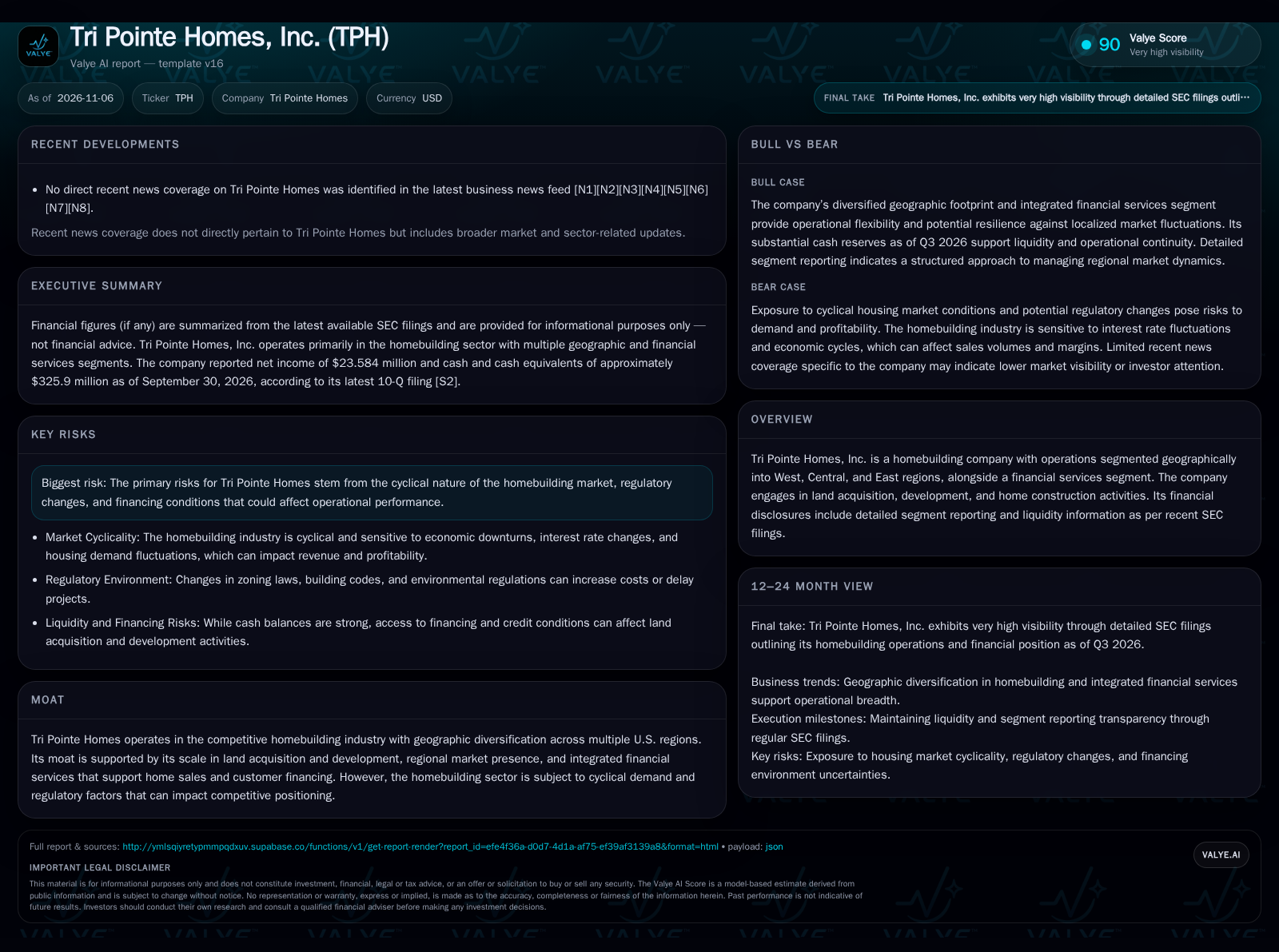
Tri Pointe Homes, Inc. posted $23.584 million in net income and held $325.9 million in cash as of Q3 2026, underlining its operational scale and liquidity. With a multi-region homebuilding model and integrated financial services, the company seeks to buffer against regional and macroeconomic shocks. The durability of margins and volume will hinge on housing cycle dynamics, regulatory shifts, and the ability to redeploy capital into attractive land and development opportunities. Watch for shifts in sales pace, absorption rates, and cost inflation as indicators of future trajectory. [S2]
Tri Pointe Homes, Inc. operates in one of the most cyclical sectors of the U.S. economy, yet it seeks to offset volatility through a multi-region strategy and an integrated financial services segment. With $23.584 million in net income and a cash position of $325.9 million as of Q3 2026, the company enters the next phase of the housing cycle with a solid financial base. The real test will be whether Tri Pointe can sustain growth and margin discipline as macroeconomic conditions and regulatory environments evolve, all while deploying capital efficiently across its geographically diverse platform. [S2]
Recent Results and Strategic Insights: A Data-Driven Overview
Tri Pointe Homes reported net income of $23.584 million for the quarter ended September 30, 2026, with a cash and cash equivalents balance of $325.9 million at that date. The company’s operating model segments activities across West, Central, and East regions, supplemented by a financial services division. This structure highlights both operational breadth and a focus on liquidity preservation, with recent SEC filings offering granular visibility into segment performance. The current facts underscore a company that is managing profitability and liquidity amid a complex and potentially shifting housing market landscape. [S2]
Revenue Streams and Risk Factors in Tri Pointe Homes’ Business Model
Tri Pointe’s core business is the acquisition, development, and sale of single-family homes, supplemented by financial services that facilitate customer financing. Revenue is primarily driven by the volume of homes closed and the average selling price (ASP), which in turn depend on sales pace, absorption rates, and product mix. Gross margins are sensitive to land acquisition costs, construction materials, labor, and selling expenses, all of which can fluctuate sharply in response to macroeconomic and local-market shifts.
Operating leverage is a double-edged sword: when volumes rise, fixed costs are spread over more units, boosting margins. However, in a downturn, fixed costs (land carrying, corporate overhead, interest expenses) can quickly erode profitability if sales slow. The company reported cash and liquidity metrics for the period; these figures do not by themselves establish operating runway, investment capacity, financial flexibility, or financing capacity. The economics of the financial services segment are less transparent, but such arms typically generate fee income and may provide captive financing, which can enhance margins and aid sales velocity if managed prudently.
The sensitivity of Tri Pointe’s revenue streams to macroeconomic variables necessitates a nuanced understanding of demand elasticity in housing markets. For example, if interest rates rise, the cost of financing homes increases, which typically dampens buyer demand and elongates absorption periods. Conversely, in a low-rate environment, demand may accelerate, but this also risks inflating land and construction input costs. Additionally, the company’s exposure to regional labor markets can impact construction timelines and cost predictability; labor shortages or wage inflation in one region may not be offset by conditions in another, thereby complicating margin management. A further layer of complexity arises from the interplay between product mix and buyer demographics, where shifts toward entry-level or luxury homes can materially affect ASPs and margin profiles.
Evaluating Competitive Strengths: Scale and Regional Footprint
Tri Pointe’s geographic diversification across three major U.S. regions is a strategic attempt to mitigate localized downturns and regulatory disruptions. In theory, this allows the company to reallocate capital and resources to the strongest markets and product types as cycles evolve. The inclusion of an integrated financial services segment may help smooth the buying process for customers and could provide incremental margin, though it also exposes the company to credit and interest rate risk.
The broader homebuilding industry is highly fragmented, with national giants, regional players, and local builders all vying for share. Scale can confer some advantages in land acquisition, procurement, and marketing, but barriers to entry are relatively low outside of land and entitlement bottlenecks. Substitutes—including rental housing and existing home inventory—can quickly alter demand. Regulatory pressures, such as changes in zoning or environmental requirements, can further shift the competitive landscape and affect cost structures.
Scale advantages in homebuilding often manifest through enhanced bargaining power with suppliers and the ability to standardize construction processes, which can reduce per-unit costs and improve margins. However, these benefits may be unevenly realized across Tri Pointe’s diverse geographic footprint due to local variations in land availability, entitlement processes, and labor market conditions. Moreover, the integrated financial services segment, while potentially a differentiator, introduces credit risk exposure that must be carefully managed, especially during economic downturns when default rates may rise. The company’s ability to adapt product offerings to regional preferences and regulatory environments can also serve as a competitive moat, but this requires agile operational capabilities and localized market intelligence.
Potential Catalysts for Outperformance in Cyclical Markets
A favorable scenario for Tri Pointe would involve a combination of resilient housing demand, stabilizing or declining interest rates, and effective cost management. If the company leverages its reported cash position to acquire land at attractive prices during downturns, it could build a pipeline for higher-margin growth as the cycle turns. Geographic diversification could allow Tri Pointe to pivot toward faster-growing regions or market segments, while the financial services arm might boost conversion rates and enhance customer loyalty.
Confirmation of this scenario would require evidence of rising sales volumes, stable or expanding gross margins, and disciplined capital deployment—particularly in land acquisition and development. A useful sign would be increased absorption rates in key markets and a healthy backlog (if disclosed), alongside limited inventory buildup and improved returns on invested capital.
In scenarios where Tri Pointe successfully capitalizes on market dislocations, the timing and scale of land acquisitions become critical. Acquiring land at cyclical lows can yield outsized returns as development progresses and market conditions improve, but this strategy depends on accurate forecasting of housing demand and capital availability. Furthermore, the company’s capacity to integrate financial services effectively could enhance buyer conversion rates by simplifying the mortgage process and offering competitive financing terms, thereby accelerating sales velocity. Geographic flexibility also permits reallocation of resources toward higher-growth regions or product segments, which can amplify returns on invested capital and buffer against localized downturns.
Expected Developments Amid Market and Regional Fluctuations
The most plausible outcome is that Tri Pointe navigates ongoing macroeconomic uncertainty with mixed results across its regions. Housing demand may remain uneven, with some local markets experiencing softness due to affordability challenges, interest rate volatility, or regulatory delays.
Evidence supporting this scenario would include relatively stable, but not rapidly growing, sales volumes and ASPs, moderate margin compression, and continued emphasis on liquidity in management commentary and filings. Watch for a steady, cautious approach to land acquisition and inventory management—signs that the company is prioritizing risk control over aggressive expansion.
Risks from Extended Market Downturns and Regulatory Changes
A more adverse scenario would see Tri Pointe hit by a combination of sustained housing market weakness, elevated interest rates, and unfavorable regulatory changes. In this environment, sales volumes could decline sharply, inventory might build up, and fixed costs would become a larger drag on profitability. If land already acquired cannot be developed or sold profitably, the company could face write-downs and cash burn despite its current liquidity.
Confirmation of this downside would be clear in the form of declining net income, negative operating cash flow, significant inventory buildup, and asset impairments. Additional warning signs would include management commentary indicating project delays, regulatory setbacks, or tightening credit conditions affecting customer financing or land purchases.
Factors Influencing Tri Pointe’s Future Trajectory
Quarterly trends in home sales volumes, absorption rates, and average selling prices by region—these will reveal demand health and pricing power.
Gross margin progression and cost-per-unit trends, especially in the face of construction input inflation or labor shortages.
Land acquisition activity and lot pipeline growth, as disclosed—indicative of future revenue potential and capital allocation discipline.
Inventory levels and turnover rates—a buildup could signal slowing demand or poor forecasting.
Financial services segment performance, including loan origination volumes and credit quality, if disclosed.
Regulatory developments or commentary in filings about zoning, permitting, or environmental hurdles impacting project timelines.
Disclaimer: This is research-only, informational analysis and not investment advice. It may include AI-generated interpretation and general industry context. Always verify important details using primary sources.

Comments