
PacBio’s Sequencing Ambitions: Platform Leverage Versus Commercialization Headwinds in Genomics
PacBio is doubling down on its HiFi long-read sequencing platform, pursuing deeper market penetration and new clinical applications while restructuring operations. Execution risk remains high as the company contends with persistent losses and the challenge of expanding adoption beyond research into clinical and applied genomics.
PacBio’s next phase hinges on converting its advanced HiFi sequencing technology into a sustainable commercial engine. Recent asset sales, partnerships, and cost reductions provide both opportunity and evidence of pressure. The critical questions: Can PacBio scale adoption in clinical and applied genomics faster than expenses and debt obligations mount, and will its unique technology translate into durable economic advantage?
Pacific Biosciences (PacBio) stands at a pivotal point: its HiFi long-read sequencing platform is recognized for technical excellence, but the company’s persistent losses and operational restructuring highlight the commercial challenges of scaling genomics technology. With the recent divestiture of short-read assets, new partnerships targeting AI and RNA therapeutics, and a sharpened focus on efficiency, PacBio’s strategy is clear—but the pathway to profitability is not. The company’s ability to convert unique sequencing advantages into sustainable market share and margins will define its next chapter, especially as it seeks to expand beyond research into clinical and applied genomics while managing liquidity and debt.
Recent Restructuring, Partnerships, and Persistent Losses: PacBio’s Operating Reality
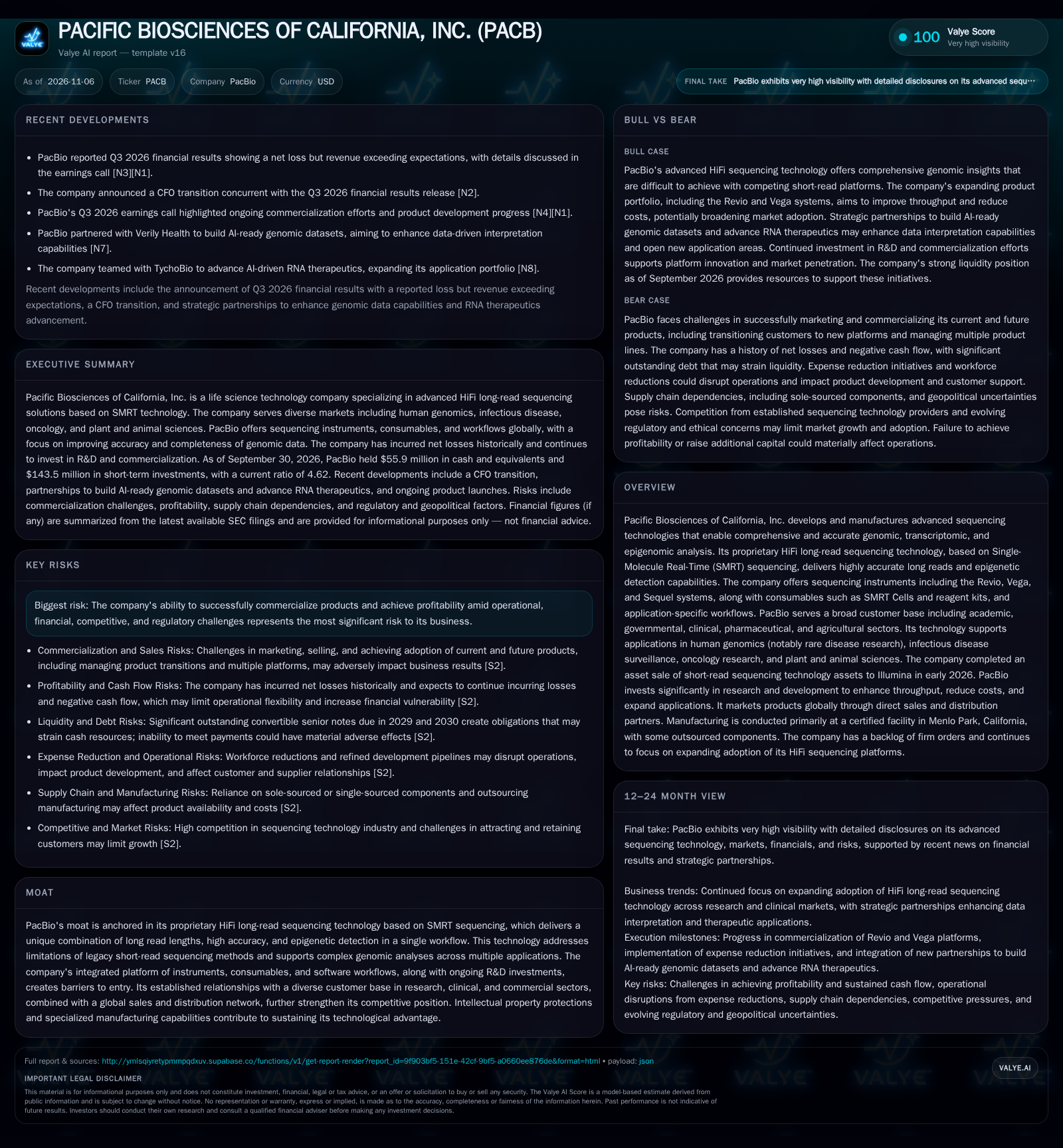
PacBio recently completed a $48.1 million asset sale of short-read sequencing technology to Illumina, effectively sharpening its focus on HiFi long-read sequencing and associated applications [S1]. This strategic realignment coincides with ongoing expense reduction initiatives, including workforce reductions and refined R&D priorities, as the company seeks to align costs with its long-term strategy [S2]. Financially, PacBio reported a Q3 2026 net loss of $37.8 million, continuing a history of negative earnings and cash flow [S2]. The company reported a current ratio of 4.62 for the period. [S2] Meanwhile, PacBio has announced partnerships with Verily Health and TychoBio to build AI-ready genomic datasets and advance RNA therapeutics, signaling a push into higher-value applications and data-centric business models [N2] [N4].
How the HiFi Sequencing Platform Could Unlock Economic Leverage
PacBio’s core revenue streams are anchored in the sale of sequencing instruments (Revio, Vega, Sequel), recurring consumables (SMRT Cells, reagent kits), and application-specific workflows [S1]. The business model relies on high upfront instrument sales and a follow-on stream of consumable and service revenues, a structure common to life science instrumentation. This model can deliver substantial operating leverage if the installed base grows and utilization rates increase—each instrument placed drives recurring, high-margin consumables revenue.
However, the economics are highly sensitive to adoption rates and the ability to cross the chasm from research to clinical or routine applied markets, where volumes and pricing can be more robust. PacBio’s technology is known for its ability to resolve complex genomes and detect epigenetic modifications, features that could command premium pricing in clinical applications such as rare disease diagnostics and oncology. Yet, the company’s history of negative cash flow and net losses suggests that either fixed costs (including R&D and SG&A) are high relative to the current revenue base, or that pricing/volume is not yet sufficient to cover the cost structure.
The recent asset sale may provide short-term funding flexibility but also removes potential diversification. With substantial convertible debt due in 2029/2030, PacBio must achieve either higher-margin sales growth or significant cost reduction to reach sustainable positive cash flow. The company’s expense reduction initiatives—while necessary—introduce the risk of under-resourcing commercial or development efforts at a critical scaling phase.
Technology Differentiation Versus Commercial Barriers in Genomics
PacBio’s competitive position is rooted in its proprietary HiFi long-read sequencing technology, which offers unique advantages in read length, accuracy, and epigenetic detection—critical for applications like complex structural variant analysis and comprehensive genome assembly [S1]. This positions PacBio as a differentiated alternative to short-read platforms, which may struggle with repetitive regions or large genomic rearrangements.
The competitive landscape, however, is intense. Short-read sequencing incumbents have established cost advantages and broad adoption in routine applications. Newer entrants and alternative long-read platforms are also vying for share, sometimes leveraging different chemistries or business models. While PacBio’s partnerships with Verily Health and TychoBio could help open new clinical and data-centric markets, the company must overcome entrenched purchasing behaviors, validation requirements, and the high switching costs associated with platform transitions in genomics labs.
Intellectual property and manufacturing know-how provide some entry barriers, but the pace of innovation and customer focus on total cost of ownership mean that any technological lead must be continuously reinforced by improved throughput, lower costs, and compelling application content. The recent sale of short-read assets to Illumina, while sharpening the strategic focus, cedes a segment of the market to a major competitor and could limit cross-platform synergies in the near term.
If Clinical Genomics Adoption Accelerates, Platform Economics Could Inflect
The most favorable scenario for PacBio is one where HiFi sequencing becomes the platform of choice for emerging clinical applications—particularly in rare disease diagnostics, oncology, and infectious disease surveillance. In this scenario, several reinforcing dynamics could unfold: clinical labs validate and adopt PacBio’s systems for routine use, driving a rapid increase in the installed base; recurring consumable sales scale with higher instrument utilization; and premium pricing is sustained due to the unique capabilities of the platform.
Such an outcome would be confirmed by evidence of accelerating instrument placements in clinical settings, growing recurring revenue from consumables, and a shift in customer mix toward clinical and applied genomics accounts (if disclosed). Partnerships with Verily Health and TychoBio would translate into concrete product launches or clinical diagnostic offerings, and R&D productivity would manifest in new applications or improved economics per genome. Gross margins would expand as fixed costs are leveraged over a larger revenue base, and net losses would narrow or reverse.
Conversely, if clinical adoption remains slow or if pricing pressure intensifies, this scenario would be falsified.
Gradual Adoption and Ongoing Restructuring Define the Most Likely Trajectory
The most plausible near-term outcome is that PacBio continues to expand its HiFi platform in research and select clinical pilot programs, but the pace of broad clinical adoption remains measured. Revenue growth is driven by a mix of new instrument placements and consumable pull-through, particularly in academic, government, and specialty commercial labs. Partnerships with Verily Health and TychoBio yield incremental data products or pilot therapeutics, but transformative clinical revenue remains a future prospect.
Expense reduction initiatives help contain losses, but the company remains unprofitable as fixed costs are only partially offset by revenue gains. The installed base grows, but at a rate that does not yet deliver full operating leverage. Evidence for this scenario would include continued net losses, steady but not explosive growth in backlog or recurring revenue, and ongoing investment in both product development and commercial outreach. Signs of clinical adoption would be present but not yet dominant in the revenue mix.
A deviation from this scenario would be confirmed if either losses narrow much faster than expected due to an unexpected surge in clinical adoption, or if restructuring leads to commercial or product execution missteps.
Execution Risk: Restructuring, Debt, and the Threat of Stalled Adoption
In a negative scenario, PacBio’s restructuring efforts (including workforce reductions and narrowed development focus) disrupt commercial and R&D execution, leading to slower platform adoption and customer churn [S2]. If the pace of new instrument placements and consumable usage stalls, fixed costs remain high, and the company continues to burn cash at an unsustainable rate.
External risks could compound these pressures: supply chain disruptions, loss of key sole-sourced components, or regulatory/geopolitical events could delay product shipments or market access. Competitive responses—such as aggressive pricing from short-read incumbents or new long-read entrants—could further limit PacBio’s ability to expand its footprint. Evidence for this scenario would include declining backlog, negative trends in instrument or consumable sales (if disclosed), persistent or widening losses, and/or the announcement of additional restructuring or capital raises.
What Will Prove Out PacBio’s Long-Read Sequencing Thesis?
The rate of new instrument placements, particularly in clinical and applied genomics settings, if disclosed.
Consumable sales growth and recurring revenue trends, which would indicate increased platform utilization and customer stickiness.
Gross margin progression as a measure of operating leverage and the ability to scale fixed costs.
Backlog growth or contraction, reflecting forward visibility and sales momentum.
Progress and monetization of partnerships with Verily Health and TychoBio—e.g., new product launches, data licenses, or clinical diagnostic offerings.
Operating expense trends and the impact of restructuring on R&D productivity and commercial execution.
Liquidity developments, including changes in cash burn, capital raises, or updates regarding convertible debt obligations.
Customer mix evolution (research vs. clinical/applied accounts), if disclosed, to assess penetration into higher-value market segments.
Disclaimer: This is research-only, informational analysis and not investment advice. It may include AI-generated interpretation and general industry context. Always verify important details using primary sources.

Comments