
Kimball Electronics: Managing Earnings Volatility Through Operational Changes
The company’s ability to stabilize performance and address liquidity limitations will shape its next phase of value creation.
The core question is whether Kimball can convert operational transparency and resilience into consistent earnings amid market and operational headwinds.
Kimball Electronics, Inc. stands at a crossroads after a period marked by earnings volatility and shifting operational dynamics. The company’s latest quarterly results show a return to profitability following a loss in the prior quarter, but persistent questions remain about the durability of its financial recovery and the underlying drivers of its performance swings. The company’s trajectory will hinge on how effectively it can manage margin pressures, customer concentration, and the cyclical nature of its business.
Mixed Momentum Evident in Recent Financial Performance
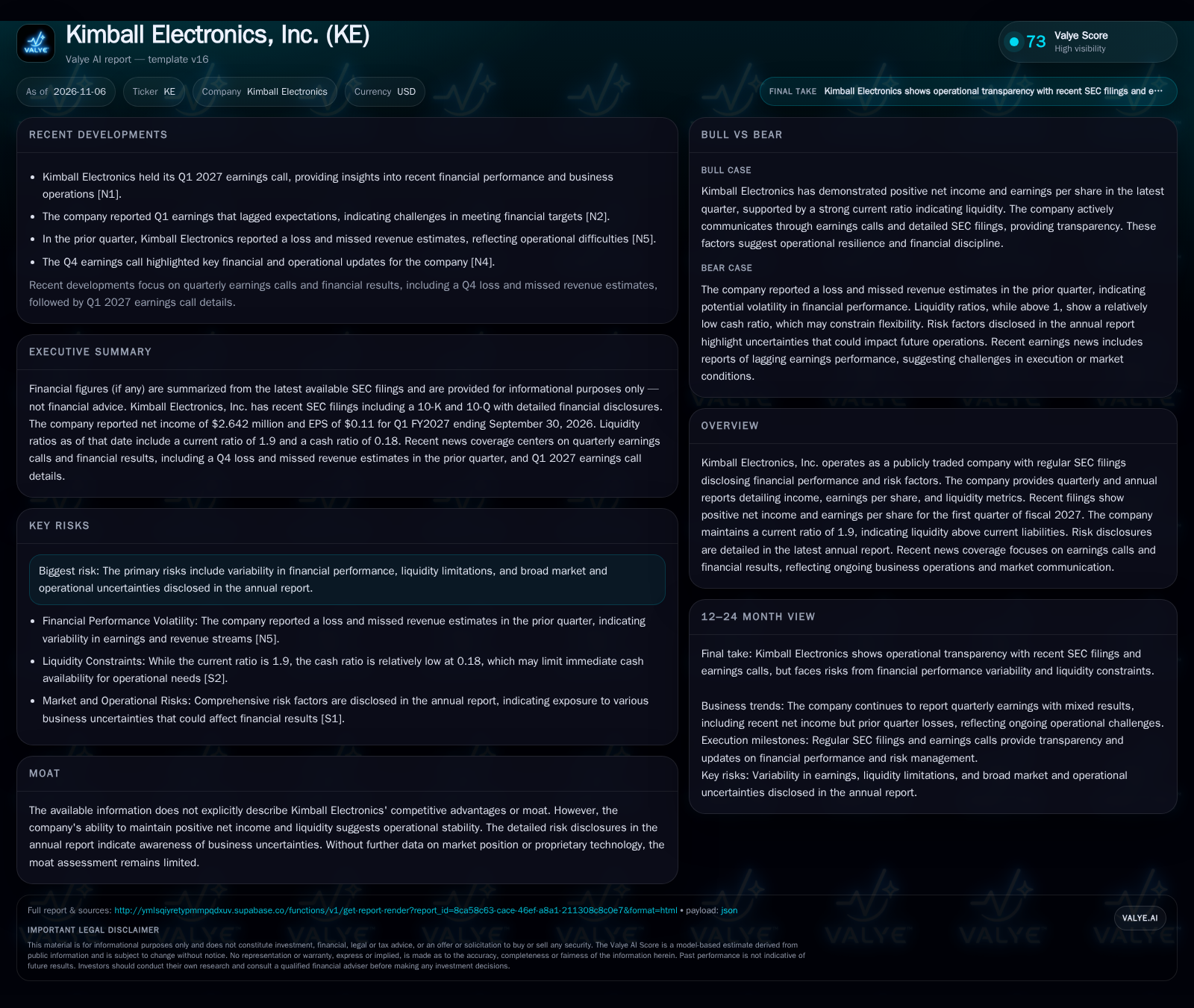
Kimball Electronics reported net income of $2.642 million and basic and diluted EPS of $0.11 for the first quarter of fiscal 2027, ending September 30, 2026 [S2]. This marks a recovery from the prior quarter, which saw a loss and missed revenue estimates [N5]. Earnings calls and news coverage have focused on this uneven performance, pointing to both operational resilience and persistent challenges [N1] [N2].
As of September 30, 2026, the company held $72.763 million in cash and cash equivalents, with current assets of $753.342 million against current liabilities of $395.592 million, resulting in a current ratio of 1.9 and a cash ratio of 0.18 [S2].
Scrutinizing Revenue Quality and Margin Drivers
Kimball Electronics’ business model is likely anchored in contract manufacturing, assembly services, and potentially value-added design or engineering for clients, as is typical in the electronics manufacturing services (EMS) sector. Gross margins in EMS are generally thin, making cost control and operating leverage critical for profitability. The company’s recent earnings volatility suggests sensitivity to customer demand swings, input cost fluctuations, or project timing. Fixed costs—such as plant, equipment, and skilled labor—may drive operating leverage, meaning small changes in revenue mix or utilization rates can have outsized effects on profitability.
Without explicit disclosure of contract structures, it is unclear to what extent Kimball benefits from multi-year agreements, recurring business, or pricing power. If the business is heavily project-based or exposed to large customers, revenue visibility and margin predictability could be limited. Management’s ability to improve working capital efficiency and secure favorable customer terms will be central to sustaining margins and funding future growth.
The absence of detailed margin breakdowns or backlog disclosures in recent filings leaves open questions about the stability of Kimball’s revenue base and the levers available for margin improvement.
The Challenge of Differentiation Amid Competitive Pressures
The EMS industry is highly competitive, with global and regional players vying for contracts from OEMs in automotive, industrial, medical, and consumer electronics. Barriers to entry are moderate, as technical know-how and capital investment are required, but switching costs for customers can be low if service, quality, or pricing falter. Kimball’s ability to maintain customer relationships and win new business likely depends on a mix of cost competitiveness, quality assurance, responsiveness, and possibly specialization in regulated or high-reliability markets.
Without evidence of proprietary technology, intellectual property, or a unique service model, Kimball may compete primarily on execution and relationship management. This could make it vulnerable to price competition, margin erosion, and customer churn. If the company can carve out a niche in high-value, regulated segments (such as medical or automotive safety), it could sustain higher margins and reduce revenue volatility. However, the available information does not confirm such positioning, leaving the competitive moat uncertain.
Industry-wide, EMS providers often seek to differentiate through operational excellence, supply chain reliability, and the ability to scale production efficiently. Kimball’s future competitive position will likely depend on its ability to demonstrate these qualities consistently, particularly as customers increasingly demand flexibility and cost savings.
Recovery Supported by Operational Discipline and Market Opportunities
A favorable scenario for Kimball Electronics would see recent cost control efforts, process improvements, or customer wins translating into consistent profitability and margin expansion. If the company secures multi-year contracts with stable customers—particularly in resilient end-markets like medical devices or automotive electronics—it could smooth out revenue volatility and support better working capital management. Improved cash generation would allow reinvestment in automation or technology, further enhancing competitiveness and reducing cost pressures.
Confirmation of this scenario would come from several quarters of positive net income, rising gross margin, and improved cash flow from operations. Disclosure of new contract awards, customer diversification, or entry into higher-margin segments would further validate the turnaround. Conversely, continued earnings volatility or persistent low cash generation would undermine the bullish case.
However, the absence of detailed disclosures on backlog or contract wins means that visibility into this upside scenario remains limited and would require close monitoring of future filings and earnings calls.
Incremental Progress Through Cyclical Fluctuations
The most plausible trajectory is for Kimball Electronics to continue experiencing quarter-to-quarter earnings variability, reflecting the cyclical and project-driven nature of its business. The company’s operational transparency, as evidenced by regular SEC filings and earnings calls, provides stakeholders with timely updates but does not eliminate the underlying volatility.
Evidence supporting this scenario would include a pattern of small but recurring profits, stable or slightly improving gross margins, and working capital metrics that do not deteriorate. Falsification would occur if the company slides back into consecutive losses, experiences a material liquidity crunch, or sees a sharp contraction in its customer base.
In this scenario, Kimball’s value creation would be incremental, driven by gradual improvements in cost structure, customer mix, and operational efficiency. The company’s ability to adapt to shifting market conditions and manage liquidity prudently will be key to avoiding downside risks.
Volatility Intensified by Liquidity Strains and Execution Challenges
A negative outcome could emerge if Kimball Electronics faces further demand shocks, customer losses, or cost overruns that erode profitability. Competitive pressures could intensify if larger EMS players cut prices or if customers shift to lower-cost regions.
This scenario would be confirmed by a return to net losses, deteriorating liquidity ratios, negative operating cash flow, or management disclosures regarding cost-cutting, asset sales, or emergency financings. Early warning signs would include missed revenue targets, shrinking backlog (if disclosed), or a spike in accounts payable and receivable days.
The breadth of risk factors disclosed in the annual report underscores the range of challenges that could trigger this downside scenario [S1].
Key Developments Influencing Kimball Electronics’ Future
Quarterly net income and EPS trends: Sustained profitability would support the case for operational stabilization and improved capital access [S2].
Gross margin evolution: Changes in gross margin would indicate success or failure in cost control and pricing discipline—critical for an EMS business (if disclosed).
Customer diversification: Disclosure of new customer wins, reduced customer concentration, or entry into new end-markets would reduce revenue volatility (if disclosed).
Contract structure and backlog: Information on multi-year contracts, recurring revenue, or backlog size would clarify revenue visibility and risk (if disclosed).
Capital expenditures: Steady or rising investment in automation and process upgrades could indicate a commitment to long-term competitiveness (if disclosed).
Disclaimer: This is research-only, informational analysis and not investment advice. It may include AI-generated interpretation and general industry context. Always verify important details using primary sources.

Comments