
BRT Apartments: Navigating Multifamily Real Estate Cycles Amid Debt, Inflation, and Regional Competition
BRT Apartments Corp. faces a confluence of inflation-driven cost pressures, rising interest expenses from recent refinancings, and competitive oversupply in key multifamily markets, while maintaining an active acquisition strategy and managing substantial mortgage maturities through 2028. The company's ability to sustain distributions, defend occupancy, and refinance on acceptable terms will shape its trajectory in the next 12-24 months.
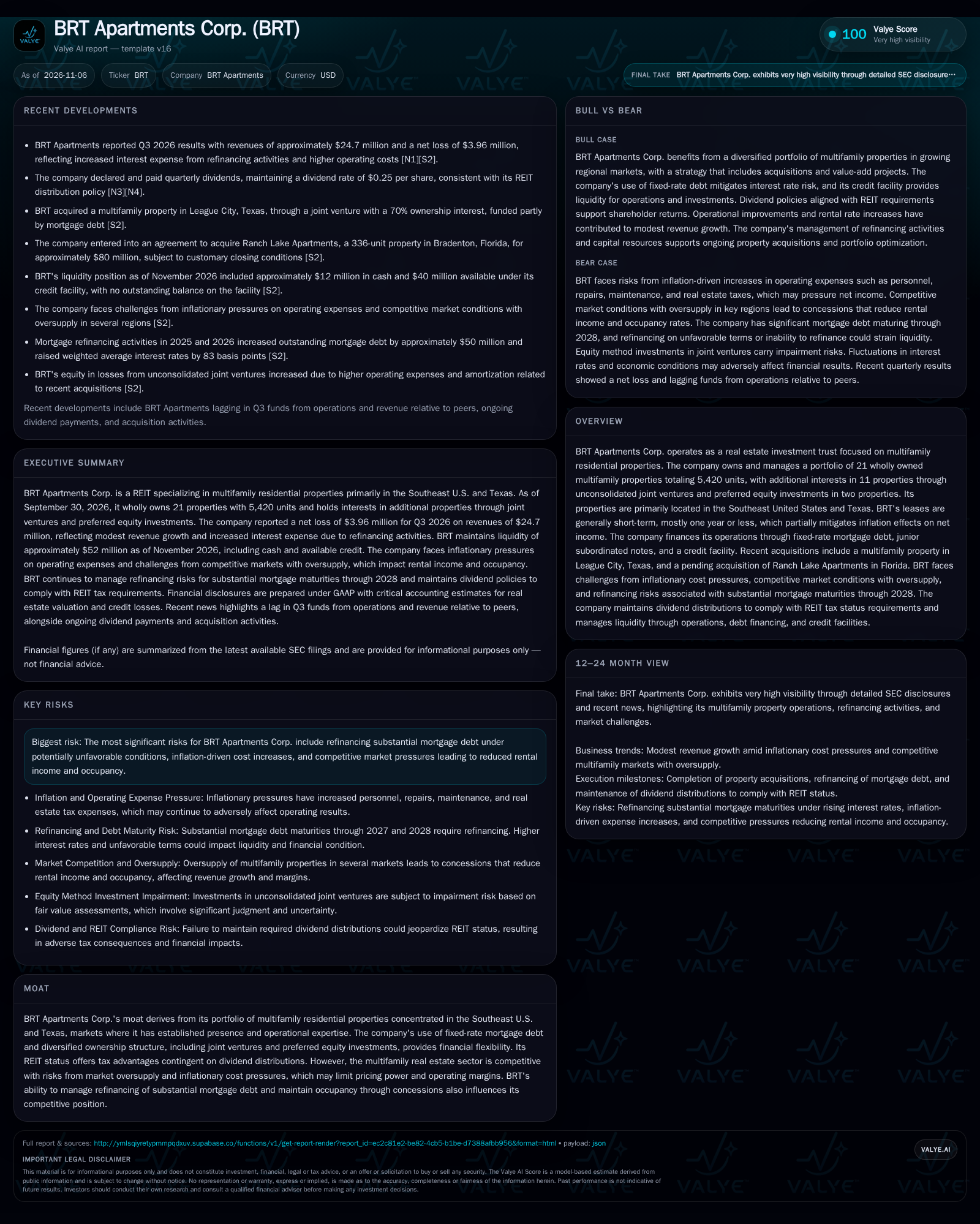
BRT Apartments operates a 21-property multifamily portfolio concentrated in the Southeast U.S. and Texas, with additional joint venture and preferred equity interests. As of Q3 2026, it reported modest revenue growth but a net loss, primarily due to increased interest expenses from recent mortgage refinancings. Funds from operations and occupancy trends will be critical to monitoring the company’s resilience and capacity to maintain REIT distributions.[S2] [N1]
BRT Apartments Corp. stands at a pivotal point, balancing the push for portfolio growth against the realities of rising operating costs, increased debt service, and intensifying competition in the Southeast and Texas multifamily markets. While the company is executing on acquisitions—such as the pending $80 million Ranch Lake Apartments deal—and maintains a liquidity cushion, its Q3 2026 financials reveal thin revenue growth and a net loss, driven by higher interest expenses from recent refinancing activity. With the multifamily sector facing inflationary headwinds and regional oversupply, BRT’s next phase will depend on its ability to manage refinancing risk, defend occupancy and rent levels, and continue delivering on REIT distribution requirements in a challenging environment.[S2] [N1]
Recent Results Highlight Rising Costs and Strategic Acquisitions
BRT Apartments reported Q3 2026 revenues of $24.7 million, a modest 1.2% year-over-year increase, but recorded a net loss of $3.96 million—driven largely by a spike in interest expense following $50 million in mortgage refinancing at higher rates.[S2] [N1] The company’s portfolio includes 21 wholly owned properties (5,420 units) and interests in 11 more through joint ventures, with preferred equity in two additional properties.[S2] BRT’s liquidity as of November 2026 was approximately $52 million, comprising $12 million in cash and $40 million in available credit under a facility with a 5% floor, with no outstanding balance at quarter-end.[S2] Notably, BRT is under contract to acquire the 336-unit Ranch Lake Apartments in Florida for approximately $80 million, following a joint-venture acquisition in League City, Texas.[S2] These developments underscore a strategy of continued portfolio expansion amid rising costs and intensifying competition.
How BRT Apartments’ Economics Respond to Inflation and Leverage
BRT’s revenue model is built on rental income from multifamily assets, with short-term (typically one-year) leases providing some ability to reprice rents annually in response to inflation. However, this flexibility is mitigated by competitive pressures and regional oversupply, which can force rental concessions and limit effective rent growth. On the expense side, inflation is driving up personnel, repair, maintenance, and real estate tax costs, compressing operating margins as rent increases struggle to keep pace.[S2]
The company’s capital structure is heavily reliant on mortgage debt, now totaling $796.5 million with weighted average interest rates of 4.37% for consolidated properties and 4.44% for joint ventures.[S2] Recent refinancing activity increased average rates by 83 basis points, raising interest expense and directly impacting net income.[S2] While BRT uses fixed-rate debt to mitigate further rate risk, a large wave of maturities through 2028 introduces refinancing risk, and higher future rates could further erode cash flow.
Operating leverage in this model is mixed: while fixed costs (depreciation, interest) are high, variable costs—primarily property-level operating expenses—are susceptible to inflation. The company reported cash and liquidity metrics for the period; these figures do not by themselves establish operating runway, investment capacity, financial flexibility, or financing capacity. The cited source reports dividend-related activity; that disclosure alone does not establish dividend-policy continuity, management confidence, or a material constraint on capital flexibility.
Market Oversupply and Regional Competition: The Battle for Occupancy and Rent
BRT’s geographic focus on the Southeast U.S. and Texas places it in some of the nation’s most dynamic multifamily markets, but also some of the most competitive. In recent years, these regions have seen significant new supply, leading to oversupply in select submarkets.[S2] This dynamic forces operators like BRT to offer concessions—such as reduced rents or free months—to defend occupancy, directly reducing rental income and pressuring margins.
The company’s competitive set includes both public REITs and private multifamily operators, many of whom are also pursuing acquisition and value-add strategies. BRT’s joint venture and preferred equity investments provide some diversification and access to larger deals, but also introduce complexity and impairment risk, as performance is not entirely under BRT’s control.
Switching costs for tenants are low in the rental apartment sector, particularly with short-term leases and abundant supply. This limits pricing power and makes occupancy highly sensitive to local employment, migration trends, and competitor actions. While BRT’s established presence and operational experience in its core markets offer some advantage, the company is not insulated from regional cyclical swings or the broader macroeconomic environment.
What Would Drive a Positive Turn? Margin Recovery and Successful Capital Deployment
A favorable scenario for BRT would see inflationary pressures on expenses easing while regional demand for multifamily housing strengthens. If new supply moderates and local employment/migration trends remain robust, BRT could raise rents more aggressively, reduce concessions, and improve occupancy—driving operating margin recovery. Successful execution of the Ranch Lake Apartments acquisition and other expansion projects could further boost rental income and economies of scale.
On the capital side, if interest rates stabilize or decline and BRT is able to refinance upcoming maturities on terms similar to, or better than, current rates, the drag from higher interest expense could be contained.
Sustaining Operations as Cost Pressures and Refinancing Risks Persist
The most likely path for BRT in the next 12-24 months is one of modest revenue growth offset by continued margin compression. Inflationary operating expenses are likely to remain elevated, and competitive oversupply in core markets will keep a lid on effective rent growth, requiring ongoing concessions to maintain occupancy. Interest expense will remain high due to recent refinancings, and additional maturities through 2028 will test the company’s ability to secure favorable terms.
Dividend distributions will likely be maintained at or near the minimum required for REIT status, with little room for increases unless operating conditions improve materially.
This scenario would be confirmed by continued low single-digit revenue growth, persistently high interest expense, stable but pressured occupancy, and flat or slightly declining FFO relative to peers.
How Margin Compression and Unfavorable Refinancing Could Squeeze Cash Flows
The adverse case for BRT involves a combination of persistent inflation, further increases in operating expenses, and continued regional oversupply depressing rents and occupancy. If refinancing conditions worsen—through higher rates, tighter credit, or reduced lender appetite—BRT may face higher debt service costs or be forced into asset sales at unfavorable valuations to meet obligations.
Should occupancy drop meaningfully or rental concessions deepen, the company could see a decline in net operating income, impairing its ability to cover interest and maintain required distributions. In this scenario, FFO could fall below dividend requirements, forcing a dividend cut or additional asset sales. Impairment charges from underperforming joint ventures or preferred equity investments could further erode book value and investor confidence.
Confirmation of this scenario would come from declining occupancy, rising rental concessions, negative trends in same-property NOI, unsuccessful or expensive debt refinancings, and any announced dividend reduction or asset disposition to shore up liquidity.
What Will Reveal BRT’s Resilience in the Next Phase?
Same-property net operating income (NOI) trends by region, if disclosed, would show whether BRT is successfully offsetting inflation with rent growth or operating efficiency.
Occupancy rates and rental concession levels across both wholly owned and joint venture properties, as these directly reflect competitive pressures and pricing power.
The terms, timing, and success of refinancing upcoming mortgage maturities—especially the spread to previous rates and total debt service cost.
Performance of recent acquisitions (such as Ranch Lake Apartments) and whether these deals are accretive to cash flow and portfolio quality.
Levels of impairment or write-downs in equity method investments, which could signal trouble in joint venture assets or preferred equity positions.
Changes in the overall leverage ratio and debt-to-asset values, as further increases could amplify vulnerability to interest rate or valuation shocks.
Any shifts in the competitive landscape in BRT’s core markets—such as a slowdown in new supply, major competitor exits, or changes in local demand drivers.
Disclaimer: This is research-only, informational analysis and not investment advice. It may include AI-generated interpretation and general industry context. Always verify important details using primary sources.

Comments