
Full House Resorts: Expansion Ambitions Meet a Liquidity Crossroads in Casino Operations
While Full House Resorts pursues growth through property development and leadership transitions, its sub-1.0 liquidity ratios and recent net losses highlight the tension between capital needs and operating realities in a competitive, regulated gaming market.
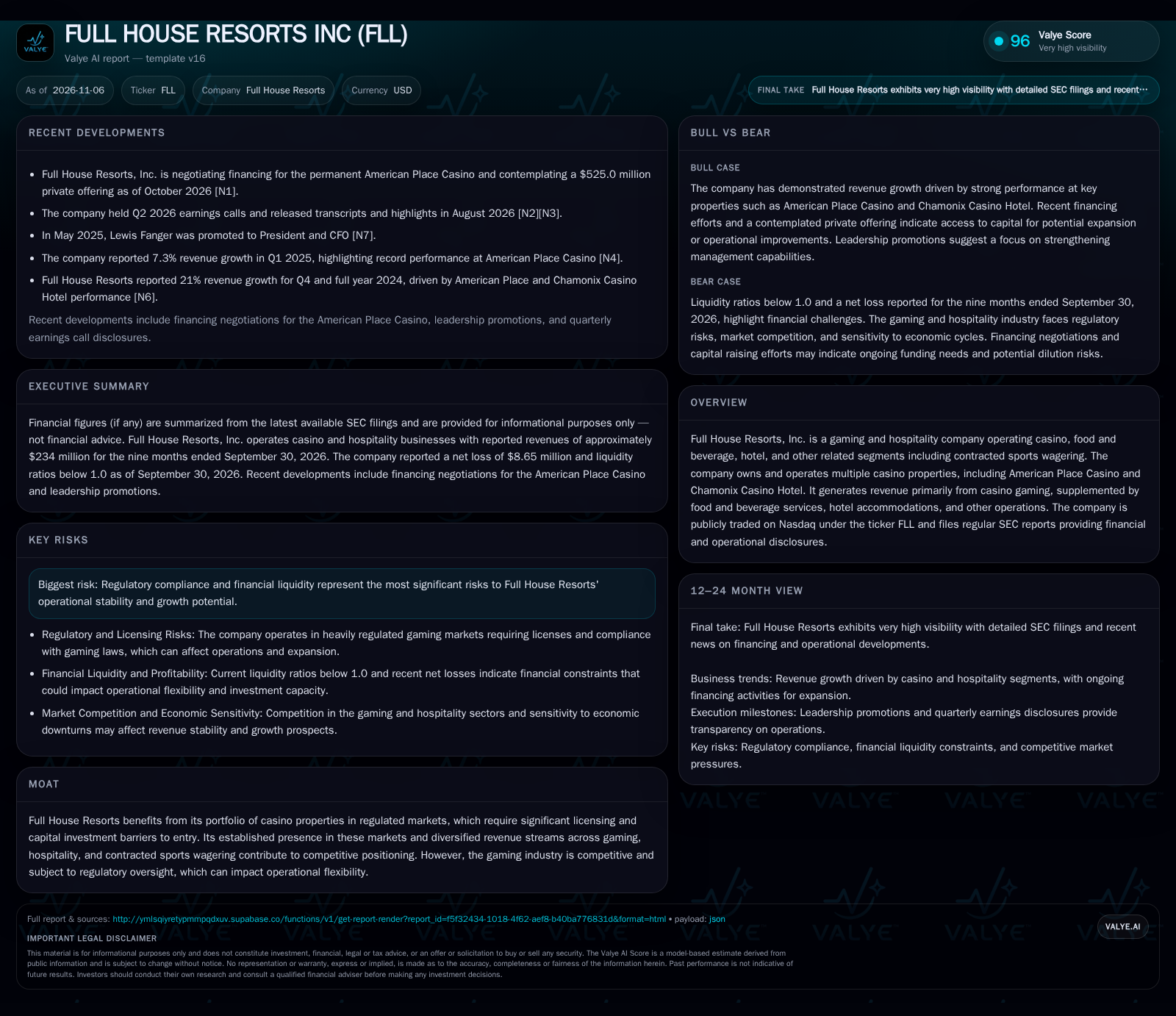
Full House Resorts is advancing financing efforts for new casino projects and recently elevated Lewis Fanger to President and CFO, signaling operational focus. However, as of September 2026, the company’s current ratio and cash ratio remain below 1.0, and it reported a net loss year-to-date. The contemplated $525 million private offering underscores the capital intensity of its growth strategy, while also raising questions about dilution and execution risk in a crowded casino landscape. Regulatory oversight and economic sensitivity remain persistent headwinds.[S2] [N1] [N7]
Full House Resorts stands at a pivotal moment: its pursuit of new casino developments and recent leadership realignment come as the company faces below-par liquidity ratios and ongoing net losses. With a $525 million private offering under consideration and financing negotiations underway for its flagship American Place Casino, Full House is betting on expansion to drive future growth. Yet, these ambitions are tempered by the realities of capital requirements, regulatory scrutiny, and intensifying competition in the gaming and hospitality sector. The coming quarters will reveal whether the company can translate its development pipeline and operational shifts into sustainable profitability—or whether financial constraints will force a recalibration.
Liquidity Pressures and Capital Raising Define the Current Strategic Landscape
As of September 30, 2026, Full House Resorts reported cash and cash equivalents of $30.7 million, current assets of $45.8 million, and current liabilities of $57.2 million—yielding a current ratio of 0.8 and a cash ratio of 0.54. The company reported cash and liquidity metrics for the period; these figures do not by themselves establish operating runway, investment capacity, financial flexibility, or financing capacity. [S2]
Despite generating $234.3 million in revenue in the first nine months of 2026 (with $179.1 million from casino operations), Full House posted a net loss of $8.65 million. [S2] [N1]
Leadership changes—including the July 2025 promotion of Lewis Fanger to President and CFO—introduce the prospect of new strategic direction or operational discipline, but the financial realities remain central to near-term outcomes.[N7]
Casino Revenue Dominance and High Fixed Costs Shape Financial Outcomes
Full House Resorts’ business model is anchored in casino operations, which accounted for $179.1 million (over 75%) of total revenue in the first nine months of 2026.[S2] Ancillary segments—food and beverage, hotel, and contracted sports wagering—provide diversification, but gaming remains the primary economic engine.
Casino and hospitality businesses are capital-intensive, with high fixed costs for property, equipment, labor, and regulatory compliance. Operating leverage is substantial: incremental revenue gains can improve margins, but downturns in gaming volume or occupancy can quickly erode profitability, as seen in the company’s recent net losses.
The contemplated $525 million private offering highlights the scale of capital required for new developments like the permanent American Place Casino.[N1] Access to external financing is crucial, but reliance on new debt or equity raises risks of dilution and higher interest burdens. The ability to drive higher casino volumes, optimize mix (e.g., premium gaming, non-gaming amenities), and control variable costs will determine whether expansion leads to improved returns or simply compounds financial strain.
Given the capital-intensive nature of casino operations, the fixed cost base creates significant operating leverage, meaning that revenue fluctuations disproportionately impact profitability. If Full House can consistently increase gaming volumes or enhance the mix towards higher-margin offerings, incremental revenue can flow directly to the bottom line after covering fixed costs. However, this leverage works both ways: any decline in visitation, gaming spend, or hotel occupancy can quickly erode earnings and cash flow, especially if fixed costs such as debt service and regulatory fees remain constant or rise. This sensitivity underscores the importance of managing operational efficiency and cost structure alongside top-line growth, particularly in periods of economic uncertainty or competitive pressure.
Barriers to Entry, Regulatory Complexity, and the Battle for Share of Wallet
Full House competes in a fragmented but fiercely competitive regional casino landscape, where established operators and new entrants vie for discretionary consumer spending. Regulatory licensing creates meaningful barriers to entry and can protect incumbents to some degree, but it also imposes ongoing compliance costs and limits strategic flexibility.
The company’s portfolio of regulated properties offers geographic diversification and a foothold in multiple markets. However, larger competitors with broader scale, deeper loyalty programs, and stronger balance sheets may have an edge in marketing, technology, and resilience during downturns. Online gaming and sports betting represent both a threat and an opportunity—potentially cannibalizing traditional casino traffic, but also expanding the addressable market if Full House can secure favorable partnerships or licenses.
Differentiation hinges on property quality, customer experience, and brand recognition. Without unique destination assets or a powerful brand, Full House may struggle to command premium pricing or sustained loyalty, especially as new supply comes online in key markets.
In addition to traditional competition, the evolving regulatory landscape introduces complexity that can affect market dynamics. Licensing delays or changes in regulatory requirements may increase capital expenditures or operational costs, potentially delaying revenue realization from new properties. Moreover, regulatory scrutiny can constrain marketing strategies or limit the introduction of innovative gaming products, impacting customer acquisition and retention. The interplay between regulatory compliance and competitive positioning requires a nuanced approach: Full House must balance adherence to regulatory demands with agility in responding to market trends, such as digital gaming or integrated resort experiences, to maintain relevance and market share.
Successful Financing Unlocks Expansion and Margin Recovery
If Full House secures the contemplated $525 million private offering and completes the permanent American Place Casino on schedule, the company could see a step-change in revenue and cash flow generation.[N1] New or expanded properties, if well-executed, could attract incremental gaming volume and higher-margin non-gaming revenue, leveraging the company’s fixed cost base.
Operational improvements under new leadership, coupled with disciplined capital allocation, could drive margin expansion and a return to profitability. The upside case would be supported by evidence of project completion on time and on budget, sustained growth in same-property gaming revenue, and stabilization or improvement in liquidity ratios.
Confirmation of the upside would come through: public closing of the private offering; timely project milestones; quarterly reports showing positive EBITDA and narrowing net losses; and management guidance pointing to occupancy, gaming volume, and non-gaming revenue growth.
Navigating Expansion While Managing Financial Tightrope
The most plausible outcome is that Full House secures some, but not all, of its desired financing, leading to phased or delayed development of the American Place Casino. Revenue growth continues, driven by incremental contributions from new and existing properties, but net profitability remains elusive as high fixed costs and interest expenses weigh on margins.
Management focuses on operational efficiencies and incremental improvements in property performance, but competitive pressures and regulatory compliance costs limit upside.
Evidence supporting the base case would include: partial or staged financing announcements; quarterly results with stable or slightly improving cash and current ratios; and management commentary emphasizing cautious growth, cost discipline, and regulatory focus.
Funding Gaps and Market Pressures Force Retrenchment
Market saturation, regulatory setbacks, or economic downturns could further suppress gaming volumes and non-gaming revenue, exacerbating cash flow pressures. In this environment, the company may struggle to meet near-term obligations, increasing the risk of covenant breaches or distressed restructuring.
Milestones That Will Shape Full House Resorts’ Expansion and Financial Trajectory
Progress and terms of the $525 million private offering—public confirmation, amount raised, structure, and cost of capital—will be pivotal.[N1]
Updates on construction milestones and opening schedule for the permanent American Place Casino, including any delays or budget overruns, would help test the growth thesis.
Quarterly trends in casino, hotel, and food and beverage revenue—especially same-property growth rates—will indicate underlying demand and operational effectiveness.
Net income, EBITDA, and cash flow from operations each quarter will clarify whether expansion is translating into improved profitability and coverage of fixed costs.
Movement in the current and cash ratios—if disclosed—will serve as direct indicators of liquidity stress or improvement.
Any changes in regulatory environment, licensing status, or compliance costs across the company’s operating jurisdictions could materially alter the risk profile.
Evidence of successful integration or performance ramp at new or renovated properties—measured by occupancy, gaming volume, or customer retention—would validate management’s capital allocation decisions.
Announcements of asset sales, partnership structures, or major changes to capital allocation policy would reveal management’s response to funding constraints or shifting strategic priorities.
Disclaimer: This is research-only, informational analysis and not investment advice. It may include AI-generated interpretation and general industry context. Always verify important details using primary sources.

Comments