
Warby Parker’s Next Phase: Scaling Omnichannel Eyewear, Technology Integration, and the Economics of Brand-Driven Vision Care
Warby Parker’s Q3 2026 results highlight modest profitability and reported liquidity position as the company pursues national omnichannel expansion, tech-enabled care, and insurance penetration in a highly competitive, structurally sticky eyewear market. As the brand pushes toward 900 stores and deeper integration of AI and vision services, the key questions center on cost discipline, customer acquisition, and sustaining its mission-driven differentiation.
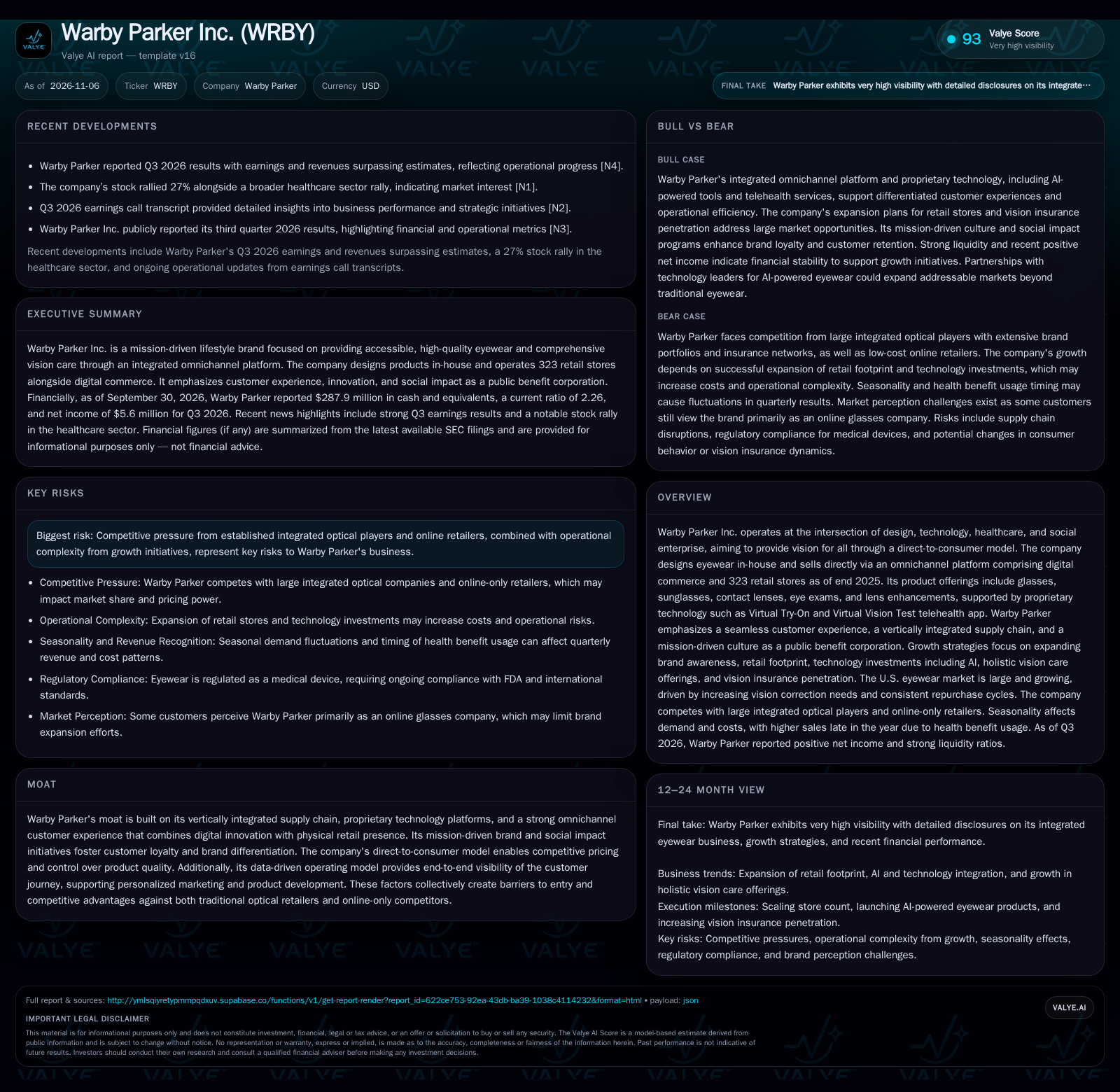
Warby Parker reported positive net income for Q3 2026 and maintains a reported cash position, signaling operational progress as it expands its omnichannel retail and tech-enabled eye care offerings. With 323 stores and a vertically integrated supply chain, the company is targeting brand expansion, AI-powered services, and vision insurance penetration in a $70 billion U.S. eyewear market. The challenge: balancing growth investments and competitive pressures while leveraging brand and mission for long-term customer loyalty. [S1] [S2] [N4]
Warby Parker is entering a critical phase as a public benefit corporation: after years of direct-to-consumer disruption, the company now operates 323 retail stores, reports positive Q3 2026 net income, and holds a substantial reported cash balance. Its omnichannel model blends in-house design, tech-enabled experiences, and vertically integrated supply chains to target a $70 billion U.S. eyewear market. With ambitious plans for up to 900 stores, deeper AI integration, and expanded vision care services, the challenge is to convert brand-driven loyalty into sustainable economics while fending off both legacy giants and digital upstarts.
Profitability and Liquidity Lay Groundwork for Growth Ambitions
Warby Parker reported $5.6 million in net income for Q3 2026, with basic and diluted EPS of $0.04 per share, marking a period of modest profitability during continued expansion. Warby Parker’s omnichannel footprint reached 323 retail stores by year-end 2025, alongside digital commerce and proprietary technology platforms. A 27% stock rally in Q3 2026 followed earnings and revenue results that surpassed estimates, suggesting renewed market confidence amid strong sector sentiment. [S2] [N1] [N4]
Revenue Drivers: Pricing, Volume, and Vertical Integration in Warby Parker’s Model
Warby Parker’s core revenue streams include in-house designed prescription glasses (starting at $95), contact lenses, lens enhancements, and eye exams. The company’s vertically integrated model—owning optical labs and manufacturing partnerships—enables control over product quality, inventory, and margins, while supporting competitive pricing. Omnichannel distribution (323 stores plus digital) facilitates customer acquisition and repeat business, with technology (Virtual Try-On, telehealth) lowering friction and potentially boosting conversion.
The eyewear market’s recurring nature—driven by prescriptions, aging demographics, and digital eye strain—supports relatively predictable volume, but mix and margin depend on upselling (e.g., progressives, lens coatings) and service adoption (eye exams, insurance billing). Fixed costs rise with store openings and technology development, but scale can drive operating leverage if revenue per location and per customer increase. [S1] [S2]
The vertical integration strategy not only enhances margin control but also serves as a buffer against supply chain volatility, which can be critical in a market where timely product availability directly influences customer satisfaction and repeat business. By owning key parts of the production and distribution process, Warby Parker can experiment with product innovation cycles, rapidly test new frame styles, and optimize inventory allocation across channels. However, this model requires continuous capital investment and operational expertise, particularly as the company scales its store footprint and digital presence. Balancing the fixed costs of owning supply chain assets with the variable nature of consumer demand will be pivotal to sustaining profitability.
Leveraging Brand, Experience, and Technology Against Optical Industry Leaders
Warby Parker competes against large integrated players (EssilorLuxottica, VSP) with extensive retail networks, eyewear brands, and established insurance relationships, as well as online-only value providers (e.g., Zenni Optical). Its primary differentiation lies in a mission-driven brand, modern design, transparent pricing, and a tech-enabled, seamless omnichannel experience. The vertically integrated supply chain allows for rapid product updates and quality control but requires ongoing capital and operational excellence.
Switching costs in eyewear are moderate: prescription requirements, insurance acceptance, and style preference create some stickiness, but price and convenience remain powerful levers for incumbents. Warby Parker’s social impact program (20 million+ pairs donated) and public benefit corporation status bolster customer affinity, but may be less salient for price-sensitive or insurance-driven buyers. The challenge is to increase insurance penetration and brand perception as a full-service vision care provider, not just a stylish DTC glasses brand. [S1]
In a market with moderate switching costs, Warby Parker’s omnichannel approach can create a more immersive and convenient customer journey, potentially increasing switching barriers through integrated services and personalized experiences. Yet, the company must carefully manage the tension between maintaining competitive pricing and investing in technology and retail expansion to avoid eroding its value proposition. Moreover, increasing insurance penetration is a double-edged sword: while it can drive volume and customer loyalty, it may also introduce reimbursement complexities and margin pressures typical of insurance-based healthcare models. Strategic partnerships and operational efficiencies in billing and claims processing will be crucial to capitalize on this opportunity without sacrificing financial discipline.
Potential Upside from Enhanced Brand Loyalty and AI-Enabled Customer Value
The most favorable scenario is one where Warby Parker’s omnichannel model and proprietary tech drive higher customer acquisition and retention, with AI-powered tools (Virtual Try-On, telehealth) reducing friction and enabling up/cross-selling of premium lenses, contacts, and exams. Retail expansion (toward 900 stores) increases geographic reach and insurance acceptance, while brand strength and social impact foster loyalty and pricing power. If vision insurance penetration rises and more customers view Warby Parker as a one-stop vision care provider, the company could capture a larger share of wallet and see higher frequency of visits.
Confirmation would come from accelerating same-store and digital sales, rising attach rates for eye exams and insurance billing, and expanding adjusted operating margins despite store growth. Evidence of successful AI-driven personalization and higher customer lifetime value (if disclosed) would strengthen the bull case.
AI-enabled personalization can extend beyond virtual try-on features to include predictive analytics for inventory management, targeted marketing, and tailored product recommendations, which could enhance operational efficiency and customer satisfaction simultaneously. If Warby Parker leverages data-driven insights to optimize store locations, assortments, and service offerings, it may unlock incremental revenue streams and improve customer lifetime value. Furthermore, deeper integration of telehealth services could position the company as a comprehensive vision care provider, increasing customer touchpoints and reducing churn. However, realizing these benefits depends on effective data governance, privacy compliance, and seamless user experience design to build trust and engagement.
Projected Growth with Margin Challenges in Eyewear Retail Dynamics
The most plausible outcome is continued but measured store and service expansion, with Warby Parker gradually increasing its share in the large, slow-changing U.S. vision market. Retail buildouts, tech investments, and insurance integration drive higher revenue but also add fixed costs and operational complexity. Margins improve incrementally, but price competition from legacy chains and online value players limits upside. The company maintains positive net income and liquidity, but operating leverage is gradual due to real estate, labor, and marketing expenses.
Supporting evidence includes stable or modestly growing store-level economics, persistent seasonality, and incremental improvements in digital conversion and insurance utilization. Confirmation would be ongoing profitability and cash generation, but with continued sensitivity to cost inflation and competitive discounting.
Risks of Overexpansion and Technology Costs Outpacing Returns
A negative scenario emerges if Warby Parker’s aggressive store rollouts and technology spending fail to deliver corresponding revenue or margin growth. If insurance penetration stagnates, customers remain price sensitive, or legacy players use scale to undercut pricing, the company could see margin compression and diminished returns on capital. Operational complexity from managing hundreds of locations and omnichannel logistics may drive up SG&A, while regulatory or supply chain disruptions could add further pressure.
Downside confirmation would include negative same-store sales trends, rising per-store costs, declining gross or operating margins, or a reversal to net losses despite top-line growth. Weakening brand perception—if customers see Warby Parker as ‘just another retailer’—would also erode competitive advantage.
Indicators of Sustainable Growth Versus Overreach for Warby Parker
Store-level sales productivity and payback periods: a useful metric would be average revenue per store and time to profitability for new locations.
Penetration of vision insurance among customers: if disclosed, growth in insurance-billed transactions or revenue mix from insurance would help test the thesis.
Digital and omnichannel customer acquisition costs: trends in CAC and digital conversion rates, if available, would clarify scalability.
Attach rates for exams, contact lenses, and premium lens enhancements: higher attach rates would support margin expansion.
Gross and operating margin trends as store count grows: margin expansion or compression will reveal the fixed/variable cost balance.
Customer retention and repeat purchase rates: if disclosed, these would indicate whether brand and service investments drive loyalty.
Evidence of AI-driven personalization or new tech-enabled services boosting conversion or ARPU: product launches or usage metrics would clarify the impact of tech investment.
Any regulatory, reimbursement, or supply chain disruptions: these could quickly alter cost structures or growth velocity.
Disclaimer: This is research-only, informational analysis and not investment advice. It may include AI-generated interpretation and general industry context. Always verify important details using primary sources.

Comments