
Saul Centers: Evaluating Resilience of Necessity Retail Anchors and Mixed-Use Strategy in a Dynamic Metro Market
High portfolio occupancy and the stability of necessity-anchored shopping centers underpin Saul Centers’ income, while development projects and mixed-use diversification offer both upside and execution risk.
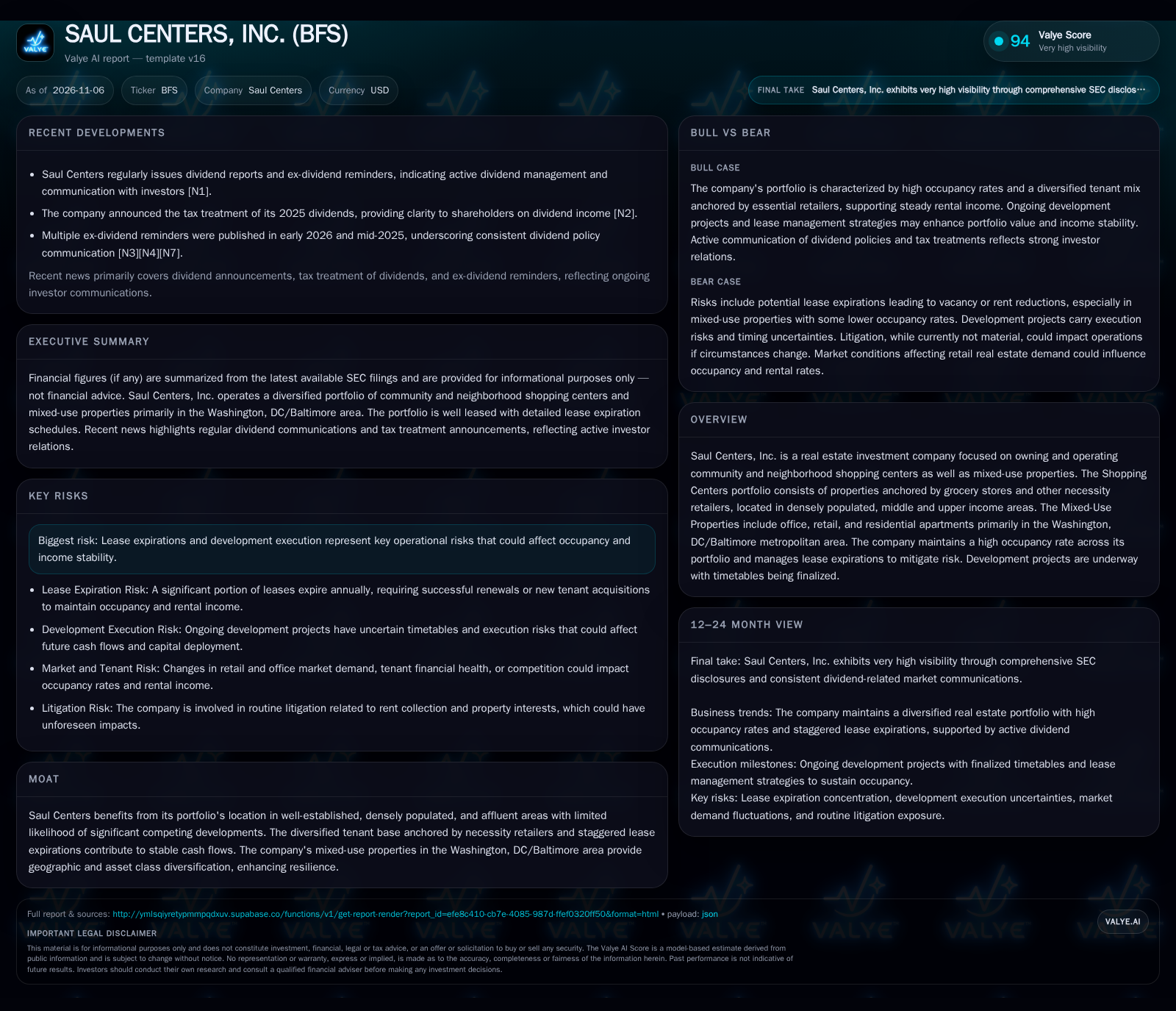
Saul Centers maintains a high-occupancy, necessity-anchored real estate portfolio in the Washington, DC/Baltimore area, with 94.6% overall leasing and ongoing development projects. The business model depends on stable rent from grocery-anchored centers and mixed-use assets, but faces lease rollover and development execution risks. Dividend continuity and income stability hinge on successful lease renewals, tenant quality, and delivering new projects on time and on budget.
Saul Centers, Inc. operates at the intersection of defensive retail and urban mixed-use real estate, with a portfolio largely anchored by necessity-based shopping centers and complemented by office and multifamily properties in the DC/Baltimore region. The company’s consistently high occupancy and the presence of essential retail tenants provide a stable income foundation, but the real test lies in how effectively Saul Centers navigates lease renewals, tenant retention, and the delivery of new development projects. These factors, alongside evolving retail and office demand, will shape the company’s ability to maintain its dividend profile and deliver long-term value.
Occupancy Rates and Tenant Composition Support Portfolio Stability
As of December 31, 2025, Saul Centers’ total portfolio encompassed approximately 10.55 million square feet, with a high overall leasing rate of 94.6%. The shopping centers segment, accounting for about 7.8 million square feet, was 95.6% leased and anchored by grocery stores, discount department stores, and drug stores—tenants that typically drive steady foot traffic and recurring rent payments. The company’s mixed-use properties, which include office, retail, and 1,824 apartment units across 2.8 million square feet, reported an 88.7% commercial space leasing rate. Lease expirations are staggered over the coming decade, reducing concentrated rollover risk. Ongoing development projects, notably Twinbrook Quarter and Ashland Square Phase II, have timetables being finalized and represent future sources of growth or risk depending on execution. Financially, as of September 30, 2026, Saul Centers reported $8.545 million in cash, $78.417 million in quarterly revenue, and net income of $9.473 million. The cited source reports dividend-related activity; that disclosure alone does not establish dividend-policy continuity, management confidence, or a material constraint on capital flexibility. [S1] [S2] [N1] [N3] [N4] [N7]
Cash Flow Benefits from Essential Retail Anchors Combined with Mixed-Use Properties
Saul Centers’ economics hinge on stable, recurring rental income from necessity-anchored shopping centers situated in dense, affluent metro areas. These assets typically command lower vacancy, more predictable cash flows, and less rent volatility compared to discretionary retail or speculative office properties. Anchor tenants such as grocery and drug stores not only pay rent but also generate traffic, supporting smaller in-line tenants and reducing risk of widespread vacancy.
The company’s mixed-use properties layer in office and multifamily revenue streams, offering some diversification but also exposing Saul Centers to segments with more cyclical demand and, currently, lower occupancy. The portfolio’s high average occupancy supports operating leverage, as incremental lease-up or rent increases can disproportionately benefit net income once fixed costs are covered. However, operating margins may be pressured if lease renewals require concessions or if new developments are delivered into soft demand environments.
Development activities (e.g., Twinbrook Quarter, Ashland Square Phase II) are capital-intensive, often requiring significant upfront investment with multi-year payback periods. These projects can enhance long-term cash flow and asset value if executed on time and on budget, but may drag on returns if leasing is slow or costs overrun. The company reported cash and liquidity metrics for the period; these figures do not by themselves establish operating runway, investment capacity, financial flexibility, or financing capacity. [S2]
Defensive Strengths Rooted in Urban Presence, Necessity Retail, and Asset Diversity
Saul Centers’ core competitive advantage derives from its real estate footprint: community and neighborhood shopping centers in established, high-income suburbs of Washington, DC and Baltimore. These are locations where barriers to new development are relatively high due to zoning, land scarcity, and entrenched retail patterns. The focus on necessity retail—grocery, pharmacy, discount stores—provides insulation from e-commerce substitution, as these categories see persistent in-person demand.
Diversification into mixed-use assets (office, multifamily, retail) offers a hedge against single-segment downturns, though it also introduces exposure to office market softness and residential leasing risk. Competitors include other public and private REITs specializing in shopping centers, mixed-use, or multifamily assets in similar metro areas. The company’s staggered lease maturities and diversified tenant roster reduce the risk of sharp income declines from a single event, but tenant retention and successful backfilling remain critical.
Potential substitutes include newer mixed-use developments, lifestyle centers, or urban retail formats, as well as ongoing migration of retail spending online. The question is whether Saul Centers can continue to attract and retain high-credit tenants in the face of evolving consumer and work patterns.
Potential for Dividend Growth Through Development Execution and Tenant Retention
If Saul Centers successfully delivers its ongoing development projects on time and on budget, and achieves high pre-leasing or rapid stabilization, the company could see a step-up in rental income and asset value. Coupled with continued high retention rates among anchor and in-line tenants, this would underpin steady or growing dividends and potentially support premium valuation.
A favorable scenario would see the company leveraging its local market expertise to backfill expiring leases quickly, maintain above-market occupancy in both shopping centers and mixed-use properties, and benefit from any recovery in office or retail demand in the DC/Baltimore metro. Additional upside could come from prudent capital allocation, such as accretive acquisitions or selective asset recycling, funded through retained earnings or attractively priced debt.
Conversely, delays in project delivery, weak leasing velocity, or a decline in occupancy would falsify the upside case.
Managing Lease Rollovers and Pursuing Incremental Growth in a Stable Environment
The most plausible near-term outcome is that Saul Centers maintains its high occupancy rates and stable rental income, but faces periodic pressure from lease expirations and the need to re-tenant space, especially in less robust mixed-use segments. Portfolio-level occupancy may drift modestly up or down depending on tenant churn and new supply in the region.
Development projects likely proceed with some delays or cost inflation, but are ultimately delivered and leased at market rates. Rental growth may be limited by competition and tenant leverage in lease negotiations, particularly for non-anchor space.
Confirmation would come from occupancy rates holding near current levels, renewal spreads tracking inflation or modest real rent growth, and development milestones reached with reasonable leasing velocity. Evidence against the base case would be a sharp drop in occupancy, major tenant bankruptcies, or sustained cost overruns in development.
Income Stability at Risk from Lease Rollover Challenges and Development Setbacks
The adverse scenario materializes if Saul Centers faces a cluster of significant lease expirations that are not renewed or replaced at comparable rents, particularly among anchor or large-format tenants. This could cascade into lower occupancy, higher concessions, and pressure on rental income, especially in mixed-use or office-heavy properties where demand is more volatile.
Broader macroeconomic weakness, a regional downturn, or a shift in consumer behavior away from in-person retail could further exacerbate these pressures.
Downside confirmation would include a marked increase in vacancy, negative rent spreads on renewals, tenant bankruptcies, development project impairments, or a dividend cut. Conversely, rapid re-leasing, successful project delivery, or stable dividend coverage would argue against the downside case.
Assessing Factors That Could Impact Saul Centers’ Metro Real Estate Performance
Occupancy rates by segment (shopping centers, mixed-use commercial, apartments): Sustained high levels would support the thesis; declines would signal tenant churn or market headwinds.
Lease renewal and retention rates, especially for anchor tenants: High renewal percentages would indicate tenant stickiness and income durability.
Pre-leasing and stabilization progress for development projects (Twinbrook Quarter, Ashland Square Phase II): If disclosed, these metrics would reveal execution strength or risk.
Average rent per square foot on new and renewed leases: Rising rents would suggest pricing power, while declines could indicate competitive or demand pressures.
Development cost overruns and delivery timelines: Any significant deviation from budget or schedule could impact returns and cash flow.
Tenant concentration risk: Exposure to any single tenant or retail category would help assess vulnerability to specific failures.
Litigation outcomes or material legal developments: Although current litigation is not material, any escalation could affect financials or operations.
Disclaimer: This is research-only, informational analysis and not investment advice. It may include AI-generated interpretation and general industry context. Always verify important details using primary sources.

Comments