
SandRidge Energy: Cherokee Expansion, Cash Flow Dynamics, and Concentration Risk Implications
The next phase hinges on capital discipline, production optimization, and navigating a concentrated revenue base.
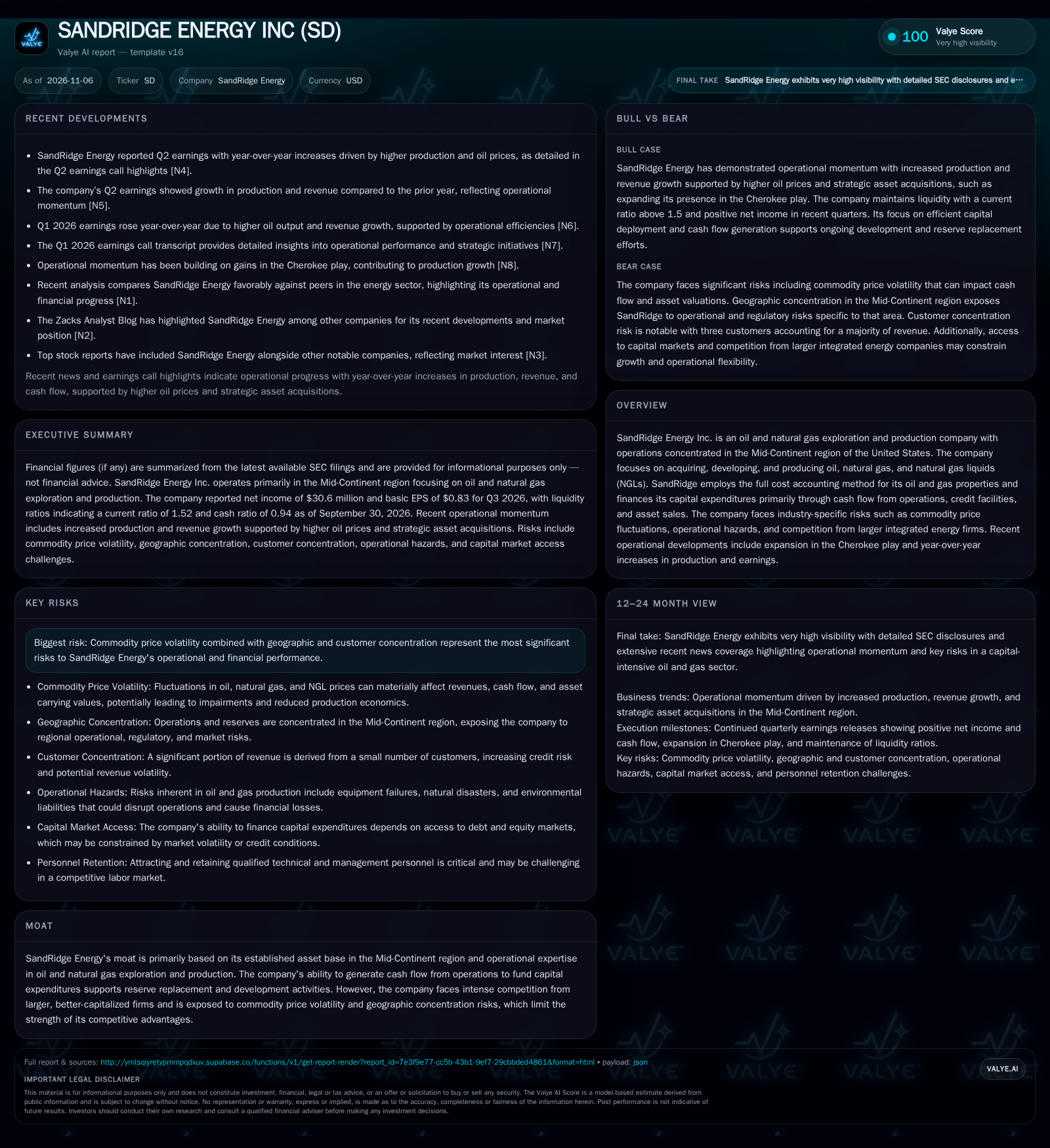
SandRidge Energy has accelerated its Mid-Continent growth with a $47.9 million Cherokee play acquisition and year-over-year improvements in production, revenue, and operational cash flow. The sustainability of recent gains will depend on SandRidge’s ability to optimize production, manage costs, and diversify its customer and asset base in a volatile sector. [S2] [N5]
SandRidge Energy’s latest quarter offers a dual picture: operational momentum from its Cherokee play expansion and growing cash flow, counterbalanced by persistent exposure to regional and customer concentration risks. The company’s $47.9 million Cherokee acquisition and robust quarterly earnings underscore its ability to deploy capital and grow reserves, but the sustainability of these gains will depend on commodity prices, the ability to manage a concentrated customer base, and ongoing discipline in capital allocation. The coming quarters will test whether SandRidge can translate recent operational gains into durable shareholder value in a volatile sector.
SandRidge’s Position Strengthened by Recent Cherokee Acquisition and Operational Advances
SandRidge Energy’s August 2026 acquisition of producing assets and leasehold interests in the Cherokee play for $47.9 million marks a notable expansion of its Mid-Continent footprint. The deal includes three contingent $2 million earn-out payments tied to future oil prices, aligning incentives with commodity market performance and adding potential upside or downside based on market swings. The acquisition was funded entirely with cash on hand, signaling available liquidity and a willingness to deploy capital for asset growth. [S2]
The company reported cash and liquidity metrics for the period; these figures do not by themselves establish operating runway, investment capacity, financial flexibility, or financing capacity. Year-over-year, both production and revenue have increased, supported by operational efficiency gains and higher oil prices. [S2] [N5]
Customer and geographic concentration are material: three customers accounted for 68% of 2025 revenue, and the asset base remains firmly anchored in the Mid-Continent, amplifying exposure to regional and market-specific risks. [S1]
Evaluating SandRidge’s Capital Efficiency and Cash Flow Generation Under Pressure
SandRidge’s business model is a classic example of capital-intensive, resource-based economics. Success depends on continually deploying capital to replace depleting reserves, extracting hydrocarbons efficiently, and converting production into operating cash flow. The full cost accounting method means periodic reassessment of asset values relative to commodity prices—protecting the balance sheet in upcycles, but exposing it to writedowns if prices fall.
Revenue is driven by realized oil, gas, and NGL prices multiplied by production volumes. Recent gains have been supported by both higher output and favorable pricing, but the underlying economics remain highly sensitive to commodity swings. Operating leverage is present: higher prices or volumes can rapidly improve margins, but the converse is also true. The Cherokee acquisition increases production scale, but also raises the capital base that must be serviced through ongoing cash flow.
Fixed costs (infrastructure, G&A, regulatory compliance) are significant, but variable costs (lifting, transportation, royalties) can be flexed somewhat in response to commodity environments. Sustaining production requires ongoing capital expenditures, which are typically funded from operational cash flow, supplemented by credit or asset sales in weaker cycles. [S2]
Assessing SandRidge’s Market Standing Within a Competitive Landscape
SandRidge’s main advantage lies in its established asset base and operational expertise in the Mid-Continent, allowing for targeted development and production optimization. The recent Cherokee play expansion reflects a strategy of deepening regional presence rather than diversifying into new basins. This can yield operational synergies and local knowledge advantages, but also amplifies exposure to regional shocks—whether regulatory, geological, or market-driven.
The company faces competition from larger integrated energy firms, independent E&Ps with more diversified asset portfolios, and private operators with different risk tolerances. SandRidge’s ability to generate cash flow to fund reinvestment is a partial moat, but limited scale and customer concentration may constrain pricing power and negotiating leverage. The structure of the Cherokee deal—with contingent earn-outs—suggests a risk-sharing approach, but also a recognition of commodity price uncertainty.
Switching frictions in oil and gas are generally low at the customer level, as hydrocarbons are largely fungible; however, long-term relationships and infrastructure commitments can provide some stability. Ultimately, SandRidge’s competitive position remains vulnerable to commodity cycles, capital market access, and the actions of larger, better-capitalized peers.
Potential for Cash Flow and Asset Growth if Commodity Prices Remain Stable and Cherokee Performs
A favorable scenario for SandRidge hinges on sustained or rising oil and gas prices, continued production growth from the Cherokee play, and successful optimization of both new and legacy assets.
Confirmation of this scenario would come from several sources: quarterly disclosures showing sequential production and revenue gains, minimal asset impairments, positive free cash flow after capital expenditures, and evidence that the Cherokee acquisition is meeting or exceeding initial production and return targets. If SandRidge can also modestly diversify its customer base or secure longer-term offtake agreements, it could reduce revenue volatility and improve margins.
Falsification would be signaled by stagnant or declining production despite recent capex, rising costs that erode margins, or a rapid drawdown of cash balances without commensurate asset growth.
Expected Scenario: Steady Growth Balanced with Concentration Risks and Capital Management
The most plausible trajectory for SandRidge is continued but moderate production and revenue growth, with periodic swings tied to commodity prices and ongoing operational improvements in the Cherokee and legacy assets.
Customer and geographic concentration will persist, leaving SandRidge exposed to external shocks or customer renegotiations. The company is likely to remain disciplined in capital deployment, balancing reinvestment with liquidity management. Quarterly reports should show steady, but not dramatic, improvements in production, revenue, and earnings, with the Cherokee play contributing incrementally to results.
This scenario would be confirmed by stable or slightly improving liquidity ratios, a lack of material impairments, and continued positive net income. It would be falsified by a sudden decline in production, adverse regulatory developments in the Mid-Continent, or signs of customer attrition or pricing pressure.
Risks of Cash Flow Challenges and Asset Write-downs from Commodity or Regional Downturns
The principal risk to SandRidge is a significant drop in oil and gas prices, which would compress cash flow, raise the risk of asset impairments under the full cost method, and potentially force curtailment of development activity. Given the company’s geographic and customer concentration, a regional operational disruption (e.g., regulatory clampdown, drought impacting water access, or midstream bottlenecks) could have outsized impact.
In this scenario, liquidity could deteriorate quickly, especially if production volumes decline or costs rise unexpectedly. The contingent earn-outs from the Cherokee deal could become a liability if oil prices stay below trigger levels, reducing future investment flexibility.
Early warning signs include rising operating costs per barrel, negative production trends, or customer payment delays.
Key Developments Influencing the Outcome of SandRidge’s Cherokee Investment
Quarterly production volumes and mix by product (oil, gas, NGL)—a useful metric for gauging operational progress and the impact of recent acquisitions.
Realized commodity prices versus benchmark indices—tracking the company’s exposure to market swings and its ability to capture pricing upside.
Free cash flow after capital expenditures—if disclosed, would indicate whether operations are funding growth or drawing on reserves.
Contingent earn-out payments triggered by WTI oil prices—disclosure of earn-out status would clarify both future liabilities and upside potential from the Cherokee deal.
Revenue concentration by customer—updates on customer mix or new offtake agreements would provide early signals of diversification or continued risk.
Asset impairment charges or reversals—watch for any signs of writedowns that could signal deteriorating asset economics.
Liquidity trends (current and cash ratios)—while not determinative alone, sequential changes could indicate evolving potential financial flexibility or stress.
Operational cost per barrel—if disclosed, would help test the sustainability of margin improvements and efficiency gains.
Disclaimer: This is research-only, informational analysis and not investment advice. It may include AI-generated interpretation and general industry context. Always verify important details using primary sources.

Comments