
Callaway Golf Co: Navigating Post-Divestiture Realignment, Margin Pressures, and Regional Divergence
Callaway Golf reported 2025 net sales of $2.06 billion, down 0.8% year-over-year, with operating income falling 8.9%.
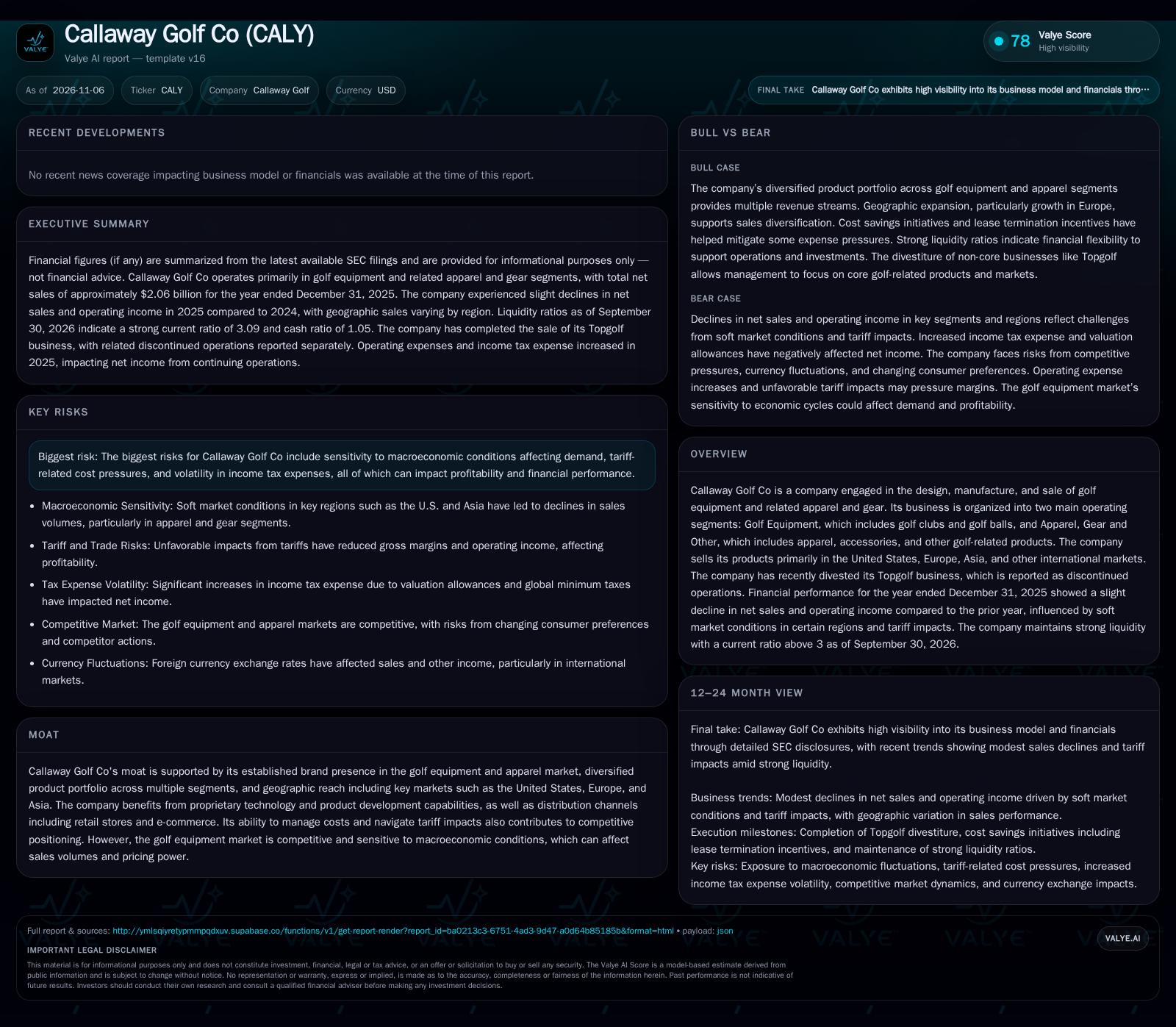
Callaway Golf reported 2025 net sales of $2.06 billion, down 0.8% year-over-year, with operating income falling 8.9%. The divestiture of Topgolf sharpened the company’s focus on core golf equipment and apparel, as mixed geographic results and higher income tax expense weighed on profitability. Gross margin compressed to 42.1%, and segment income declined across both major divisions.
Callaway Golf Co’s 2025 performance marks a strategic inflection point: the sale of Topgolf signals a return to core categories just as global demand for golf equipment and apparel faces cyclical and structural pressures. Net sales edged lower and operating income contracted, with margin compression exacerbated by tariffs, rising tax burdens, and sluggishness in key markets. Success will depend on Callaway’s ability to manage regional volatility, defend its premium brand, and recalibrate its economic model for a post-Topgolf era.
Recent Results Reflect Margin Pressures, Regional Divergence, and Strategic Refocus
For the year ended December 31, 2025, Callaway Golf Co reported total net sales of approximately $2.06 billion, representing a 0.8% decrease over 2024. Segment operating income declined 8.9% year-over-year, with both the Golf Equipment and Apparel, Gear and Other segments experiencing operating income contraction of 7.4% and 11.8%, respectively [S1]. The company’s gross margin narrowed to 42.1% from 42.7% in the prior year, reflecting tariff impacts and cost pressures. Regionally, U.S. sales fell 1.3%, Asia and Rest of World dropped 4.2% and 4.1%, while Europe provided a bright spot with 11.9% growth, highlighting uneven demand patterns [S1].
The divestiture of Topgolf, now reported as discontinued operations, marks a significant realignment toward the company’s legacy focus on golf equipment and related apparel. Liquidity remains high, with $433.5 million in cash and a current ratio of 3.09 as of September 30, 2026 [S2]. However, a sharp increase in income tax expense—driven by valuation allowances and global minimum taxes—pushed the effective tax rate to 55.7%, materially impacting net income [S1]. These developments frame a company recalibrating its core business amid macro and structural headwinds.
How Product Mix, Pricing, and Fixed Costs Shape Earnings Power
Callaway’s economics depend on its ability to balance product innovation, brand premium, and channel mix across its two major segments: Golf Equipment (clubs and balls) and Apparel, Gear and Other. Golf Equipment, at $1.375 billion in net sales, provides higher gross margins due to premium pricing and brand differentiation, but is sensitive to both discretionary consumer spending and competitive discounting. Apparel and gear, representing $685 million in sales, typically carry lower margins and higher exposure to fashion cycles, inventory risk, and promotional activity [S1].
The company’s cost structure includes substantial fixed costs from product development, marketing, and global distribution. In 2025, SG&A expenses rose 0.6% and R&D increased 2.2%, signaling continued investment despite top-line pressure [S1]. Operating leverage can amplify both upside and downside, as small shifts in demand or pricing flow directly to margins. Tariffs and global supply chain volatility have elevated input costs, compressing gross margin and pressuring profitability. The recent Topgolf divestiture removes a potential cross-subsidization engine, making segment-level efficiency and product mix optimization even more critical.
[S2] However, the spike in income tax expense—driven by valuation allowances and global minimum taxes—has introduced volatility to the bottom line, reducing net income conversion from operating results.
Brand, Innovation, and Distribution: Defending Turf in a Crowded Global Market
Callaway’s competitive position rests on its established brand, proprietary technology, and broad distribution network spanning the U.S., Europe, Asia, and other markets. In golf equipment, the company must routinely refresh its product lineup to maintain relevance with both serious and recreational golfers, leveraging R&D investment to differentiate on performance and technology. Apparel and gear, meanwhile, compete in a fragmented market with lower switching costs and greater exposure to fast-moving fashion trends.
The divestiture of Topgolf has narrowed Callaway’s business focus, but it also removes a unique experiential and cross-selling platform, potentially reducing opportunities for customer engagement outside traditional retail and e-commerce. The company faces intense competition from established golf brands, mass-market sporting goods companies, and emerging direct-to-consumer players. Pricing power is mixed: while premium equipment can command a margin, price sensitivity rises in apparel and during economic downturns.
Tariffs, currency volatility, and global supply chain disruptions remain persistent counterforces, increasing input costs and complicating inventory management. The company’s ability to leverage its brand and channel relationships, particularly in expanding European markets, will be critical to offsetting softness in the U.S. and Asia.
Margin Recovery and Geographic Expansion Could Drive a Rebound
A favorable scenario would see global demand for golf equipment and apparel stabilize or grow, aided by successful product launches and improved macroeconomic conditions. If Callaway can capitalize on double-digit sales growth in Europe and reverse declines in Asia and Rest of World, geographic diversification could provide a buffer against U.S. market stagnation [S1].
Operationally, targeted cost management, further supply chain optimization, and the benefit of recent lease termination incentives could help restore gross margin to prior levels. A reduction in tariff exposure—either through trade policy changes or supply chain adjustments—would offer further upside. Continued R&D investment may yield differentiated products, supporting premium pricing and brand loyalty.
Confirmation of this scenario would include: sustained sales growth in Europe; stabilization or recovery in U.S. and Asia; sequential improvement in gross margin and operating income; and normalization of the effective tax rate. Evidence of successful product innovation and increased direct-to-consumer penetration would further bolster the case.
Core Franchise Endures, Margin Pressures Persist, and Adaptation Is Ongoing
The most plausible path is for Callaway to maintain its position as a leading global golf equipment and apparel provider, with modest top-line growth offset by continued margin pressure from tariffs, input costs, and tax volatility. U.S. and Asian markets may remain soft, while Europe partially offsets declines. Incremental improvements in operating efficiency and selective cost management could mitigate some of the gross margin compression, but significant expansion is likely constrained by macroeconomic headwinds and competitive intensity.
The effective tax rate may remain elevated in the near term, muting net income growth even if operating results stabilize.
This scenario would be confirmed by continued modest declines or stabilization in sales, gross margin holding in the low-40% range, and operating income tracking recent trends. Evidence of ongoing cost discipline and incremental international market gains would reinforce the picture of a durable, but not rapidly expanding, core business.
Sustained Economic Weakness and Competitive Pressures Could Erode Profitability
In a more adverse scenario, persistent macroeconomic weakness and consumer pullback—especially in the U.S. and Asia—drive further declines in equipment and apparel volumes. If tariffs remain elevated and supply chain costs do not abate, gross margin could erode below historical levels. Intensifying competition may force price cuts or higher promotional activity, particularly in apparel, undermining brand premium and profitability.
A continued surge in effective tax rates, due to further valuation allowances or unfavorable policy changes, could reduce net income conversion even as operating results stagnate. Liquidity could be pressured if working capital needs rise in a sluggish sales environment or if restructuring costs are required to right-size the business.
This scenario would be supported by sequential declines in net sales, further gross margin compression, rising operating expenses, and persistent tax rate volatility. Evidence of inventory buildups, channel destocking, or market share losses would further validate the downside case.
Signals That Will Reveal Callaway’s Next Phase
Quarterly and annual sales trends by region—particularly whether European growth is sustained and if U.S./Asia declines accelerate or stabilize.
Gross margin trajectory, especially any recovery from 2025’s 42.1% level or further erosion due to tariffs and input costs.
Operating income progression in both Golf Equipment and Apparel, Gear and Other, as an indicator of cost discipline and segment profitability.
Effective tax rate movements and associated drivers; a reduction would improve net income conversion, while further spikes would signal ongoing structural challenges.
Inventory levels and turnover rates, if disclosed, to gauge demand health and supply chain management.
R&D and SG&A expense trends, as a proxy for investment discipline and ability to support product innovation without margin sacrifice.
Evidence of successful new product launches, channel expansion, or increased direct-to-consumer penetration.
Any signals of further restructuring, cost-saving initiatives, or strategic pivots following the Topgolf divestiture.
Disclaimer: This is research-only, informational analysis and not investment advice. It may include AI-generated interpretation and general industry context. Always verify important details using primary sources.

Comments