
Surf Air Mobility: Revenue Growth, Liquidity Strain, and the Test of Regional Aviation Economics
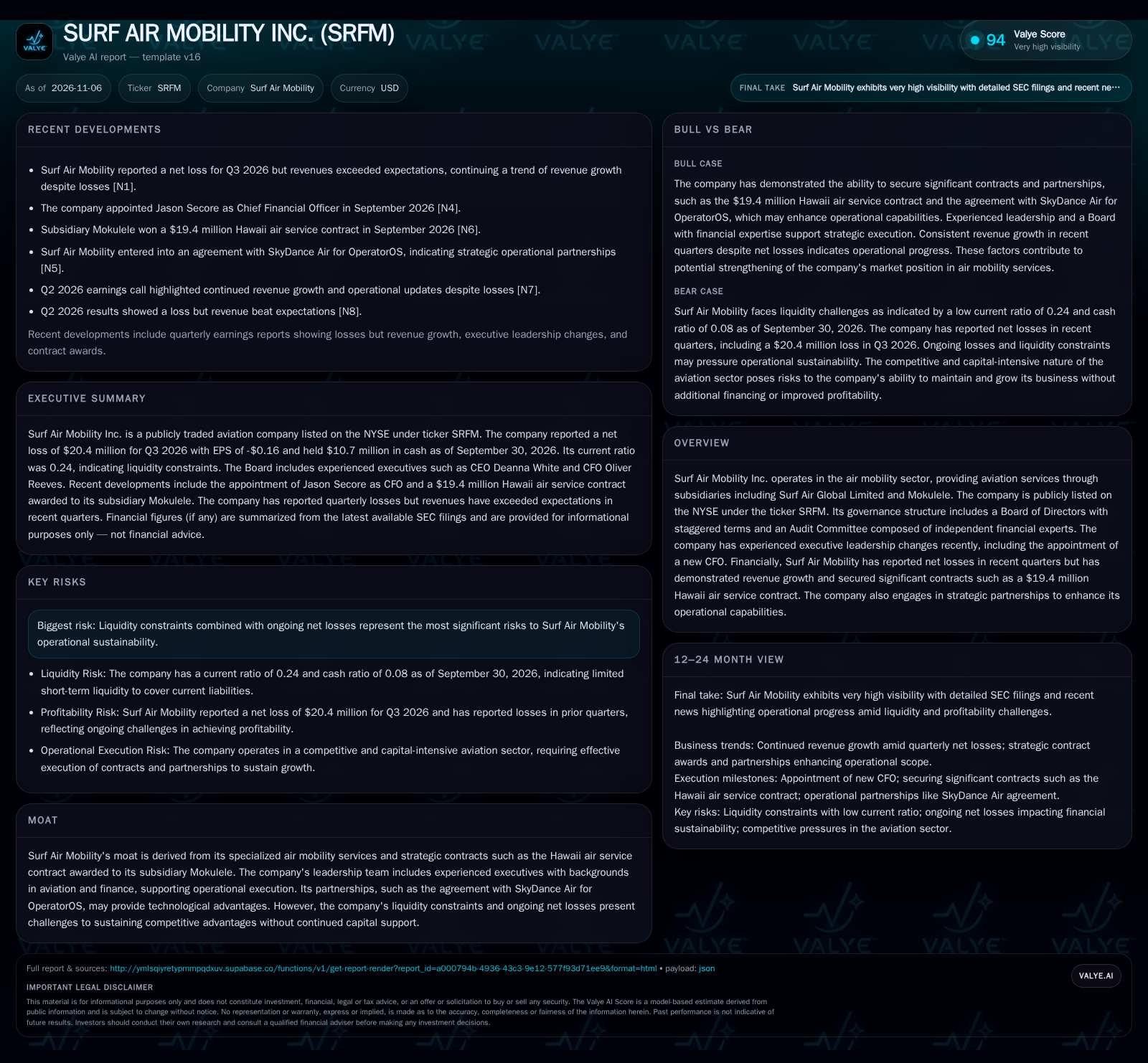
Surf Air Mobility, operating regional air mobility services via subsidiaries like Mokulele, has shown revenue outperformance in recent quarters and landed a significant $19.4 million Hawaii contract.
Surf Air Mobility, operating regional air mobility services via subsidiaries like Mokulele, has shown revenue outperformance in recent quarters and landed a significant $19.4 million Hawaii contract. The core question is whether ongoing revenue growth and contract wins can outpace cash burn and unlock a viable path to long-term profitability—or if Surf Air Mobility will be forced into restructuring or rapid capital raises to survive. [S2] [N1] [N6]
Surf Air Mobility sits at a crossroads: its regional air service model, operated through subsidiaries like Mokulele, has recently delivered revenue outperformance and secured new government contracts. Yet, the company’s persistent net losses and a sharply negative liquidity position—just $10.7 million in cash versus $127.2 million in current liabilities—cast a shadow over these operational wins. With the aviation sector demanding heavy capital outlays, Surf Air Mobility’s survival and future growth hinge on its ability to convert top-line momentum into durable profitability or secure additional funding before its financial runway runs out.
Recent Contract Wins and Financial Strain Define the Near-Term Reality
The company reported a current ratio of 0.24 for the period. This acute liquidity strain means the company’s liabilities vastly outstrip its liquid assets, putting immediate pressure on operations and any growth initiatives. Meanwhile, the $19.4 million Hawaii air service contract awarded to subsidiary Mokulele provides a tangible revenue opportunity and validates Surf Air Mobility’s regional service model. However, the company has yet to demonstrate that contract wins and revenue growth can translate into a path out of persistent quarterly losses. The appointment of Jason Secore as CFO in September 2026 adds fresh financial leadership, but the fundamental challenge remains converting operational momentum into financial sustainability. [S2] [N1] [N4] [N6]
Regional Air Mobility: Scale, Fixed Costs, and the Cash Burn Dilemma
Surf Air Mobility’s core business—regional scheduled and charter air services—features a mix of fixed and variable costs typical of the aviation sector. Aircraft acquisition or leasing, maintenance, insurance, fuel, and crew costs create a high fixed-cost base, while ticket sales, charter contracts, and government service agreements like the recent Hawaii award drive revenue. The company’s ability to achieve operating leverage depends on filling seats and maximizing aircraft utilization. In theory, route density and exclusive regional contracts could improve margins by spreading fixed costs across higher volumes. Without a significant and sustained uplift in passenger volume, pricing power, or ancillary revenues, cash burn will likely remain high. The capital intensity of aviation also means that even modest expansion or fleet upgrades require outside funding or strong free cash flow—neither of which Surf Air Mobility currently demonstrates. [S2] [N6]
A critical factor in Surf Air Mobility’s financial dynamics is the interplay between fixed costs and variable revenue streams. Fixed costs such as aircraft leases or debt service remain constant regardless of utilization, which means that any underperformance in passenger loads or contract fulfillment disproportionately impacts profitability. Conversely, variable costs like fuel and crew expenses fluctuate with flight frequency and distance, offering some flexibility but also introducing volatility tied to external factors such as fuel price spikes or labor market tightness. The company’s ability to manage this cost structure through dynamic scheduling, route optimization, and fuel hedging strategies could materially influence its cash flow profile. Additionally, ancillary revenue opportunities—such as premium seating, cargo services, or loyalty programs—if effectively developed, could provide incremental margins that help offset fixed costs and reduce overall cash burn.
Niche Positioning in a Fragmented, Capital-Intensive Sector
Surf Air Mobility’s competitive positioning hinges on its focus on underserved regional routes and on-demand air mobility—a market where large national carriers may not compete aggressively due to scale and cost constraints. By targeting government-subsidized contracts (e.g., Essential Air Service in Hawaii) and leveraging localized brand presence via subsidiaries like Mokulele, Surf Air Mobility may avoid direct price wars with major airlines. However, the regional aviation market is fragmented, with numerous small operators vying for limited contracts and passenger flows. Barriers to entry exist in the form of regulatory compliance, fleet acquisition, and route licensing, but barriers to exit are low, and competitive churn is high. Technology substitution—such as electric or hybrid aircraft—could reshape the landscape, but capital constraints may limit Surf Air Mobility’s ability to lead in next-generation fleet adoption. The sector’s chronic margin pressures and exposure to fuel, labor, and insurance cost shocks further erode any sustainable economic moat absent scale or proprietary technology.
The fragmented nature of regional air mobility markets creates both opportunities and challenges for Surf Air Mobility. On one hand, the lack of dominant players on many underserved routes allows for niche specialization and tailored service offerings, which can command pricing premiums and foster customer loyalty. On the other hand, this fragmentation often results in intense competition for limited government contracts and thin margins, especially when multiple operators underbid to secure essential air service routes. Sustaining competitive advantage may therefore depend on operational efficiency, regulatory relationships, and the ability to innovate within tight capital constraints. Moreover, any shift in regulatory frameworks—such as stricter environmental standards or new safety requirements—could disproportionately affect smaller operators lacking scale, potentially reshaping competitive dynamics and raising barriers to entry or continuation.
How Contract Wins and Route Density Could Reverse Cash Burn
The most favorable outcome for Surf Air Mobility involves leveraging its recent $19.4 million Hawaii contract and ongoing revenue outperformance to achieve scale on core routes. If the company can rapidly boost load factors, secure additional regional contracts (especially with government support), and improve aircraft utilization, the resulting operating leverage could narrow losses or even turn the company cash-flow positive. Evidence confirming this scenario would include sequential improvements in gross margin, rising load factors, new contract announcements, and a declining quarterly net loss. Early adoption of new aircraft technologies—if supported by third-party financing or grants—could further enhance cost competitiveness. However, this scenario would be quickly falsified if revenue momentum stalls, contract churn outpaces new wins, or the company is forced into dilutive capital raises before profitability is in sight.
Revenue Growth Outpaced by Persistent Losses and Funding Needs
The most probable path is that Surf Air Mobility continues to win contracts and grow revenue, but ongoing fixed-cost burdens and subscale operations keep the company in a cycle of net losses and cash burn. Confirmation of this scenario would include continued revenue beats without a corresponding improvement in operating margins, further executive turnover, or announcements of bridge financing and/or restructuring. Falsification would require a clear inflection point in margin trends or a major, non-dilutive capital infusion.
Acute Liquidity Crisis Forcing Restructuring or Asset Sales
In a negative scenario, Surf Air Mobility’s limited cash and reported current ratio force the company into crisis: missed payments, service disruptions, or forced asset divestitures could follow if new capital is not secured quickly. Contract delays, operational hiccups, or cost inflation (e.g., fuel or labor spikes) would accelerate this spiral. Evidence of this downside would include default notices, abrupt service reductions, layoffs, or public warnings about going-concern status. Rapid and unfavorable dilution or distressed asset sales may be necessary to stave off insolvency. This scenario could also be triggered if the company fails to renew key contracts or faces regulatory penalties.
What Will Define Surf Air Mobility’s Next Chapter
Quarterly cash burn and operating margin trends—sequential improvement or further deterioration would clarify the trajectory.
Load factors and aircraft utilization rates—if disclosed, these would show whether the company is approaching profitable scale.
Contract pipeline and renewal rates—tracking new awards and retention of existing contracts, especially in government-subsidized markets.
Announcements of new financing—timing, structure, and cost of any equity or debt raises will indicate the urgency of liquidity pressures.
Executive turnover or restructuring moves—further leadership changes may signal instability or a strategic pivot.
Disclosures of regulatory actions, service interruptions, or payment defaults—any such events would confirm acute distress.
Adoption or piloting of next-generation aircraft or cost-saving technologies—evidence of technological progress or capital constraints.
Revenue per available seat mile (RASM) and cost per available seat mile (CASM)—if disclosed, these unit economics would help test the scalability thesis.
Disclaimer: This is research-only, informational analysis and not investment advice. It may include AI-generated interpretation and general industry context. Always verify important details using primary sources.

Comments