
Brighthouse Financial: Annuity Innovation, Hedging Discipline, and Managing Volatility
Brighthouse Financial’s focus on Shield Annuities and disciplined risk management has supported recent sales momentum, but market volatility, investment income swings, and earnings variability highlight the persistent tension between growth, capital stability, and the complexity of managing insurance guarantees.
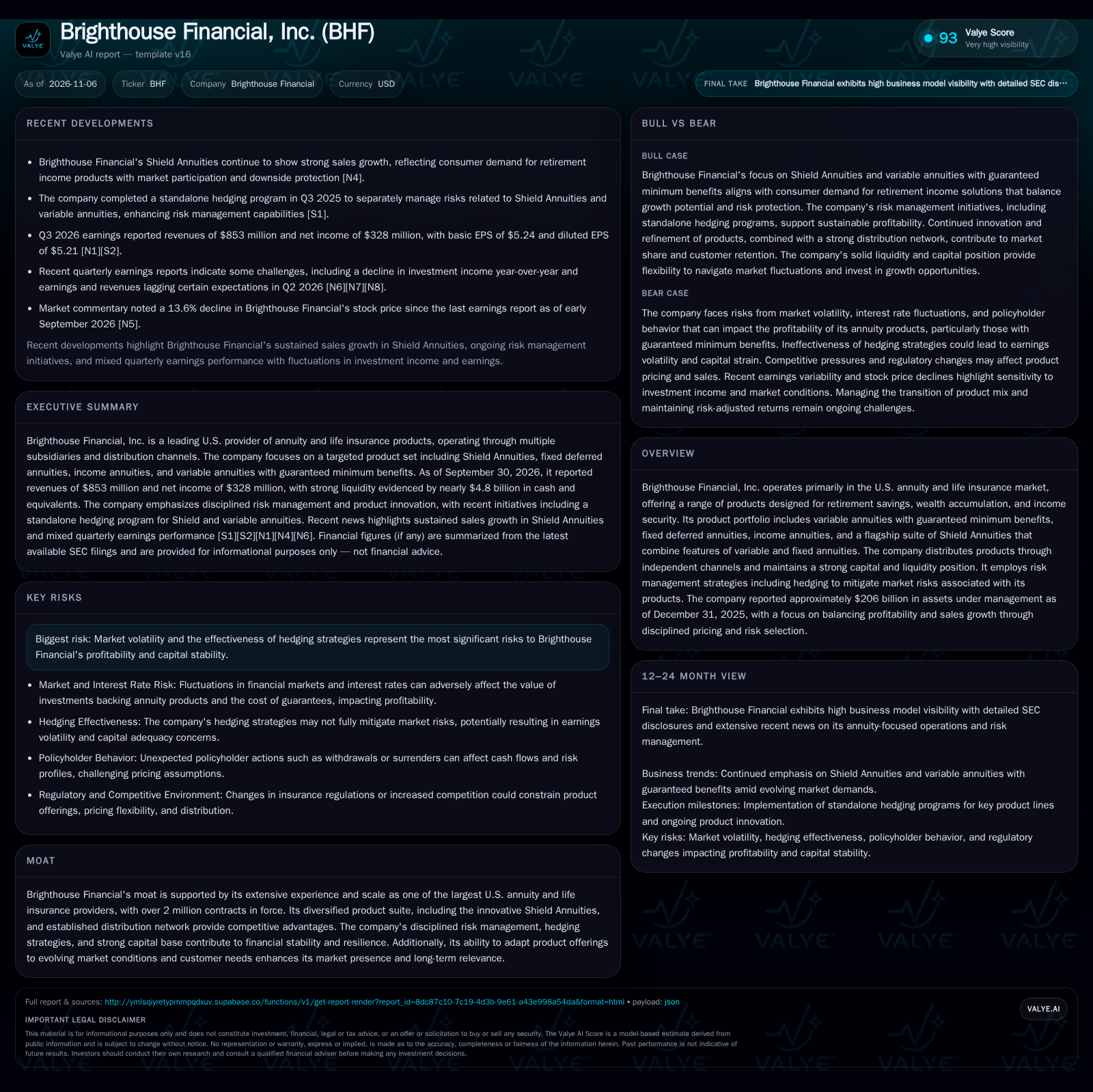
Brighthouse Financial’s Shield Annuities continue to drive sales growth amid consumer demand for retirement income products with downside protection. The company’s standalone hedging program and strong capital base are designed to mitigate market risk, but recent earnings volatility and a notable stock price decline underscore exposure to investment income swings and the limits of risk transfer. The next phase hinges on product mix execution, sustained demand for hybrid annuities, and the effectiveness of hedging strategies in a dynamic rate and equity environment. [S1] [S2] [N4] [N5]
Brighthouse Financial, Inc. stands at the crossroads of innovation and risk in the U.S. annuity and life insurance landscape. Its Shield Annuities, which blend market-linked upside with downside protection, have captured sustained sales momentum, even as the company contends with the structural challenges of guaranteeing long-term retirement income in unpredictable markets. A newly implemented standalone hedging program aims to sharpen risk management, but recent earnings volatility and a significant stock price decline highlight the persistent sensitivity to investment returns and policyholder behavior. Whether Brighthouse can maintain profitable growth will depend on the durability of demand for its hybrid annuity products, the precision of its hedging, and its ability to navigate regulatory and competitive headwinds.
Recent Performance: Shield Annuities Drive Growth Amid Earnings Volatility
Brighthouse Financial reported $853 million in revenue and $328 million in net income for Q3 2026, with basic EPS of $5.24 and diluted EPS of $5.21. The company maintains $4.79 billion in cash and $1.24 billion in short-term investments as of September 30, 2026. The Shield Annuities product line continues to post strong sales growth, reinforcing its central role in the company’s strategy. However, earnings have shown variability, with recent quarters lagging expectations due to declining investment income. The stock price has fallen 13.6% since the most recent earnings report, reflecting investor unease about future profitability and sensitivity to market conditions. [S2] [N1] [N4] [N5] [N6] [N7] [N8]
How Brighthouse Earns: Fee Streams, Spread Income, and the Economics of Guarantees
Brighthouse Financial’s core revenue streams stem from fees on annuity and life insurance contracts, net investment income on assets under management, and the spread between returns earned on invested assets versus crediting rates and guarantees promised to policyholders. The company’s product mix includes variable annuities (with optional guaranteed minimum benefits), fixed and indexed annuities, and the flagship Shield Annuities, each carrying distinct risk and revenue characteristics.
Fee income is primarily tied to account values and the election of guarantee riders—such as guaranteed minimum death and living benefits—which increase the complexity and capital requirements of the portfolio. Brighthouse has increasingly shifted toward products with lower embedded guarantees (notably index-linked Shield Annuities) to limit capital strain and reduce exposure to extreme market moves. However, profitability remains closely linked to effective pricing of guarantees, accurate assumptions about policyholder behavior, and prudent investment asset allocation.
The company incurs significant hedging and reinsurance costs to offset the market and behavioral risks associated with these products. Fixed costs are high due to regulatory, distribution, and technology needs, but operating leverage can improve if asset and contract volumes grow faster than expenses. Capital requirements are elevated for products with embedded guarantees, making disciplined risk selection and capital deployment central to sustainable returns.
Annuity Market Dynamics: Product Innovation, Distribution Reach, and the Race for Risk-Adjusted Returns
Brighthouse Financial operates in a highly competitive U.S. annuity and life insurance landscape, facing established insurers and newer entrants offering similar retirement income products. Its competitive positioning rests on the breadth of its annuity suite—especially the Shield Annuities, which appeal to risk-averse but growth-seeking consumers—and its ability to distribute through independent channels. The company’s experience in product design and risk management offers some scale and expertise advantages.
However, the market is crowded, with competitors frequently launching new index-linked and hybrid annuity products and leveraging digital distribution. Pricing pressure and regulatory scrutiny can erode margins or limit product flexibility. Substitutes such as mutual funds, ETFs, and direct retirement accounts, while lacking insurance guarantees, may appeal to less risk-averse savers, especially in rising-rate or strong equity environments.
Brighthouse’s focus on product innovation and hedging discipline is a potential edge, but the durability of this advantage depends on its ability to adapt to regulatory changes, maintain cost discipline, and preserve consumer trust in the face of market volatility.
If Shield Annuities Sustain Demand and Hedging Proves Robust, Margin Expansion Is Achievable
A favorable outcome for Brighthouse would see continued strong sales of Shield Annuities and other index-linked products, as demographic trends and retirement anxieties drive consumer demand for principal protection with market participation. If the standalone hedging program consistently dampens earnings volatility and the company maintains pricing discipline on guarantees, margins could expand even in a lower-rate environment.
Upside would be confirmed by a sustained increase in annuity inflows, stable or rising fee income per contract, and a narrowing gap between expected and actual investment income. Evidence of improved earnings stability quarter-over-quarter, despite market swings, would support the thesis that hedging discipline is delivering tangible results. Positive regulatory developments or successful product launches in adjacent segments could further enhance growth prospects.
Navigating the Middle: Moderate Growth, Earnings Sensitivity, and Ongoing Repricing
The most plausible trajectory for Brighthouse is one of moderate growth in assets under management, led by continued but potentially decelerating sales of Shield Annuities and selective expansion in variable and fixed annuities. Earnings would remain sensitive to investment income and market conditions, with hedging programs reducing but not eliminating volatility.
Base case confirmation would include steady (but not accelerating) new business sales, manageable fluctuations in net income, and continued investment in product and risk management innovation. Falsification would come from a sharp drop in annuity sales, persistent earnings disappointments, or evidence of hedging ineffectiveness leading to capital strain. Regulatory or competitive shocks could also destabilize this scenario.
When Volatility Overwhelms: Hedging Gaps, Policyholder Shocks, and Margin Compression
In an adverse scenario, a combination of severe market volatility, policyholder behavior deviating from assumptions (such as elevated surrenders or withdrawals), and ineffective or costly hedging could drive earnings volatility and capital depletion. If investment income materially underperforms or guarantees prove underpriced, Brighthouse could face margin compression, increased reserve requirements, and potentially negative net income.
Downside would be confirmed by a sharp and sustained drop in net income, unexpected reserve charges, and negative sales momentum in key annuity lines. A further decline in the stock price and/or downgrades from rating agencies would signal investor and market concern about capital adequacy and business model resilience. Regulatory changes that limit product flexibility or increase capital requirements would exacerbate these risks.
Milestones and Metrics That Will Test Brighthouse’s Annuity Strategy
Quarterly Shield Annuity sales growth and total inflows: Sustained momentum would support the thesis of durable consumer demand. [N4]
Net investment income trends: Stabilization or improvement would suggest better asset-liability management and hedging effectiveness. [S2] [N6] [N7] [N8]
Earnings volatility and reserve changes: A useful metric would be the quarter-over-quarter standard deviation of net income and the frequency of material reserve adjustments.
Fee income per contract (if disclosed): Rising or stable fee yields would indicate pricing power and product mix improvement.
Policyholder behavior metrics: Actual vs. expected lapse, surrender, and withdrawal rates would help test the accuracy of pricing assumptions and risk models.
Regulatory or rating agency actions: Downgrades or new capital requirements could materially alter the risk profile and growth potential.
Disclaimer: This is research-only, informational analysis and not investment advice. It may include AI-generated interpretation and general industry context. Always verify important details using primary sources.

Comments