
PAR Technology: Platform Leverage, Restaurant Tech Volatility, and the Test of Integrated Solutions
PAR Technology’s blend of hardware, subscription software, and services for restaurants puts it at the crossroads of digital transformation and operational challenge. Recent earnings highlight operational progress, but sustained losses and competitive intensity raise questions about the scalability and resilience of its business model.
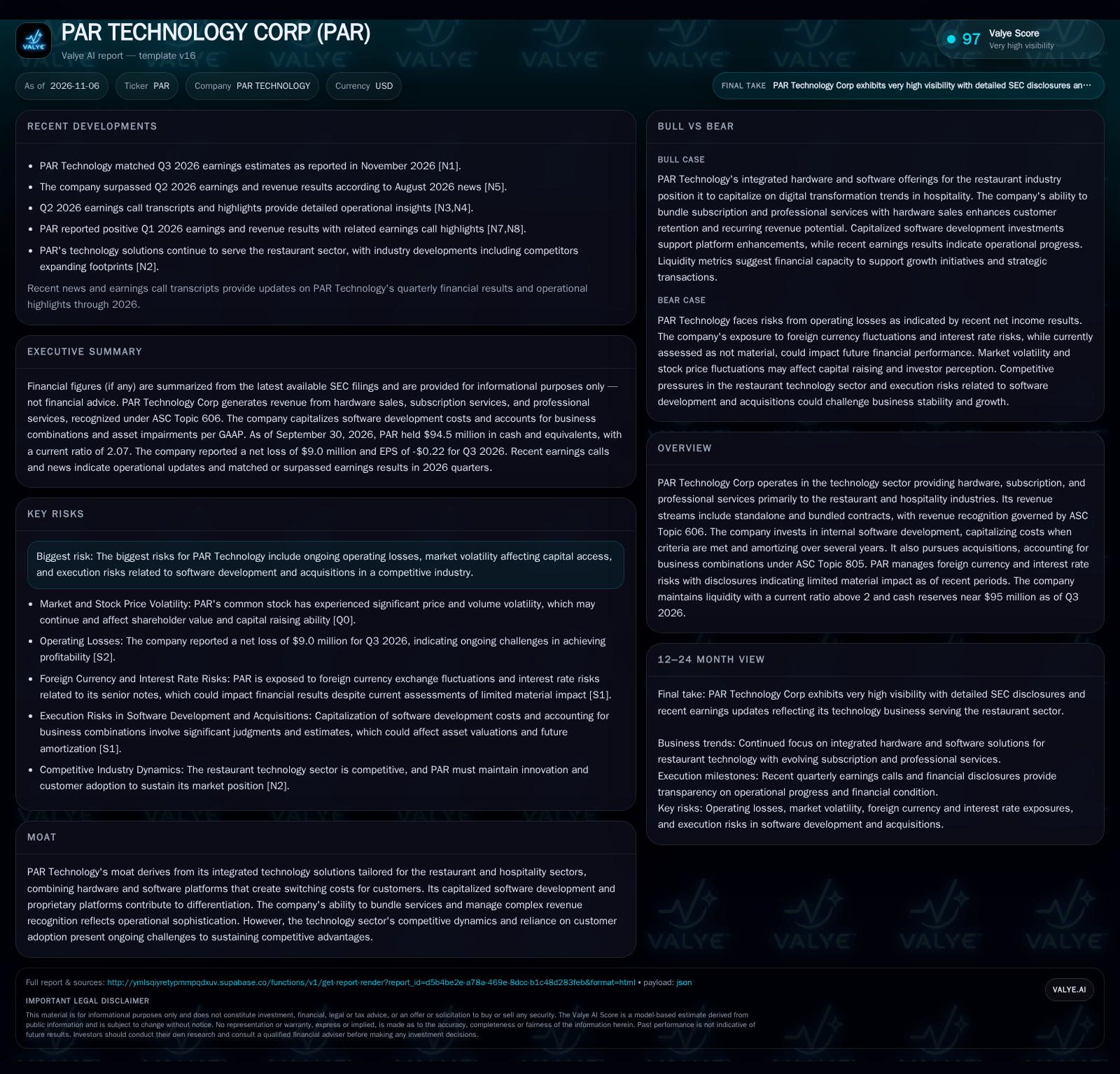
PAR Technology serves the restaurant and hospitality sector with integrated hardware and software solutions, generating revenue from hardware sales, subscriptions, and services. Despite surpassing or matching earnings estimates in each 2026 quarter, the company posted a $9 million net loss in Q3. PAR’s strategy hinges on driving recurring revenue and customer stickiness through bundled offerings, but persistent operating losses and sector competition test its ability to convert platform investments into durable profitability. The next phase depends on subscription growth, margin improvement, and evidence of customer retention.
PAR Technology sits at a critical juncture in the restaurant and hospitality technology market, offering integrated hardware, subscription-based software, and professional services to a sector undergoing rapid digital transformation. While the company’s ability to match or beat quarterly earnings expectations in 2026 signals operational momentum, its $9 million net loss in the most recent quarter underscores the central challenge: turning platform breadth and recurring revenue ambitions into sustainable profitability. The next act will hinge on the company’s ability to drive customer adoption, improve margin structure, and defend its position against intense competition and evolving customer expectations.
Recent Earnings, Losses, and a Liquidity Snapshot: The State of PAR Technology
PAR Technology’s most recent financials reveal a company balancing operational progress with ongoing losses. For Q3 2026, PAR reported a net loss of $9.0 million (EPS of -$0.22), following a pattern of matching or surpassing earnings estimates in each quarter of 2026 [S2] [N1] [N5] [N8]. The company held $94.5 million in cash and equivalents and a current ratio of 2.07 as of September 30, 2026, indicating a reported liquidity position [S2]. Revenue is generated from a mix of hardware sales, subscriptions, and services, governed by ASC 606 principles that require careful allocation of contract consideration based on distinct performance obligations [S1].
How PAR Makes—and Could Scale—Money: Platform Economics and Margin Tension
PAR’s economics are shaped by its multi-layered revenue streams: hardware sales, software subscriptions, and professional services [S1]. Hardware sales likely provide upfront cash flow but may carry lower margins and greater cyclicality, especially as restaurants face capex constraints. Subscription-based software and bundled services offer the potential for higher-margin, recurring revenue, critical for platform valuation and investor confidence. However, the transition to a subscription-heavy mix typically brings near-term margin compression due to deferred revenue recognition and the upfront cost of customer acquisition and onboarding.
The company capitalizes internal software development costs, amortizing them over three to seven years, which helps smooth reported R&D expenses but can mask the true cash cost of innovation [S1]. Operating leverage is theoretically attractive: as more customers are added to the platform, incremental software and service revenue should drop disproportionately to the bottom line. Yet, persistent net losses suggest that either customer acquisition costs, support requirements, or R&D spend are absorbing much of the gross profit, or that the installed base is not yet large enough to realize scale benefits. A core question is whether subscription revenue growth can outpace the drag from hardware and services, and if customer retention and upsell rates can eventually flip the P&L into sustained profitability.
Platform Integration as Differentiator—But Is It Enough in a Crowded Restaurant Tech Field?
PAR’s competitive position is built around its integrated hardware and software offering, targeting the restaurant and hospitality verticals with end-to-end solutions. This integration can create switching frictions for customers—especially chain operators seeking unified data and operational platforms—but the magnitude of these frictions depends on actual implementation complexity and the cost or risk of migration to rival platforms. The restaurant technology market is crowded, with competition ranging from legacy POS vendors to cloud-native upstarts and vertical SaaS specialists, each vying for share with aggressive pricing and rapid innovation.
PAR’s ability to bundle professional services, subscriptions, and hardware may foster customer lock-in, but it also exposes the company to execution risk if any element of the platform underperforms. Substitution risk is ever-present: if competitors offer superior integrations, lower TCO, or more flexible contracts, PAR could face pricing pressure and elevated churn. The company’s capitalized software development and proprietary platforms may provide some moat, but the durability of this advantage will be tested as customer expectations and technology standards evolve.
Recurring Revenue Acceleration and Platform Stickiness Drive Profitable Growth
A bullish scenario for PAR Technology hinges on the company converting its installed base of hardware customers into long-term, high-retention subscription and service clients. If the company can demonstrate accelerating growth in subscription revenue, rising average revenue per customer, and declining churn, operating leverage could rapidly improve as fixed platform costs are spread over a broader base. Evidence supporting this scenario would include consecutive quarters of expanding subscription gross margin, reported improvements in net retention (if disclosed), and positive operating cash flow. Successful cross-selling of new modules or services to existing customers would further validate the stickiness and scalability of the platform.
Confirmation would come from management commentary about contract wins, reference customers, or ecosystem partnerships that drive network effects and reinforce switching costs.
Mixed Progress: Subscription Gains Offset by Margin Pressure and Competitive Drag
The most plausible outcome for PAR over the next 12-24 months is a continuation of modest subscription and service revenue growth, partially offset by persistent margin pressure from hardware mix, competitive pricing, and elevated support costs. Customer adoption trends may be positive but not explosive, with some evidence of churn or pricing concessions required to retain key accounts.
Confirmation of this scenario would include steady but unspectacular growth in subscription revenue (if disclosed), continued reporting of net losses or operating near breakeven, and management commentary focused on cost discipline and incremental improvement rather than transformative wins. Falsification would require either a sharp inflection in profitability or a material contraction in customer base or revenue.
Customer Churn, Competitive Displacement, and Limited Margin Recovery
A negative scenario emerges if PAR is unable to retain or upsell its customer base, leading to elevated churn and revenue contraction. This could be triggered by aggressive moves from competitors offering lower-priced or more advanced solutions, or by customer dissatisfaction with any element of PAR’s bundled offering. In this world, hardware sales become increasingly commoditized, subscription growth stalls, and the company faces a squeeze on both gross and operating margins.
Confirmation would include flat or declining subscription revenue (if disclosed), rising customer acquisition costs, negative operating cash flow, and management guidance revising growth or margin targets downward. Early warning signs might include increased customer incentives, layoffs, or restructuring initiatives. If liquidity is depleted by continued losses and no clear pathway to profitability emerges, the company could be forced into asset sales, dilutive financings, or strategic pivots.
Testing the Thesis: Customer Adoption, Subscription Mix, and Execution Landmarks
Quarterly growth in subscription and service revenue (if disclosed), as a share of total revenue, would clarify the transition to a recurring revenue model.
Gross margin trends by segment—especially for software subscriptions versus hardware—would help assess the path to operating leverage and profitability.
Customer retention and churn rates (if disclosed) would directly measure the stickiness of PAR’s platform and the durability of its competitive position.
Net retention or average revenue per customer (if disclosed) would indicate success in cross-selling and upselling to the installed base.
Operating cash flow and free cash flow trends—particularly in relation to capitalized software development—would reveal the true cash economics of the business.
Evidence of major contract wins, reference customer endorsements, or ecosystem integrations would demonstrate competitive traction.
Management commentary on pricing discipline, cost structure, and competitive dynamics in earnings calls would provide forward-looking insight into strategy execution.
Any significant changes in liquidity, capital structure, or external financing needs would signal pressure on self-funding and risk of dilution.
Disclaimer: This is research-only, informational analysis and not investment advice. It may include AI-generated interpretation and general industry context. Always verify important details using primary sources.

Comments