
Health Catalyst Refocuses on Core Analytics: Restructuring, Competition, and the Next Phase of Healthcare IT Economics
After divesting its Vitalware business and navigating leadership transitions, Health Catalyst faces a pivotal moment as it sharpens focus on core analytics and consulting offerings. The company’s recent operational changes, financial results, and evolving sales cycles highlight both the potential for streamlined growth and the risks from intensified competition and restructuring execution.
Health Catalyst’s latest quarter reveals a business in transition: divesting non-core assets, realigning leadership, and reporting positive net income amid competitive and structural pressures. The company’s ability to leverage its healthcare analytics and consulting platform, manage long sales cycles, and execute restructuring will determine its future resilience and profitability. Watch for impacts from the Vitalware divestiture and platform migration on revenue mix, client retention, and cost structure over the next year. [S2] [N1] [N2] [N4]
Health Catalyst, Inc. stands at a strategic crossroads following its divestiture of the Vitalware business, a high-margin segment that previously diversified its revenue stream. As the company sharpens its focus on healthcare analytics and consulting, recent leadership changes and ongoing restructuring initiatives point to a new phase of operational realignment. Yet, these moves come amid intensifying competition from heavyweight healthcare IT players and shifting client expectations. [S2] [N1] [N2] [N4]
Strategic Realignment: Vitalware Sale, Leadership Shifts, and Financial Milestones
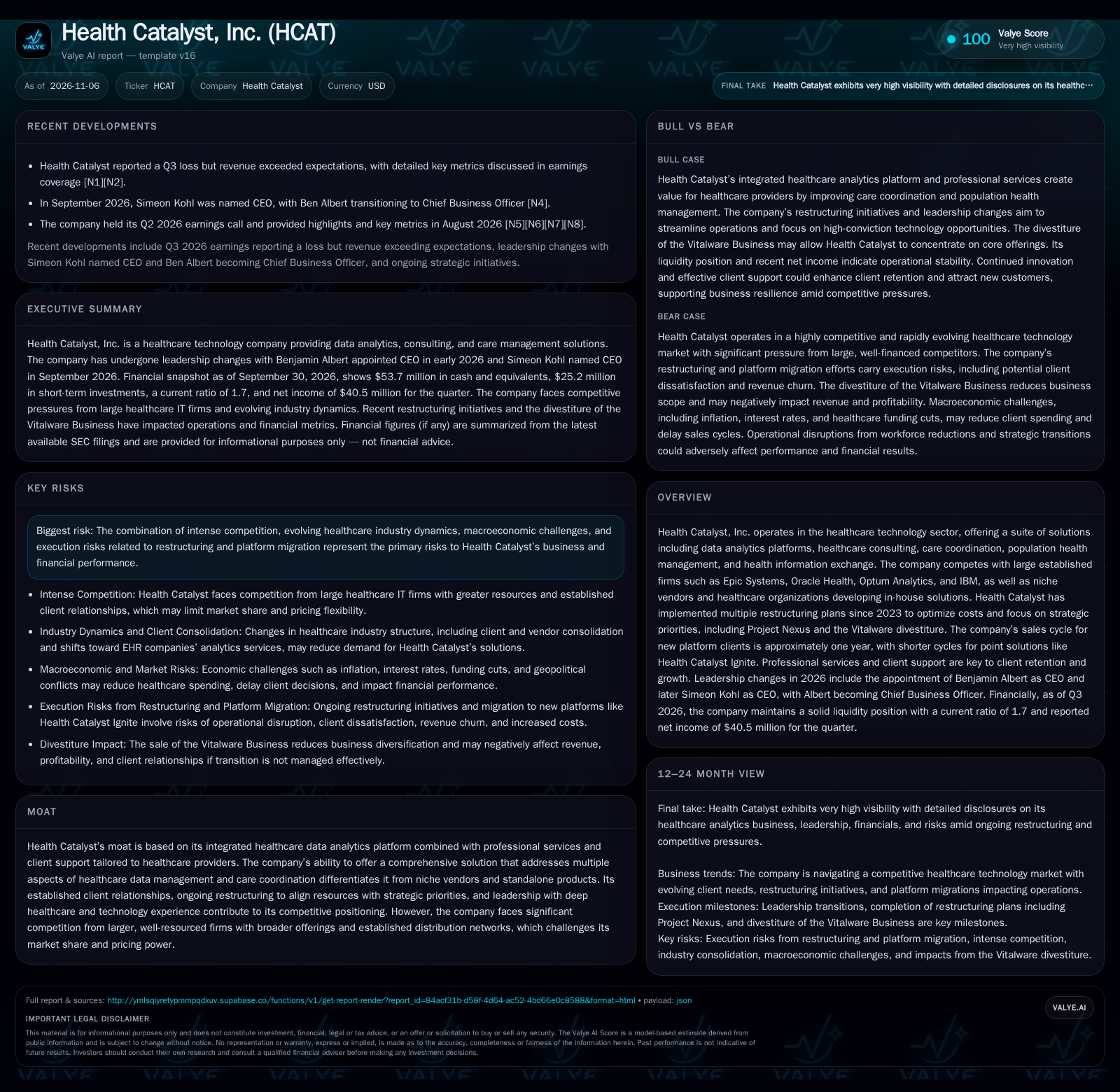
Health Catalyst’s operating profile changed significantly in 2026 with the divestiture of its high-margin Vitalware business, a move that narrows its portfolio and could impact revenue mix and overall profitability. The company also underwent major leadership transitions: Benjamin Albert, CEO since February 2026, transitioned to Chief Business Officer in September as Simeon Kohl assumed the CEO role, coinciding with ongoing restructuring efforts. These developments collectively reflect a company refocusing on its core analytics and consulting strengths while navigating the risks of a more concentrated business model and organizational change. [S2] [N1] [N2] [N4]
How Health Catalyst Earns: Analytics, Consulting, and the Challenge of Fixed-Cost Leverage
Health Catalyst’s economics are driven by a mix of platform-based healthcare analytics, professional consulting, care management, and population health solutions. Revenue is typically generated through licensing fees for its analytics platform, complemented by professional services contracts that are labor-intensive and require deep domain expertise. This blend creates a moderately recurring revenue base but also exposes the company to the challenges of long sales cycles (about one year for new platform clients), high customer acquisition costs, and variable utilization of consulting staff.
The divestiture of the high-margin Vitalware business may reduce blended gross margin and place greater emphasis on the company’s core analytics and services economics. As the company streamlines, it may gain some fixed-cost leverage by aligning its resource base with a narrower set of offerings, but success depends on maintaining or growing platform adoption and professional services utilization. Capital needs remain moderate for a software and consulting business, yet ongoing restructuring and platform migration introduce near-term execution costs and potential revenue disruptions if client transitions are not smooth. If Health Catalyst can increase the proportion of multi-year contracts or deepen integration with client workflows, it could improve revenue visibility and margin stability—but such outcomes are not yet established in current disclosures.
Competition Intensifies: Platform Depth Versus Scale and Client Lock-In
Health Catalyst faces formidable competition from large, well-resourced healthcare IT companies such as Epic Systems, Oracle Health, Optum Analytics, and IBM, as well as niche analytics vendors and health systems developing internal solutions. While Health Catalyst’s integrated analytics and consulting platform offers breadth and depth tailored to provider needs, these advantages are countered by larger competitors’ scale, established distribution, and broader product suites that often bundle analytics with core electronic health record (EHR) systems.
Switching costs in healthcare IT can be significant due to data integration, workflow dependencies, and regulatory constraints. However, large incumbents often have entrenched relationships, making new client acquisition costly and slow—particularly given Health Catalyst’s year-long sales cycle for platform deals. The company’s professional services and client support are critical for retention, but also resource-intensive, potentially limiting margin expansion unless offset by higher-value, stickier analytics contracts. The ongoing platform migration and restructuring may temporarily weaken competitive positioning if service levels or product development are disrupted.
Unlocking Value Through Focus: What a Successful Core Realignment Could Deliver
If Health Catalyst executes well on its core analytics and consulting focus post-Vitalware divestiture, it could achieve higher margin consistency and improved client retention, especially if platform migration (such as to Health Catalyst Ignite) enhances product stickiness and reduces churn. Streamlined operations and a sharper technology roadmap may allow the company to deepen relationships with existing clients, cross-sell advanced analytics modules, and incrementally shorten sales cycles for point solutions.
Upside would be confirmed by sustained or expanding gross margins, evidence of multi-year contract wins or renewals, positive client satisfaction metrics post-migration, and a rebound in revenue growth from core analytics and services. If the company demonstrates the ability to grow its platform client base without significant margin dilution from professional services—or to automate more of its consulting workflow—this would further support the case for operating leverage and improved profitability.
A Transitional Year: Execution, Stability, and Gradual Realignment
The most plausible outcome is a transitional year in which Health Catalyst experiences operational stability but limited growth, as restructuring and the Vitalware divestiture work through the system. Revenue may be flat or modestly down as the company adjusts to a narrower business scope and absorbs the near-term costs of platform migration and workforce realignment. Margins could be pressured initially, especially if consulting utilization dips or if new platform sales are slower to ramp.
Confirmation would come from steady client retention rates, neutral to slightly negative revenue growth, and operating margins stabilizing after the initial impact of restructuring costs. Falsification would be a material drop in core analytics revenue, elevated client churn, or persistent negative operating leverage. Progress on multi-year contract signings, successful migration to Health Catalyst Ignite, and maintenance of professional services attach rates would suggest the transition is on track.
Where the Real Risks Lie: Execution Missteps and Competitive Squeeze
In a negative scenario, Health Catalyst could face operational disruptions from restructuring and platform migration, leading to client dissatisfaction, increased churn, or delayed implementations. The loss of the high-margin Vitalware business may expose the company to margin compression if core analytics and consulting cannot compensate for the lost contribution. Intensified competition from larger incumbents or EHR vendors integrating analytics could further erode market share or force pricing concessions.
The downside would be confirmed by a sharp decline in core platform revenue, negative net income persisting beyond one or two quarters, or a spike in client attrition rates. Additional warning signs would include missed milestones on platform migration, rising restructuring or severance costs, and evidence of lost key accounts to larger, bundled competitors. If macroeconomic pressures also reduce healthcare IT spending, sales cycles could lengthen further, amplifying revenue volatility.
How Health Catalyst’s Refocusing Will Be Tested in the Next Year
Core analytics platform revenue growth or contraction—especially post-Vitalware divestiture—will reveal whether the company’s focus is driving sustainable demand. [S2]
Client retention and churn rates: If disclosed, these will indicate the impact of restructuring and platform migrations on customer loyalty.
Gross margin trends: Movement here will show whether the loss of Vitalware is being offset by higher-margin core analytics and consulting activities.
Professional services utilization rates: A useful metric would be the percentage of consulting staff billable hours, reflecting demand and operational leverage.
Sales cycle duration for both platform and point solution deals—any shortening would support the case for improved sales efficiency.
Progress and client feedback on Health Catalyst Ignite platform migration, including any delays or reported disruptions.
Operating expense run-rate and restructuring costs: Ongoing tracking will help assess whether cost optimizations are translating to improved profitability.
Multi-year contract wins or renewals: Evidence of these would confirm improved revenue visibility and client commitment.
Disclaimer: This is research-only, informational analysis and not investment advice. It may include AI-generated interpretation and general industry context. Always verify important details using primary sources.

Comments