
SkinHealth Systems (Formerly Beauty Health Co): Rebranding, Recurring Revenue, and the Next Phase of Medical Aesthetics Platform Economics
SkinHealth Systems Inc. is navigating the headwinds of rebranding, operational losses, and Nasdaq compliance while leveraging a patented, consumables-driven business model in the growing global market for noninvasive skin and scalp health treatments.
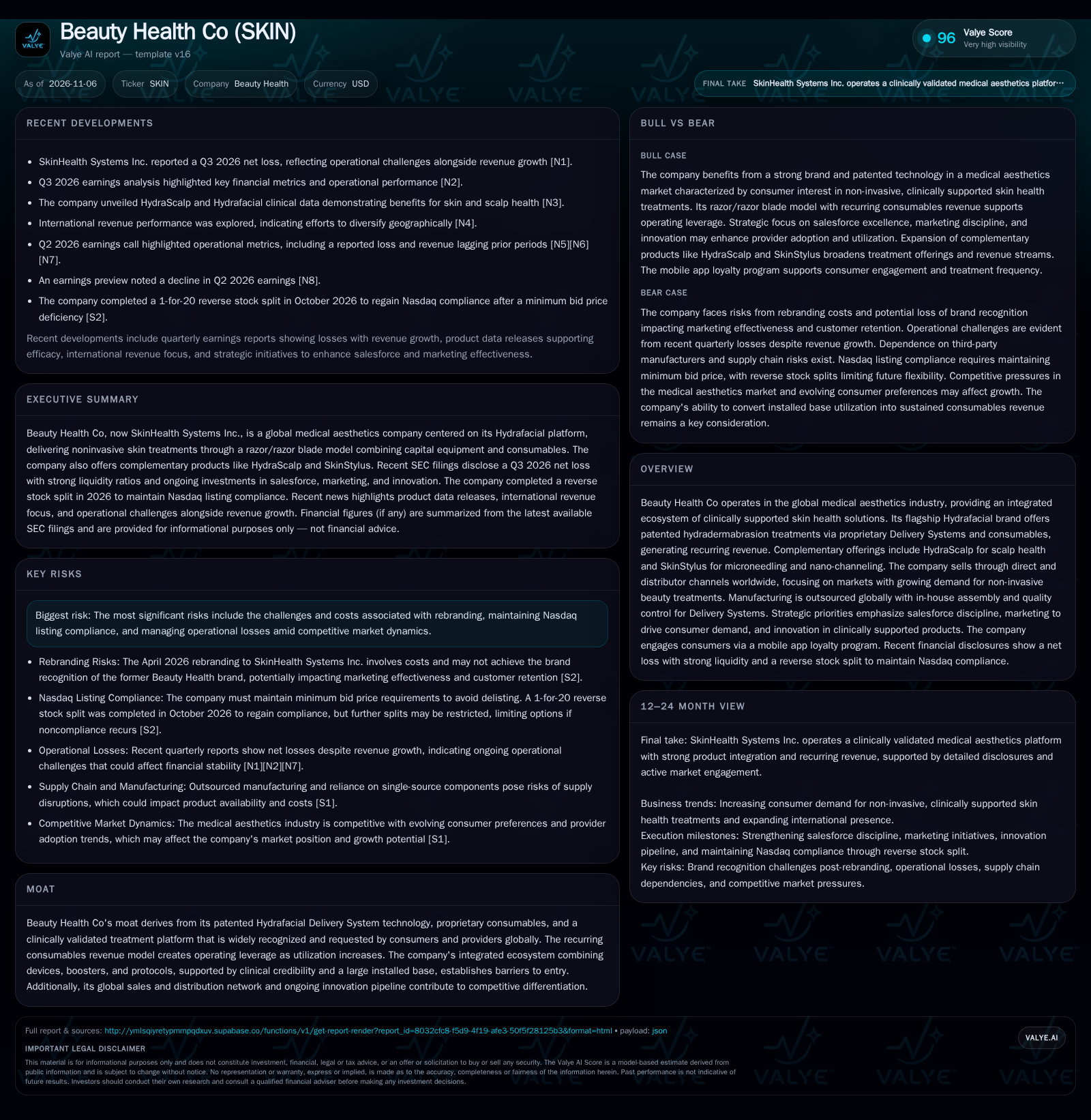
SkinHealth Systems, formerly Beauty Health Co, is contending with rebranding costs and ongoing losses but retains a defensible position through its clinically validated Hydrafacial platform and recurring consumables model. The company’s recent reverse stock split underscores the urgency of maintaining Nasdaq compliance amid market and operational pressures. Recurring revenue from consumables, global expansion, and product innovation could drive upside, but execution on provider adoption, brand transition, and cost discipline remains critical to realizing its potential. [S1] [S2] [N1]
SkinHealth Systems Inc. (formerly Beauty Health Co) stands at a critical juncture in the global medical aesthetics market. The April 2026 rebranding brings both opportunity and risk, as the company must balance the costs of transition with the need to sustain consumer and provider engagement. While the patented Hydrafacial platform continues to anchor a recurring revenue model through consumable sales, recent operational losses and the necessity of a reverse stock split to maintain Nasdaq compliance highlight the pressure for near-term execution. The company’s success hinges on its ability to convert its installed base and innovation pipeline into sustainable growth as it expands internationally and navigates a more competitive landscape. [S1] [S2] [N1]
Rebranding, Losses, and Nasdaq Compliance: The Critical Facts Shaping SkinHealth’s Trajectory
SkinHealth Systems Inc. (formerly Beauty Health Co) underwent a substantial rebranding in April 2026, incurring costs and potential risks to brand recognition and customer retention. This transition coincides with ongoing operational challenges: the company reported a net loss of $0.888 million and a basic/diluted EPS of -$0.14 for Q3 2026, even as it topped revenue estimates for the quarter. Liquidity ratios remain high, with a current ratio of 2.89 as of September 30, 2026, but persistent losses underscore the need for improved cost discipline. To address a minimum bid price deficiency, the company executed a 1-for-20 reverse stock split in October 2026 to maintain Nasdaq listing compliance, limiting future flexibility for similar remedies if share price pressure persists. [S2] [N1]
How the Razor/Razor Blade Model Drives Revenue and Margin Dynamics
SkinHealth’s core business model centers on selling capital equipment (Hydrafacial Delivery Systems) to providers, followed by recurring sales of proprietary consumables (single-use tips, solutions, serums). This creates a classic razor/razor blade dynamic: upfront revenue from device sales and higher-margin, recurring revenue from consumables as providers perform treatments. The key economic lever is installed base utilization—higher device adoption and more frequent use drive incremental consumables demand, which can generate substantial operating leverage if fixed costs are controlled.
Complementary product launches such as HydraScalp and SkinStylus broaden the potential revenue base, introducing new treatment categories and cross-selling opportunities. However, the company’s outsourced manufacturing model, while capital-light, introduces supply chain risks and could limit gross margin expansion if component costs rise or disruptions occur. Marketing and sales investments are necessary to drive both provider acquisition and end-consumer demand, but these costs must be balanced against the need to move toward profitability.
The company’s mobile app and loyalty program aim to increase consumer engagement and treatment frequency, potentially boosting consumables pull-through. The scalability of the consumables business is contingent on sustained provider adoption, patient retention, and the ability to introduce new, clinically validated boosters or protocols.
Defensible Technology, but Competitive Pressures Intensify in Medical Aesthetics
SkinHealth’s competitive advantage is anchored in its patented Hydrafacial technology, proprietary consumables, and clinical validation, which together create switching frictions for providers and encourage consumer loyalty. The installed base effect—where more devices in the field drive recurring consumables revenue—offers a structural moat if utilization remains high.
However, the medical aesthetics industry is highly fragmented and subject to rapid innovation, with competitors ranging from other device-based treatment platforms to topical skincare, injectables, and emerging noninvasive technologies. Many rivals offer their own device/consumable ecosystems or attempt to differentiate on clinical efficacy, price, or patient experience. Provider switching costs exist but may be mitigated if competitors offer compelling economics, superior outcomes, or bundled services.
International markets present both opportunity and risk: while geographic diversification can drive growth, local regulatory, reimbursement, and competitive dynamics vary widely. The company’s global direct and distributor sales model allows broad reach but could dilute margin if distributor terms are less favorable than direct sales.
Accelerated Installed Base Utilization and International Expansion Could Unlock Leverage
The most favorable scenario for SkinHealth involves rapid growth in the installed base of Hydrafacial and complementary devices, coupled with increasing utilization rates. If the mobile app loyalty program succeeds in driving patient frequency and providers are incentivized to promote high-margin boosters, consumables revenue could scale meaningfully, improving gross margins and operating leverage.
International expansion may provide a second engine of growth if the company can navigate regulatory hurdles and tailor marketing to local consumer preferences. Successful launches of new products like HydraScalp and SkinStylus could further diversify revenue and entrench the company’s ecosystem with providers.
Evidence confirming this scenario would include sequential increases in consumables sales outpacing device placements, rising average revenue per provider, improved gross margins (if disclosed), and sustained international revenue growth. A return to profitability and organic market share gains in core and new markets would further validate the upside case.
Balancing Revenue Growth with Margin Pressure During the Brand Transition
The most plausible near-term outcome is continued revenue growth from both devices and consumables, but with margin pressure as marketing and sales investments rise to support the rebranding and international initiatives. Operational losses may persist as the company absorbs rebranding costs and seeks to defend or grow its installed base amid competitive pressure.
Consumables revenue is likely to remain the primary driver of operating leverage, but the pace of margin improvement will hinge on the company’s ability to convert device placements into higher utilization and repeat purchases. The brand transition may temporarily slow provider acquisition or consumer retention if marketing effectiveness dips.
Confirmation of this scenario would be steady (if not accelerating) consumables growth, stable or modestly improving gross margin (if disclosed), and operating losses that narrow over time as rebranding expenses abate. Warning signs would include flat or declining installed base utilization, slower international momentum, or repeated need for financial engineering (such as additional reverse splits) to maintain Nasdaq compliance.
Brand Erosion, Stagnant Utilization, and Margin Compression Threaten Platform Economics
Adverse outcomes could materialize if the rebranding fails to achieve sufficient market recognition, causing a decline in both provider adoption and patient engagement. If the installed base stagnates or utilization rates fall, consumables revenue could flatten, exposing the company to negative operating leverage due to its fixed cost base and ongoing marketing spend.
Intensifying competition—particularly from lower-cost or more innovative rivals—could compress pricing power, erode gross margins, or force costly promotions to retain providers. Supply chain disruptions or quality issues with outsourced manufacturing could further pressure margins and damage reputation.
Downside confirmation would include declining device placements, falling consumables sales, deteriorating gross or operating margins, and repeated regulatory or compliance issues (such as failing to meet Nasdaq requirements).
Testing the SkinHealth Thesis: Metrics That Will Reveal Platform Trajectory
Installed base growth: Quarterly device placements, both in core and international markets, would indicate provider adoption momentum (if disclosed).
Consumables revenue as a percentage of total revenue: A rising share would confirm increased utilization and recurring revenue strength (if disclosed).
Average revenue per provider or per installed device: This would help assess utilization trends and upsell effectiveness (if disclosed).
Gross margin progression: Improvement would signal scaling benefits and pricing discipline, while declines could flag competitive or supply chain pressures (if disclosed).
Net income trajectory and pace of operating loss reduction: Progress toward profitability is critical to sustaining market confidence.
Consumer engagement metrics from the MyBeautyHealth app: Growth in active users, repeat treatment rates, and loyalty program uptake would test the impact of digital engagement (if disclosed).
International revenue growth rates: Acceleration would suggest successful geographic diversification and market fit.
Brand awareness and provider retention metrics post-rebranding: Survey results or retention rates would directly address the rebranding risk (if disclosed).
Disclaimer: This is research-only, informational analysis and not investment advice. It may include AI-generated interpretation and general industry context. Always verify important details using primary sources.

Comments