
NuScale Power: Commercialization Risks, Modular Promise, and the High Bar for Nuclear’s Next Wave
NuScale Power stands at a pivotal juncture as it transitions from engineering to commercialization of its small modular reactor (SMR) technology, with regulatory approvals and a reported cash position but facing skepticism over contract visibility and the scale of actual deployments. The company’s fortunes hinge on converting pipeline interest—especially from strategic partners and global energy demand—into signed, financed projects amid sector tailwinds and execution headwinds.
NuScale Power holds the only NRC-approved small modular reactor design and a cash-rich balance sheet following a $1 billion equity raise, but revenue fell in 2026 as a major engineering phase ended and no new customer contracts were announced. While U.S. and global policy strongly favor nuclear expansion, especially for AI-driven and data center energy demand, the company’s future depends on its ability to secure and execute multi-unit deals with anchor customers like ENTRA1/TVA and RoPower. Commercialization, contract execution, and cost discipline are the key swing factors as the SMR market moves from hype to proof.
NuScale Power has reached an inflection point: The company’s advanced small modular reactor design is fully approved by U.S. regulators, and it boasts a formidable reported cash balance after a major equity raise. Yet, the transition from engineering showpiece to commercial reality is proving challenging. Revenue fell in 2026 as its flagship Romanian project entered a lull, and investors are increasingly focused on whether NuScale can convert interest and partnerships into binding, financed orders for multi-module SMR deployments. The business now faces the quintessential dilemma of cutting-edge energy tech: how to turn regulatory and technical milestones into tangible, profitable growth in a capital-intensive, risk-averse sector.
NuScale’s Cash Strength, Regulatory Lead, and Contract Gaps Shape the Near-Term Outlook
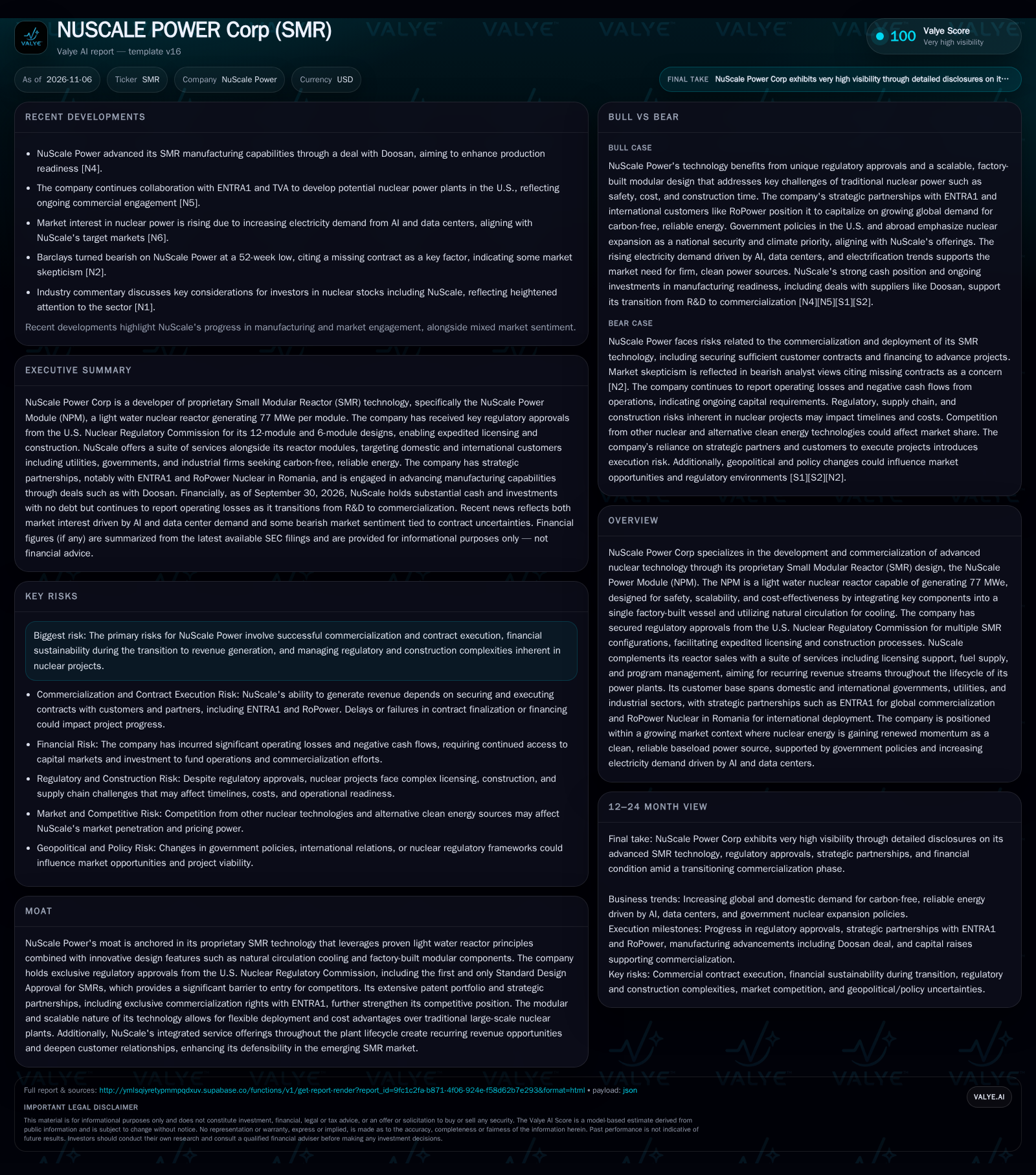
NuScale Power’s current position is defined by a unique combination of technical achievement and commercial uncertainty. It is the only company with a U.S. Nuclear Regulatory Commission Standard Design Approval for an SMR, now covering both 12-unit and 6-unit configurations, which should enable more streamlined project licensing and construction [S1]. Financially, NuScale reports over $900 million in cash and investments and no debt as of September 2026, thanks to a $1 billion at-the-market equity raise earlier in the year [S2]. However, the company’s 2026 revenue declined as a major engineering phase for its Romanian customer (RoPower) concluded, and it continues to post significant net losses with elevated R&D spend [S2]. Critically, no new signed contracts for multi-unit SMR plants have been reported, with public market skepticism now centered on the absence of such deals despite strong policy support and a growing global pipeline [N2].
Modular Reactor Economics: Factory Scale, Recurring Revenue Hopes, and Capital Realities
NuScale’s business model is built on the promise of factory-built, scalable nuclear power. Its NPM units are designed to be manufactured centrally, shipped to sites, and assembled into 6- or 12-module plants, theoretically reducing construction risk, time, and cost compared to traditional gigawatt-scale reactors. The up-front economics hinge on securing large, financed orders, with each plant representing a multi-billion-dollar capital commitment typically involving government, utility, or industrial customers. While the unit economics could benefit from production scale and standardized design, much depends on the company’s ability to move from bespoke engineering contracts to repeatable module sales.
On the revenue side, NuScale aims to layer in recurring service streams—including licensing, fuel supply, training, and program management—across the multi-decade lifecycle of its plants [S1]. This could eventually create annuity-like revenue if a critical mass of deployed modules is achieved. However, the current financial reality is dominated by R&D outlays, negative operating margins, and the need to continually raise capital until meaningful commercial deployments are realized [S2]. The capital intensity of nuclear means even a reported balance sheet position can be quickly consumed by delays or overruns, and the jump from engineering revenue to full-plant delivery is non-trivial.
Barriers, Substitutes, and the Challenge of Converting Pipeline to Market Share
NuScale’s competitive edge is grounded in regulatory first-mover status, a proprietary SMR design, and an extensive patent portfolio [S1]. Its NRC approvals give it a head start in the U.S. and a template for international acceptance, and the partnership model with ENTRA1 and RoPower illustrates its ability to attract credible counterparties. However, the landscape is rapidly evolving: Rival SMR vendors (both light water and advanced designs), large nuclear OEMs, and alternative clean technologies (renewables plus storage, advanced gas, hydrogen) all vie for the same decarbonization budgets.
Switching costs in nuclear are inherently high once a plant is committed, but pre-contract, customers face a plethora of options—and may hesitate to be first-mover on a new technology. The strategic logic of modularity and factory production could, if validated, create cost and schedule advantages. But until NuScale demonstrates successful, on-budget deployment at scale, the perceived risk premium for customers remains substantial. In parallel, the surge in AI and data center demand for clean firm power creates new opportunities, but also draws the attention of established conventional and renewable power players [N6] [N7].
Accelerated SMR Adoption: What Would a Commercial Breakout Look Like?
The most favorable scenario for NuScale involves rapid conversion of its project pipeline into signed, financed, multi-unit orders—particularly with anchor customers like ENTRA1/TVA in the U.S. and RoPower in Romania. Government policy momentum, especially the U.S. goal to quadruple nuclear capacity by 2050, would be matched by utility and industrial willingness to commit capital to SMR projects, potentially catalyzed by rising electricity prices and grid reliability concerns [S1]. Each successful deployment would de-risk the technology, drive learning-curve cost reductions, and create reference plants to spur further adoption.
Confirmation of this scenario would require public disclosure of new multi-module contracts with committed financing, ground-breaking on new sites, and evidence of on-schedule, on-budget execution. Early recurring service revenue, progress payments, and growth in the order backlog (if disclosed) would support the thesis. If NuScale can deliver its first plants with minimal delays and cost overruns, the company could establish itself as the potentially leading standard for SMRs, benefiting from network effects and policy tailwinds.
From Milestones to Momentum: A Measured Progression Amid Industry Complexity
The most plausible near-term scenario is one of gradual progress, marked by continued engineering work, deepening partnerships, and incremental demonstration of manufacturing and licensing capabilities. NuScale’s existing cash reserves and regulatory approvals buy it time to pursue further deals, but the pace of commercial contract conversion is likely to remain slow given the capital intensity and inherent conservatism of the nuclear sector.
In this scenario, the company may secure additional pre-construction agreements, memoranda of understanding, or early-phase contracts, but full-scale, financed plant orders could remain elusive in the near term. Revenue would be volatile, dependent on the timing of engineering milestones and service delivery, while operating losses persist as R&D and commercialization costs continue. Evidence for this scenario would include additional project announcements (even if not yet fully financed), continued progress on manufacturing partnerships (such as with Doosan), and modest growth in the company’s customer pipeline. Falsification would come from either a breakthrough contract announcement (tilting to upside) or evidence of partner/customer attrition and mounting cash burn (tilting to downside).
Execution Delays, Contract Drought, and the Risk of Capital Erosion
The most adverse scenario features prolonged difficulty in converting pipeline interest into binding, financed orders, leading to persistent revenue shortfalls and accelerating cash burn. Failure to land a flagship multi-module contract—especially in the U.S. with ENTRA1/TVA or internationally with RoPower—would cast doubt on the commercial viability of NuScale’s SMR offering and could erode customer and partner confidence [N2].
In this outcome, delays in manufacturing readiness, regulatory bottlenecks in other jurisdictions, or escalating project costs could further discourage new buyers. The absence of recurring service revenue and a shrinking engineering backlog would exacerbate operating losses. Confirmation would come from further declines in backlog or pipeline updates (if disclosed), lack of new contract announcements, and disclosure of cost-cutting, restructuring, or additional capital-raising actions. A deteriorating cash position without offsetting growth in commercial orders would be a key warning sign.
Milestones That Will Determine NuScale’s Transition from Promise to Profit
Announcement of new signed, financed multi-module SMR contracts with anchor customers such as ENTRA1/TVA or additional international partners.
Ground-breaking or start of construction at the first U.S. or international NuScale SMR plant site.
Updates on manufacturing progress and capacity expansion with suppliers, including tangible output from the Doosan partnership.
Trends in cash burn and operating expense, especially relative to disclosed cash reserves and capital raise timing.
Disclosure (if any) of recurring service revenue streams or growth in the company’s project backlog/order book.
Evidence of cost or schedule overruns—or, conversely, on-time, on-budget project execution for early deployments.
Any changes in nuclear policy or regulatory frameworks that would accelerate or delay SMR adoption in target markets.
Customer or partner attrition, renegotiations, or public statements indicating wavering commitment to NuScale-powered projects.
Disclaimer: This is research-only, informational analysis and not investment advice. It may include AI-generated interpretation and general industry context. Always verify important details using primary sources.

Comments