
EverCommerce: Vertically-Tailored SaaS at Scale—AI Integration, Payment Opportunity, and the Next Phase of SMB Digitalization
Now serving over 745,000 service SMBs with a platform spanning home, health, and wellness verticals, EverCommerce is advancing its AI and payment-processing capabilities. The company’s recent pivot—divesting marketing tech, acquiring ZyraTalk, and posting positive net income—highlights a business model in transition and the stakes of scaling specialized SaaS for fragmented markets.
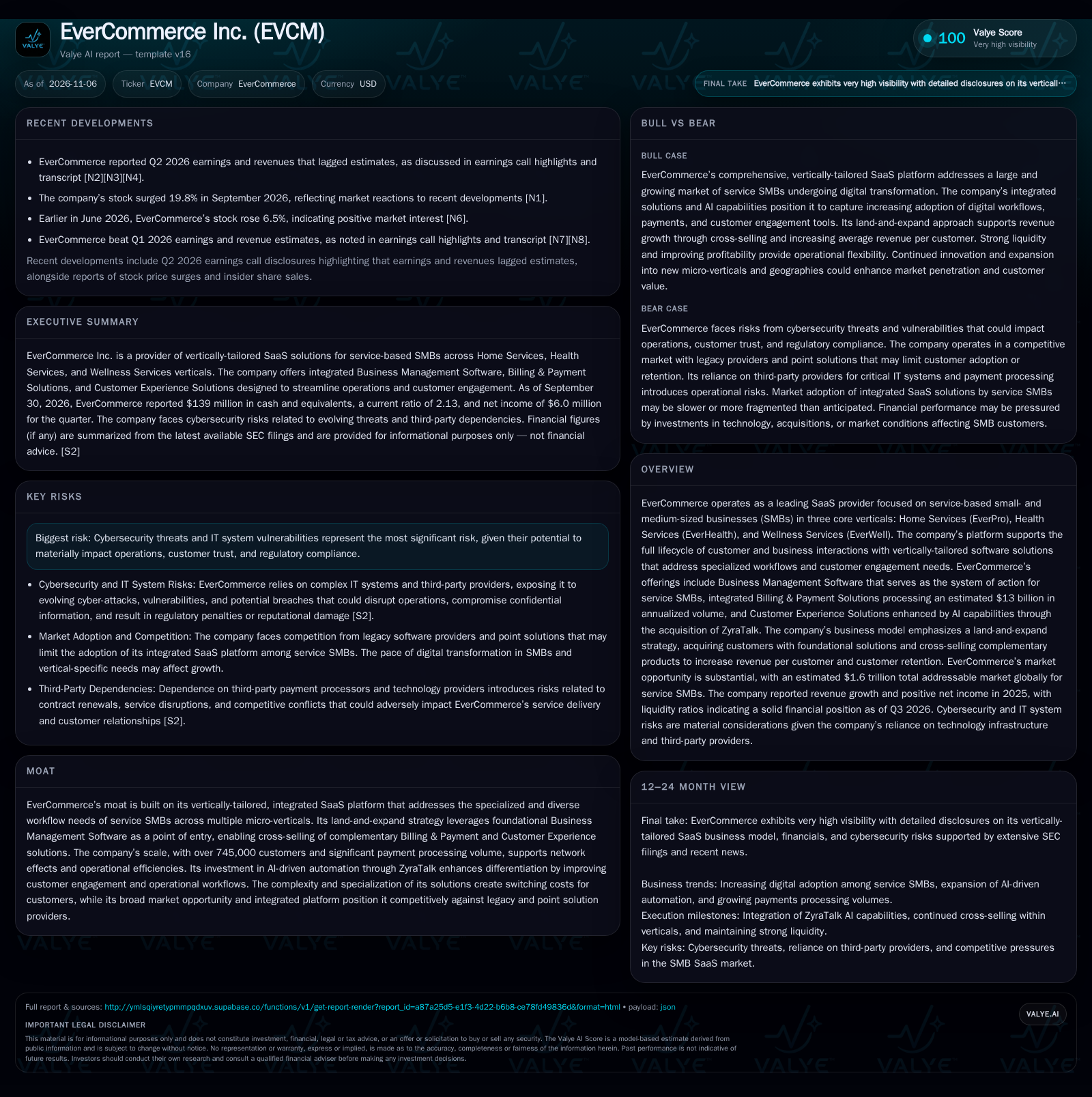
EverCommerce’s SaaS platform serves 745,000+ service SMBs with tailored software, payment, and customer engagement solutions. Recent moves—selling its marketing tech segment and acquiring AI-powered ZyraTalk—signal a focus on automation and core verticals. With 2025 revenue of $588.9M and a shift to net profitability, EverCommerce’s economics hinge on cross-selling, payment integration, and managing cybersecurity and third-party risks. The next phase depends on deepening wallet share, mitigating operational complexity, and proving sustainable expansion in a crowded SMB software landscape. [S1] [S2]
EverCommerce stands at a pivotal juncture as a scaled SaaS provider for service-based SMBs, having reoriented its business through divestitures and targeted AI acquisitions. With over 745,000 customers and a growing suite of vertically-tailored solutions, the company is leveraging automation and integrated payments to deepen its footprint across home, health, and wellness services. Achieving positive net income in 2025 signals operational progress, but the dynamics of high-volume, low-ticket SMB software, intense competition, and ongoing cybersecurity risks pose persistent challenges. The company’s ability to expand wallet share, execute on AI-driven differentiation, and realize its payment-processing ambitions will determine whether it can build durable economic advantage in a fragmented and rapidly evolving market. [S1] [S2]
Strategic Refocus, AI Integration, and Profitability Milestone
EverCommerce has taken significant steps to reshape its business in the past year: it divested its marketing technology solutions segment in October 2025, signaling a sharpened focus on its core vertical SaaS offerings. At the same time, the September 2025 acquisition of ZyraTalk brought AI-driven customer engagement to its Home Services vertical, with ambitions to expand automation benefits platform-wide. As of year-end 2025, the company served over 745,000 SMB customers, with a revenue mix heavily weighted toward small accounts—93% of customers generated less than $2,000 in annual revenue, while just 3% contributed more than $5,000. Financially, EverCommerce reported $588.9 million in revenue from continuing operations for 2025, with net income of $18.2 million—marking a return to profitability after previous losses. Adjusted EBITDA improved to $180.5 million for the year. The company’s liquidity position at September 30, 2026, included $139 million in cash and a current ratio of 2.13. These milestones matter because they reflect both a successful pivot to core strengths and the operational discipline required to profitably serve a fragmented, cost-sensitive SMB base while investing in next-generation technology. [S1] [S2]
SaaS Economics at Scale: Volume, Mix, and the Payments Upside
EverCommerce’s business model is predicated on high customer volume and relatively low average revenue per user, typical of SMB-focused SaaS. The company’s land-and-expand approach begins with foundational business management tools, then seeks to cross-sell billing, payments, and customer engagement solutions. This structure produces a high mix of small accounts with modest individual value but meaningful aggregate revenue. The company claims an estimated lifetime value of customers roughly six times the cost of acquisition, suggesting favorable cohort economics if churn remains manageable and cross-sell success continues. [S1]
A major economic lever is the integration of payment solutions: EverCommerce processes $13 billion in annualized payment volume, but estimates the addressable opportunity at over $100 billion. If the company can capture greater share of customer payment flows—either through increased adoption of its payment solutions or higher attach rates—it could drive higher-margin, transaction-based revenue and deepen customer stickiness. The company’s adjusted EBITDA margin (from continuing operations) improved from $164.4 million in 2024 to $180.5 million in 2025, indicating some operating leverage as the business scales. However, the cost base remains sensitive to ongoing technology investment (especially in AI and integration), customer acquisition, and the support burden of serving highly fragmented micro-verticals. [S1]
Capital needs are moderate for a SaaS business, but EverCommerce’s acquisition-driven history and requirement to support payment processing infrastructure mean that liquidity and access to capital remain relevant—especially if the company seeks to accelerate AI capability or enter new verticals.
Navigating Fragmented Markets and Specialized Rivals
EverCommerce operates in a competitive landscape defined by legacy software vendors, vertical-specific point solutions, and emerging integrated platforms. Its core advantage lies in delivering vertically-tailored, workflow-specific SaaS that addresses the nuanced needs of service SMBs—requirements that generic platforms or horizontal software often fail to meet. The company’s scale (over 745,000 customers) and breadth across home, health, and wellness services create some network effects and operational efficiencies, particularly in product development and cross-vertical learnings. [S1]
The recent integration of AI (via ZyraTalk) may provide a temporary differentiation edge in automating customer engagement and workflow tasks, but the durability of this advantage depends on execution and the pace at which competitors adopt similar technologies. Switching costs exist due to workflow integration and data migration friction, but these may be lower for SMBs than in enterprise settings. EverCommerce’s reliance on third-party payment processors and cloud providers introduces potential vulnerability if those partners change terms, experience outages, or enter the market directly. The most direct competitors are likely other vertical SaaS providers and niche point solution vendors, though broader horizontal platforms could target the segment if integration capabilities improve.
AI-Driven Automation and Payments Penetration Unlock Margin Expansion
A favorable scenario for EverCommerce unfolds if the company successfully leverages its AI-driven ZyraTalk acquisition to automate key SMB workflows—reducing manual workload, improving service provider productivity, and enhancing end-customer satisfaction. If AI-led automation boosts the perceived value of the platform, increases retention, and raises cross-sell rates for higher-margin payment and customer engagement solutions, EverCommerce could drive both revenue and margin expansion. The company’s large installed base creates a substantial opportunity for incremental monetization if adoption of new features is strong.
Confirmation of this scenario would come from accelerating average revenue per user, rising attach rates for payment and advanced engagement modules, and further improvement in adjusted EBITDA margin. Evidence of durable reductions in customer churn, robust net dollar retention, or case studies documenting quantifiable SMB productivity gains would further validate the thesis. Conversely, if AI integration fails to drive adoption or is rapidly commoditized, the margin and retention benefits could prove fleeting.
Sustained Growth Amid Execution Complexity
The most plausible trajectory for EverCommerce is steady, mid-single-digit revenue growth, incremental margin expansion, and ongoing operational complexity. The company’s platform should continue to attract new SMB customers in core verticals, with modest increases in wallet share through cross-selling and payment adoption. AI capabilities may enhance customer experience and reduce support costs, but are unlikely to deliver step-change economics without significant differentiation or broader adoption. [S1]
This scenario is confirmed if EverCommerce maintains or modestly improves its current customer base size, sustains positive net income, and continues incremental gains in adjusted EBITDA. Watchpoints include stable churn rates and evidence that the company can manage technology investment without eroding profitability. Falsification would come from stagnating customer acquisition, rising churn, or failure to improve operating leverage despite scale.
Cybersecurity Incidents, Churn, and Platform Complexity Erode Value
The primary risk to EverCommerce is a combination of cybersecurity incidents, operational failures in third-party IT systems, and rising customer churn. A major security breach or extended payment processing outage could damage the company’s reputation, trigger regulatory action, and accelerate customer attrition—especially among cost-sensitive SMBs with limited switching friction. If competitive pressure from nimble point solutions or well-capitalized horizontal platforms intensifies, EverCommerce could see pricing pressure and difficulty maintaining wallet share.
This downside scenario would be confirmed by reported breaches or outages, a sharp increase in churn or customer complaints, and/or a reversal to net losses or negative cash flow. Stagnant or declining payment processing volume, coupled with increased support and technology costs, would further signal deteriorating economics. A useful falsification would be continued resilience in customer metrics and successful mitigation of technology incidents.
Testing EverCommerce’s Thesis: Expansion, Adoption, and Resilience
Trends in average revenue per customer and attach rates for payment and AI-driven engagement solutions—if disclosed—would help gauge success in cross-selling and wallet share expansion.
Customer churn and net dollar retention rates, if released, would provide insight into the durability of EverCommerce’s customer relationships and the impact of new features.
Growth in annualized payment processing volume relative to the $13 billion baseline will indicate progress toward capturing a larger share of the SMB transaction opportunity.
Quantitative and qualitative disclosures on AI feature adoption and resulting workflow automation—such as reductions in SMB administrative time or improved service ratings—would validate the value proposition of recent technology investments.
Incidence, severity, and response to cybersecurity breaches or major IT outages, as disclosed in filings or news, will test the company’s operational resilience and risk management.
Evidence of ongoing profitability (net income and adjusted EBITDA margin) despite increased investment in product development and integration will signal sustainable economics.
Any material changes in third-party provider relationships (e.g., contract renewals, pricing, or outages with payment processors) should be monitored for impact on service delivery and cost structure.
If disclosed, cohort-level data on customer acquisition cost, payback period, and lifetime value would help test the claimed 6x LTV/CAC ratio and validate unit economics.
Disclaimer: This is research-only, informational analysis and not investment advice. It may include AI-generated interpretation and general industry context. Always verify important details using primary sources.

Comments