
Turtle Beach: Brand Leadership, Margin Pressures, and the Challenge of Gaming Accessory Cycles
Turtle Beach remains a top player in console gaming headsets and is expanding into broader peripherals, but faces volatile demand, shrinking margins, and rising costs amid a competitive and promotion-driven market.
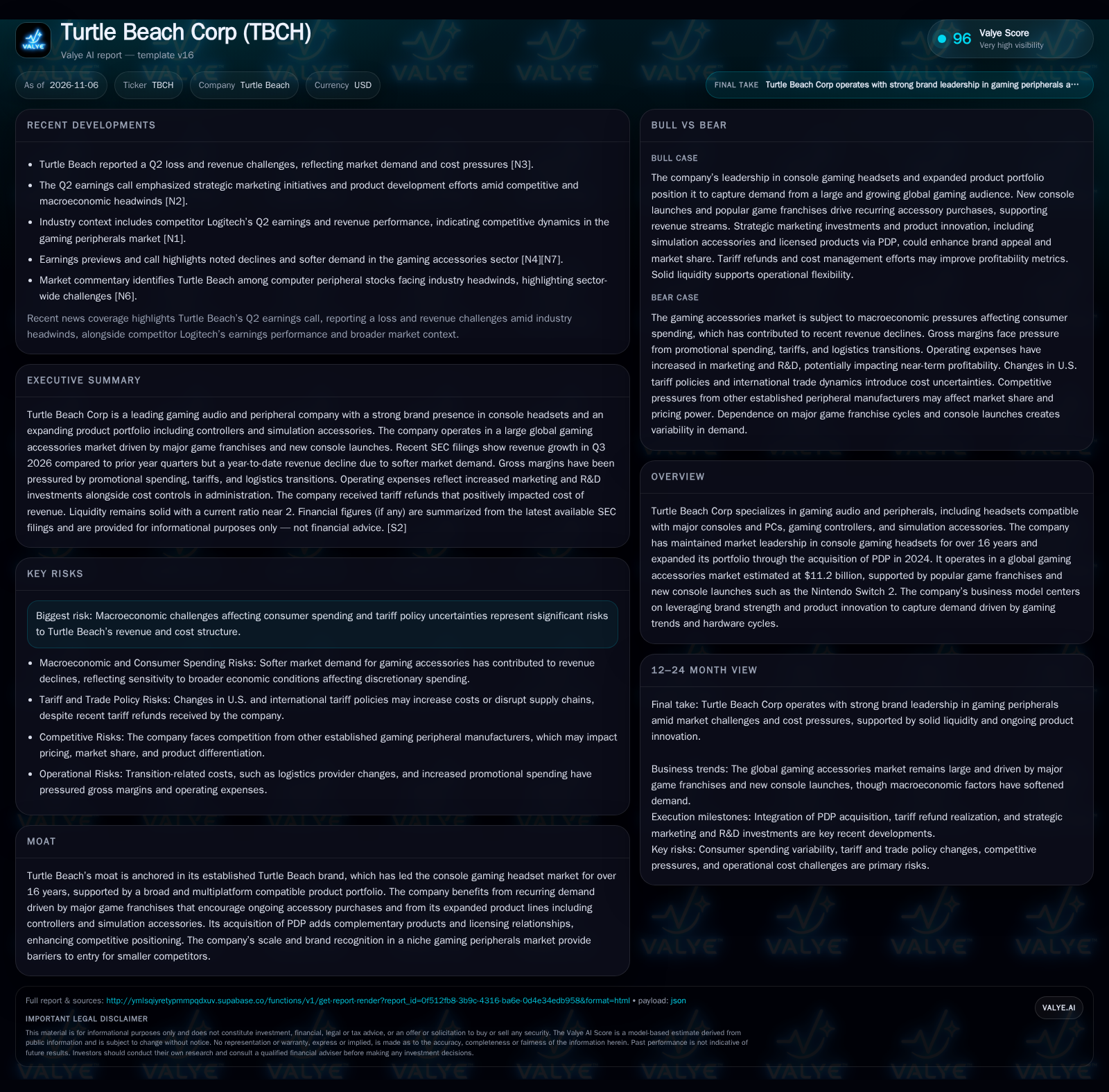
Turtle Beach reported Q3 2026 revenue growth year-over-year, yet its year-to-date sales remain down, with gross margins pressured by higher promotions and tariffs. The acquisition of PDP expands its product range and licensing reach, but the company must navigate a cyclical, highly competitive market where consumer demand and costs are increasingly unpredictable. [S2]
Turtle Beach Corp has long dominated the console gaming headset market, leveraging its brand leadership to expand into controllers and simulation accessories. Its recent acquisition of PDP strengthens its licensing and multiplatform presence, but the company now faces a market where promotional intensity and cost pressures have eroded margins. Despite a rebound in Q3 2026 revenue, year-to-date sales remain lower, highlighting the volatility of gamer-driven cycles and the challenge of maintaining profitability amid macroeconomic and competitive headwinds. The key question is whether Turtle Beach can translate its broadening product suite and brand recognition into sustained, profitable growth as market dynamics evolve.
Recent Results Highlight Growth Pockets—and Persistent Margin Squeeze
Turtle Beach posted net revenue of $84.7 million for the quarter ending September 30, 2026, representing a 5.3% year-over-year increase. This rebound, however, contrasts with a 9% year-to-date revenue decline, reflecting ongoing softness in consumer demand for gaming accessories. Gross margin fell to 34.9% in Q3, driven by increased promotional spending and the continued impact of tariffs. Operating expenses rose to $23.7 million in the quarter, with higher outlays for marketing and R&D, partially offset by administrative cost controls. The company benefited from $8.2 million in tariff refunds over the first nine months of 2026, which helped offset some cost pressures. As of September 2026, Turtle Beach reported $11.2 million in cash and equivalents, a current ratio of 1.94, and a cash ratio of 0.13. [S2]
How Revenue Is Won—and Margins Lost—in Gaming Peripherals
Turtle Beach’s business model is anchored in hardware sales—primarily headsets, controllers, and simulation accessories—distributed across retail, e-commerce, and distribution channels. Revenue growth is highly sensitive to hardware upgrade cycles, major game launches, and seasonal gifting periods. Pricing power is limited by intense competition and frequent promotions, which have recently deepened to stimulate demand. Margins are structurally vulnerable to shifts in promotional intensity, input costs (notably tariffs on imported electronics), and logistics expenses. Fixed costs center on product development and brand marketing, while variable costs are dominated by manufacturing, freight, and channel incentives.
The operating leverage potential is real but contingent on top-line momentum: gross margins can expand in periods of strong demand and when premium new products are introduced, but contract sharply when promotions are required or costs spike. The PDP acquisition adds scale and licensing relationships, which could offer some cost synergies and portfolio breadth, but integration costs and blended product mix may weigh on near-term profitability. Capital needs are moderate and typical for a consumer electronics company, with working capital requirements peaking around major launches and the holiday season.
Brand Equity and Portfolio Breadth: Are They Enough in a Crowded Field?
Turtle Beach has maintained a leading share in the console gaming headset segment for over 16 years, which provides both brand cachet and retail leverage. The expansion into controllers and simulation accessories through the PDP acquisition broadens its addressable market, but also increases direct competition with larger, diversified players such as Logitech and Razer as well as lower-cost brands and private labels.
The main sources of competitive differentiation are product quality, brand recognition, and multiplatform compatibility. However, these advantages are eroding as competitors invest aggressively in feature-rich products and as consumers become more price sensitive. The recurring nature of demand—driven by new game and console cycles—offers some revenue resilience, but also exposes the company to sharp swings in demand outside major launch windows. Licensing deals via PDP could help secure shelf space and attract franchise-loyal customers, but the cost and renewal terms of such licenses could compress margins if not managed tightly.
If Gaming Cycles and Product Innovation Align, Profitable Growth Could Resume
A favorable scenario would see Turtle Beach capitalize on the 2025 Nintendo Switch 2 launch and major franchise releases, driving a surge in headset and controller sales. If the company can leverage its PDP acquisition to introduce high-margin, licensed accessories that resonate with core gamers, it could both expand revenue and partially restore gross margins. Effective promotional targeting and supply chain execution would be key to capturing peak demand while minimizing cost overruns.
Confirmation would come from sequential revenue acceleration in quarters following major hardware and game launches, stabilization or improvement in gross margin despite heightened volumes, and evidence that new PDP-branded products are gaining market share. Falsification would be apparent if incremental revenue from new launches is offset by further margin erosion or if licensing costs outpace their revenue contribution.
Portfolio Expansion Offsets Demand Swings—But Margins Remain Under Pressure
A realistic baseline is that Turtle Beach maintains its leading share in headsets while using the PDP acquisition to modestly grow its presence in controllers and licensed accessories. Top-line results could remain volatile, tracking the ebb and flow of major game and hardware cycles. Margins are unlikely to fully recover in the near term, given persistent promotional activity and exposure to tariffs and logistics costs.
Evidence supporting this scenario would include relatively stable market share in core categories, moderate sequential revenue growth tied to marquee launches, and incremental improvements in operating efficiency. Signs that would challenge this scenario include accelerating share loss to lower-cost competitors or further increases in promotional spend required to maintain sell-through.
Sustained Cost Pressures and Weak Cycles Could Trigger Profitability Risks
The adverse case is that macroeconomic softening further dampens discretionary spending on gaming accessories, while promotional intensity escalates across the industry. If new hardware cycles underperform or if the PDP integration fails to deliver incremental revenue or cost synergies, Turtle Beach could face continued revenue declines and persistent margin compression. Rising input and logistics costs, combined with potential licensing fee escalations, could drive operating losses and erode cash reserves.
This scenario would be confirmed by consecutive quarterly revenue declines, further gross margin deterioration, rising operating losses, or warnings about working capital constraints. Conversely, any stabilization in margin or a successful cost containment initiative could mitigate the downside.
Signals That Will Test Turtle Beach’s Ability to Sustain Leadership and Profitability
Gross margin progression on both a quarter-over-quarter and year-over-year basis, especially in periods following major product launches, would help gauge pricing discipline and cost management.
Market share trends in core headset and new controller/accessory categories—if disclosed—would reveal whether the company is maintaining its leadership or ceding ground to rivals.
Revenue mix by product line and region would clarify the impact of portfolio expansion and international growth opportunities.
Promotional spend as a percentage of revenue—if disclosed—would provide insight into the intensity of price competition and its effect on profitability.
Integration milestones and financial contribution from the PDP acquisition, including the performance of licensed products, would be critical to assessing the success of recent strategic moves.
Tariff and input cost sensitivity: updates on supply chain costs, tariff refunds, or exposure to new trade policies would be important for forecasting future margin trends.
Operating expense trends, particularly in R&D and marketing, would indicate whether the company is investing for future growth or forced to retrench.
Disclaimer: This is research-only, informational analysis and not investment advice. It may include AI-generated interpretation and general industry context. Always verify important details using primary sources.

Comments