
Hanover Insurance Group: Earnings Surprises, Profit Variability, and the Economics of Risk Management
Hanover Insurance Group delivered Q3 2026 results ahead of expectations but reported a year-over-year profit decline, highlighting the delicate balance between underwriting gains and claims volatility in property and casualty insurance.
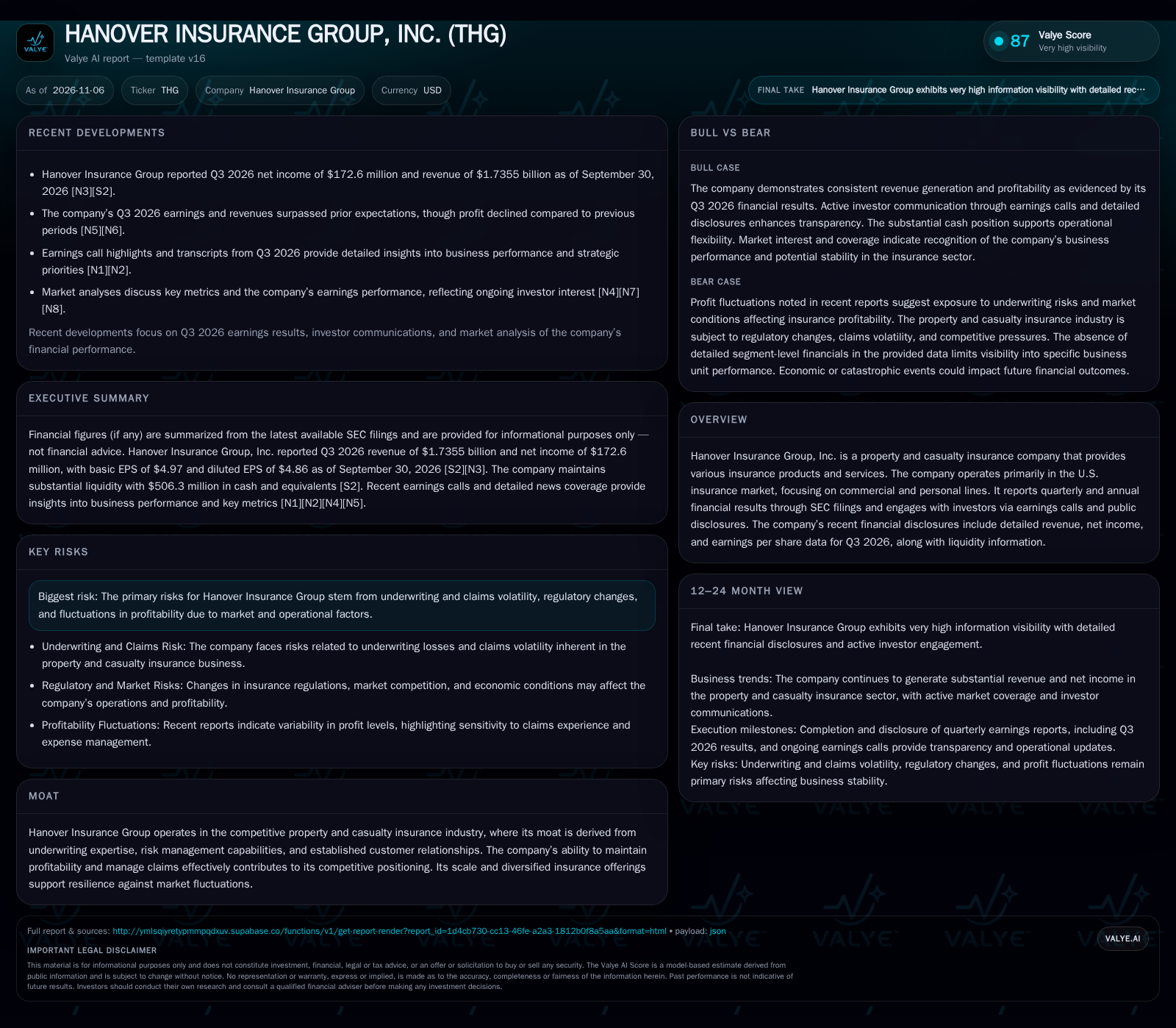
Hanover Insurance Group reported Q3 2026 revenue of $1.7355 billion and net income of $172.6 million, surpassing analyst expectations but reflecting a profit drop versus prior periods. The company maintains $506.3 million in cash and continues transparent investor communications. Future performance will hinge on underwriting discipline, claims trends, and navigating regulatory and competitive pressures in the property and casualty insurance market. [S2] [N3] [N5] [N6]
Hanover Insurance Group’s latest financials present a nuanced picture: Q3 2026 results beat analyst estimates on revenue and earnings, yet profit declined year-over-year, highlighting the persistent volatility and margin sensitivity inherent in property and casualty insurance. As the insurance sector faces shifting market conditions, Hanover’s next chapters will be shaped by its underwriting discipline and capacity to adapt.
Earnings Outperformance and Profit Decline Define Recent Results
Hanover Insurance Group reported Q3 2026 revenue of $1.7355 billion and net income of $172.6 million, with diluted EPS of $4.86. These results exceeded analyst expectations for both top and bottom lines, but the company also experienced a decline in profit compared to prior periods. The cash and cash equivalents balance was $506.3 million as of September 30, 2026. The company maintained active investor engagement through earnings calls and detailed public disclosures, reflecting a commitment to transparency. This combination of beating expectations while seeing profit pressure highlights the complex interplay between growth, risk, and margin management in the insurance sector. [S2] [N3] [N5] [N6]
How Underwriting and Risk Selection Drive Hanover’s Economics
Hanover’s core economics are determined by its underwriting discipline, pricing strategy, and ability to manage claims costs across its portfolio of property and casualty products. Revenue is primarily generated through premiums collected from commercial and personal lines customers, with investment income from float providing an additional, though often volatile, income stream. Profitability is highly sensitive to loss ratios (claims paid as a percentage of earned premiums) and expense ratios (operational costs relative to premiums).
Fixed costs include personnel, regulatory compliance, IT systems, and distribution infrastructure, while variable costs are driven largely by claims and commissions. Operating leverage can materialize when premium growth outpaces fixed cost increases, but this leverage is quickly eroded by spikes in claims frequency or severity, as often seen after natural catastrophes or adverse litigation trends.
Capital requirements are significant due to regulatory mandates and the need to maintain reserves for potential claim payouts. The company reported cash and liquidity metrics for the period; these figures do not by themselves establish operating runway, investment capacity, financial flexibility, or financing capacity. Sustained profitability depends on pricing risk accurately, maintaining underwriting discipline, and controlling loss costs in a competitive market.
The interplay between underwriting discipline and risk selection is further complicated by the evolving nature of risk exposures, including emerging perils such as cyber threats and climate change impacts. These factors introduce uncertainty into loss forecasting models, necessitating continual refinement of actuarial assumptions and pricing algorithms. Moreover, the balance between premium adequacy and market competitiveness requires Hanover to dynamically adjust its risk appetite and product offerings in response to shifting customer needs and competitor actions. The effectiveness of reinsurance arrangements also plays a critical role in buffering volatility, but these come at a cost that must be factored into overall profitability analysis.
Competitive Forces in Property and Casualty Insurance: Scale, Expertise, and the Battle for Margin
The property and casualty insurance sector is intensely competitive, with players ranging from large national carriers to specialized regional insurers and insurtech entrants. Hanover’s competitive positioning relies on established distribution relationships, underwriting expertise, and its ability to offer a diversified mix of commercial and personal lines products. Scale can confer advantages in negotiating reinsurance, spreading risk, and investing in technology for claims and pricing analytics.
However, the sector faces persistent downward pressure on pricing due to competition, as well as threats from new entrants leveraging digital distribution and data-driven underwriting. Regulatory changes and capital requirements can further challenge profitability. Superior risk selection, customer retention through service, and effective claims management are critical to defending and growing share. The question is whether Hanover can sustain or improve its combined ratio in the face of these pressures.
In addition to scale and underwriting expertise, technological innovation increasingly defines competitive advantage in property and casualty insurance. Hanover’s ability to leverage data analytics, machine learning, and automation can enhance risk assessment precision, accelerate claims processing, and improve customer engagement. However, technology adoption demands upfront investment and organizational change, with benefits realized over a multi-year horizon. Competitive pressure from insurtech firms, which often operate with lower cost structures and agile digital platforms, may compel traditional insurers to rethink distribution models and underwriting workflows. Regulatory compliance complexity further differentiates players able to efficiently navigate evolving requirements while maintaining operational agility.
Margin Expansion Through Disciplined Underwriting and Favorable Claims Trends
A favorable scenario for Hanover would see continued premium growth, stable or improving loss ratios, and disciplined expense management leading to margin expansion. This could occur if the company’s underwriting models accurately price risk, claims frequency remains subdued, and competitive intensity does not force excessive rate cuts. Investment income could also provide incremental upside if interest rates remain favorable.
Confirmation of this scenario would be evident in sequential improvements in the combined ratio, rising net income, growth in book value per share, and positive commentary on claims experience in future earnings calls. A useful metric would be segment-level profitability, if disclosed, to verify where margin gains are being realized.
Navigating Cyclical Volatility While Maintaining Core Profitability
The most plausible path forward is that Hanover continues to deliver steady premium growth and maintains profitability, but with ongoing quarter-to-quarter volatility in net income due to claims experience and market conditions. The company’s established distribution and underwriting capabilities should allow it to defend its core book, but margin pressure from competitive pricing and occasional adverse claims development is likely to persist.
Evidence supporting this base case would include stable revenue growth, a combined ratio fluctuating within a typical industry band (e.g., 95-102%), and consistent investor communications emphasizing risk management and pricing discipline. Conversely, a spike in the loss ratio or a negative trend in reserve development would challenge this scenario.
Profit Erosion from Claims Surges, Rate Pressure, or Regulatory Shocks
Hanover’s downside risk centers on a combination of adverse claims trends (such as higher-than-expected catastrophe losses), inability to achieve adequate rate increases in a soft market, or regulatory changes that increase capital requirements or restrict pricing flexibility. These factors could drive up the combined ratio, erode net income, and potentially threaten capital adequacy.
Evidence of this scenario materializing would be a sustained increase in the loss ratio, negative reserve development, declining book value, or management commentary highlighting difficulty in passing through rate hikes. In such a scenario, the company could be forced to re-underwrite parts of its book, raise additional capital, or retrench from less profitable lines.
Evidence That Will Shape Hanover’s Risk/Reward Profile
Quarterly changes in the combined ratio (if disclosed), as this integrates both underwriting and expense performance.
Loss ratio and reserve development trends, which can signal emerging claims pressures or underwriting discipline.
Premium growth rates broken down by commercial and personal lines, if available, to assess where momentum or risk concentrations lie.
Commentary or disclosure on reinsurance costs and coverage, indicating risk transfer strategy and exposure to large losses.
Investment income trends and asset allocation, as shifts here can materially affect bottom-line results in a low-yield or volatile market.
Regulatory or legal developments affecting capital requirements, pricing flexibility, or claims adjudication processes.
Disclaimer: This is research-only, informational analysis and not investment advice. It may include AI-generated interpretation and general industry context. Always verify important details using primary sources.

Comments