
Innodata’s AI Lifecycle Ambition: Sustainable Growth or Platform Plateau?
Innodata’s 12-quarter growth streak, expanding Federal Practice, and strong Q3 profitability frame a compelling narrative in AI data engineering. But as competition intensifies and the market pivots toward ever-higher evaluation and safety standards, the company’s ability to scale its differentiated offering—and defend its economics—faces new tests.
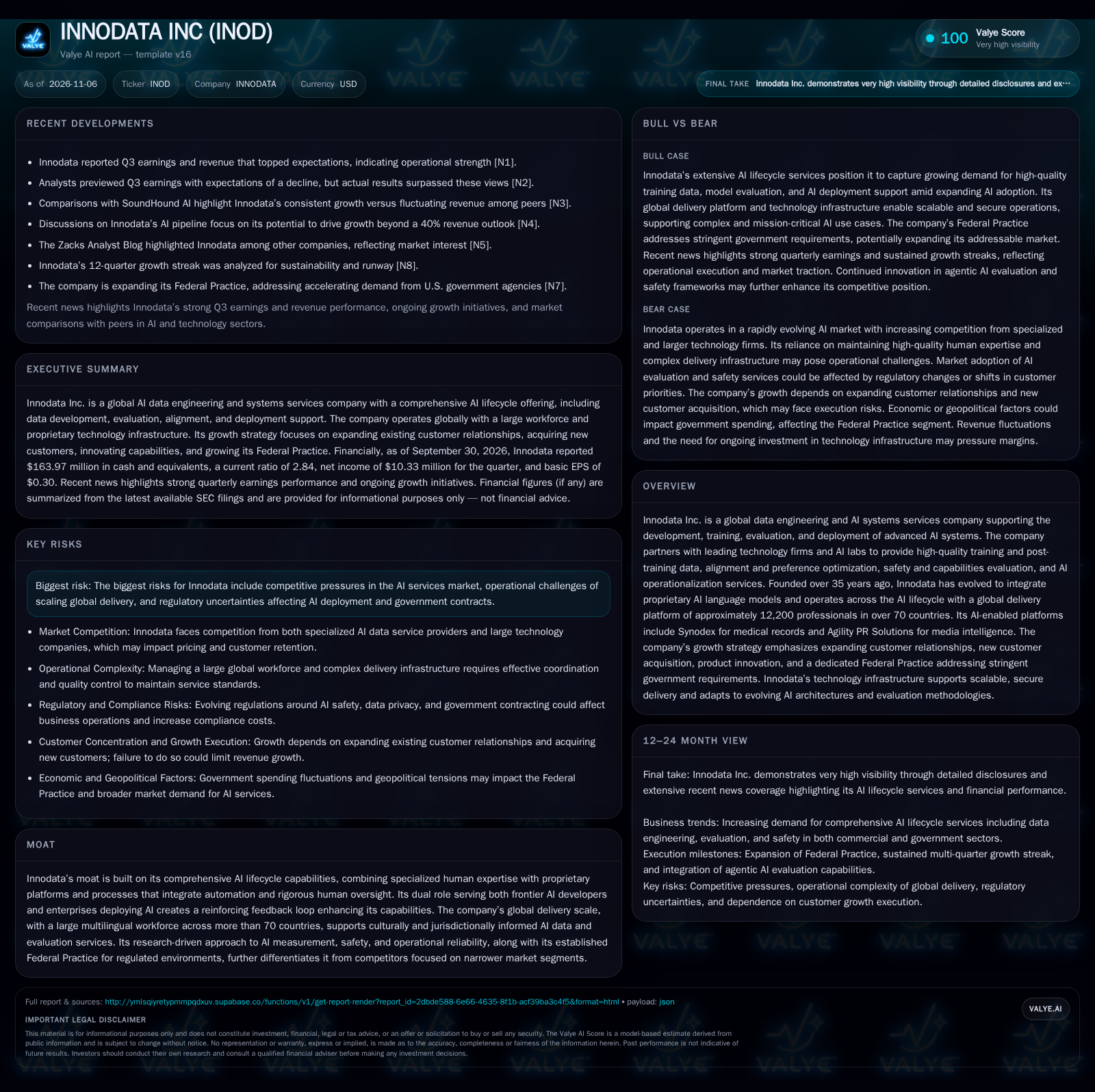
Innodata continues to outperform expectations with consistent growth, robust earnings, and a deepening footprint in both commercial and government AI services. Its end-to-end position across the AI lifecycle and multinational delivery platform support strong revenue momentum, but the future will hinge on sustaining innovation, defending margins, and navigating an evolving regulatory and competitive landscape. [S1] [S2] [N1] [N4] [N8]
Innodata Inc. is navigating a rare confluence of operational momentum and strategic opportunity. With a 12-quarter growth streak, Q3 2026 earnings that topped expectations, and a deepening push into government AI services, the company stands out in a sector defined by volatility and hype cycles. Its core bet: that the next phase of AI adoption will reward providers capable of delivering not just data, but rigorous evaluation, safety, and integration frameworks. Whether Innodata can maintain its trajectory as AI deployment standards rise and competitive intensity grows is now the central question for investors and partners alike. [S1] [S2] [N1] [N4] [N8]
Growth Streak, Federal Expansion, and Earnings Outperformance: What’s Changed in 2026
Innodata reported net income of $10.33 million for Q3 2026, with basic EPS of $0.30, exceeding consensus expectations and extending its 12-quarter growth streak—a notable achievement in an industry where peer revenue often fluctuates. This operational consistency is paired with ongoing expansion of its Federal Practice, as the company targets mission-critical U.S. government contracts with heightened requirements for data governance, security, and compliance. Recent news also highlights Innodata’s AI pipeline as a potential lever for revenue growth beyond a 40% outlook, underscoring investor and analyst focus on future scalability and sustainability. [S2] [N1] [N4] [N7] [N8]
How Innodata’s Model Converts AI Lifecycle Services into Profitable Growth
Innodata’s economics are shaped by its position as an AI data engineering and systems services provider, supporting the full spectrum from data curation and labeling to model evaluation, alignment, and deployment. Revenue is likely generated through a mix of project-based contracts, ongoing service agreements, and potentially platform usage fees—though the exact commercial mechanics are not disclosed. The integration of proprietary AI models into workflows and the use of purpose-built automation platforms suggest the potential for operating leverage, particularly as higher-margin evaluation and safety services scale. However, delivery remains labor-intensive: the company’s 12,200-strong workforce underpins multilingual and culturally informed services, which may limit margin expansion unless automation meaningfully offsets human resource costs. Capital needs are moderate compared to hardware-centric AI peers, but ongoing investment in technology infrastructure and compliance (especially for government contracts) could pressure free cash flow if not matched by pricing power or volume growth. The mix of commercial and government clients may also influence payment terms, contract duration, and revenue visibility, with public-sector work typically offering longer cycles but more stringent performance requirements.
Defensible Differentiation or Commoditization Risk? Innodata’s Place in the AI Services Value Chain
Innodata’s competitive position is anchored in its end-to-end AI lifecycle coverage, combining specialized human expertise with proprietary platforms and a research-driven approach to measurement and safety. This dual focus enables the company to serve both cutting-edge AI developers and enterprises deploying AI in regulated, high-stakes environments—a segment where requirements for explainability, evaluation, and compliance are highest. The global scale and multilingual capabilities offer a barrier to entry, particularly for clients needing culturally contextualized AI systems. However, the market is seeing rapid entry by both large technology firms (with greater capital and in-house capabilities) and specialized data/evaluation providers targeting niche verticals or geographies. If AI evaluation and safety increasingly become table stakes, differentiation may erode, putting pressure on pricing and retention. Conversely, Innodata’s track record of consistent growth and its Federal Practice suggest it remains ahead of many competitors on execution and trust, at least in the near term. The question is whether it can continue to innovate faster than the market commoditizes core services.
If AI Standards Tighten, Innodata’s End-to-End Offering Could Become Indispensable
A favorable outcome for Innodata would be driven by a convergence of regulatory pressure, customer demand for trustworthy AI, and rising standards for evaluation and safety. In such a scenario, the company’s integrated platform—spanning data production, model alignment, evaluation, and operationalization—becomes a one-stop shop for both tech majors and enterprises seeking to deploy responsible AI. Expansion of the Federal Practice could accelerate, as government agencies prioritize compliance and partner with established vendors. Operating leverage could improve if automation and proprietary tooling reduce the marginal cost of service delivery, while higher-value evaluation work lifts blended margins. Confirmation would come from sustained double-digit revenue growth, margin expansion, multi-year federal contract wins, and external validation (e.g., industry certifications or participation in regulatory pilots). Falsification would be signaled by decelerating growth, margin compression, or high-profile losses to larger competitors.
Sustained Growth, Margin Pressure, and Competitive Churn: The Most Likely Trajectory
The most plausible path is continued above-market growth, supported by a mix of expanding existing customer relationships, incremental Federal Practice wins, and ongoing innovation in AI evaluation and safety. However, as the market matures, pricing pressure from both large technology firms and aggressive new entrants may limit margin expansion, particularly in commoditized data preparation and annotation segments. Investment in technology infrastructure and compliance will remain necessary, capping free cash flow conversion even as revenue grows. The company’s ability to upsell higher-value evaluation and operationalization services will be critical to offsetting cost inflation and competitive churn. Evidence for this scenario includes steady revenue and earnings growth, a stable or modestly improving margin profile, and ongoing but not breakout success in federal and enterprise contracts. Evidence against would be abrupt shifts in customer retention, margin erosion, or failure to land new high-profile contracts.
When AI Services Become a Commodity: The Risks of Margin Erosion and Stalled Innovation
In the adverse scenario, the market for AI data and evaluation services becomes increasingly commoditized, with price competition intensifying from both global IT outsourcers and niche data shops. If automation advances rapidly, customers may shift to self-service platforms or in-house solutions, eroding Innodata’s value proposition. Regulatory or procurement changes could slow government spending, while failure to keep pace with evolving safety and evaluation standards could lead to lost contracts or reputational setbacks. Margin compression would accelerate if labor costs rise faster than automation can offset, or if new compliance requirements drive up overhead. Early warning signs would include revenue stagnation, negative operating leverage, contract losses to lower-cost competitors, and rising customer churn, especially in core commercial segments.
What Will Determine Innodata’s Next Phase of AI Services Leadership?
Pace of Federal Practice expansion, including new contract awards, pipeline disclosures, and the share of revenue from government clients.
Gross and operating margin trends, especially in relation to automation initiatives and the mix of high-value evaluation versus commodity data services.
Customer concentration metrics, if disclosed, to assess dependency risk and the sustainability of recurring revenue streams.
Churn rates and contract renewal/expansion activity among large technology and enterprise clients, as indicators of competitive defensibility.
R&D and technology infrastructure spending as a percentage of revenue, signaling ongoing investment in differentiation and automation.
Progress on industry certifications, regulatory partnerships, or participation in AI safety/evaluation standard-setting bodies.
Disclosure of platform adoption rates or usage metrics for proprietary tools and AI-enabled platforms like Synodex and Agility, if provided.
Any changes in government procurement policy or regulation that could impact the Federal Practice pipeline or contract economics.
Disclaimer: This is research-only, informational analysis and not investment advice. It may include AI-generated interpretation and general industry context. Always verify important details using primary sources.

Comments