
WillScot’s Recurring Revenue Model Confronts Utilization and Liquidity Pressures
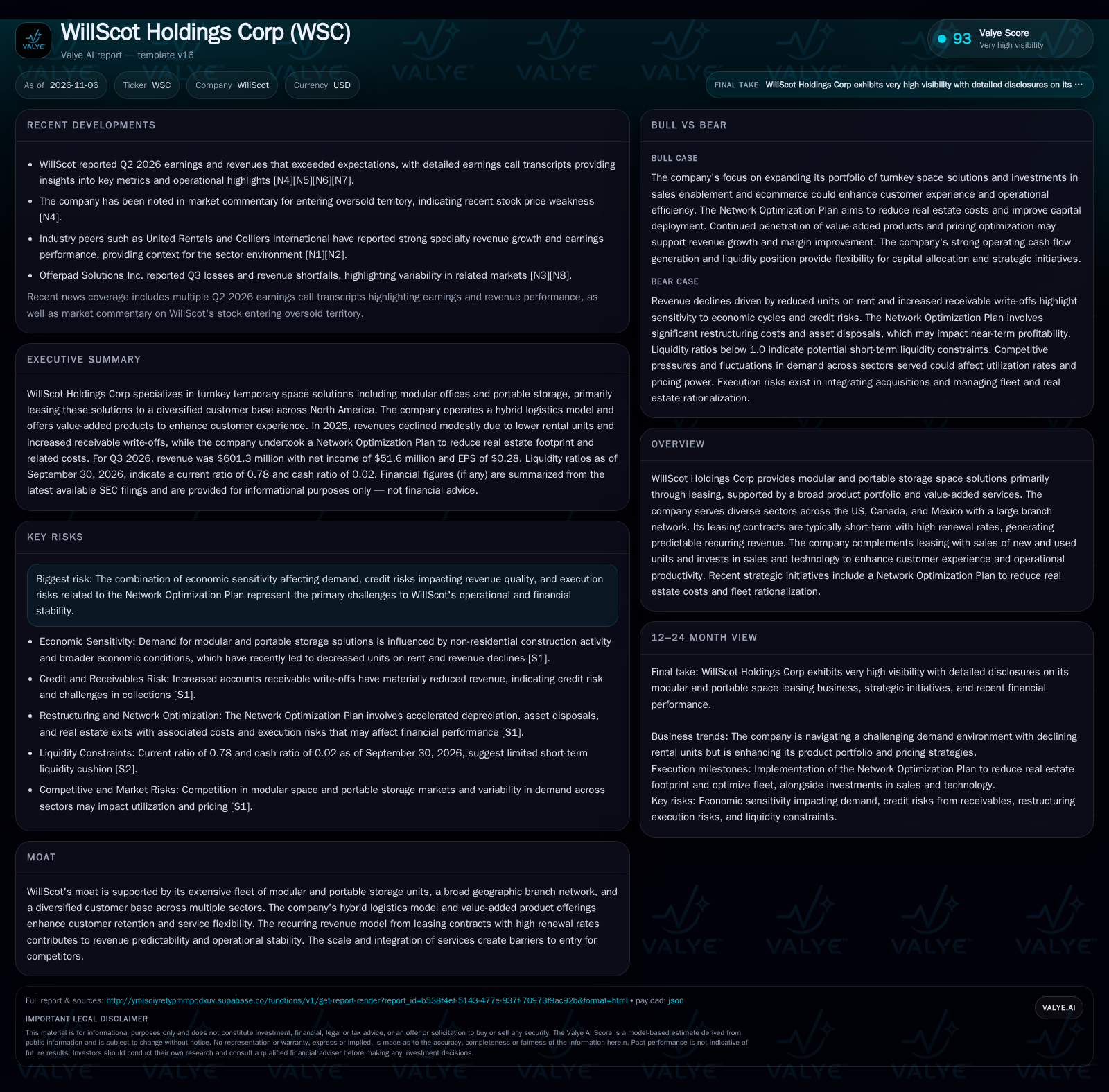
WillScot Holdings’ modular leasing model delivers robust recurring revenue, but recent declines in rental units and tight liquidity ratios highlight operational and financial pressures. The outcome of its Network Optimization Plan, VAPS penetration, and sectoral demand swings will determine whether the company can regain growth momentum or face deeper structural headwinds.
WillScot Holdings remains a leader in modular and portable space solutions, leveraging a predominantly leasing-based model with high renewal rates and broad geographic reach. Execution of the Network Optimization Plan and success in driving value-added product adoption are pivotal for stabilizing and expanding cash flows. [S1] [S2]
WillScot Holdings Corp’s modular leasing platform has long benefited from high renewal rates and a diversified customer base across North America. Yet, recent declines in units on rent and a sharp drop in leasing revenue signal mounting pressure from sectoral demand shifts and credit risks. As the company embarks on a major Network Optimization Plan to slim its real estate footprint and fleet, its ability to increase value-added product penetration and optimize pricing will be critical. [S1] [S2]
Utilization and Liquidity Trends Impacting WillScot’s Business Model
WillScot Holdings saw total revenues decline by 4.8% in 2025, with leasing revenue dropping 4.9% amid an 11.3% reduction in average units on rent. These declines were only partially offset by modest rate increases for both modular and storage units. Accounts receivable write-offs also weighed on results, highlighting credit risk in the customer base. The company reported a net loss of $53 million for 2025, largely due to $301.9 million in restructuring charges related to its Network Optimization Plan. The company reported cash and liquidity metrics for the period; these figures do not by themselves establish operating runway, investment capacity, financial flexibility, or financing capacity. [S1] [S2]
Modular Leasing: Recurring Revenue Dynamics and Capital Cycle Considerations
WillScot’s business is anchored in a leasing model where over 90% of new orders are standard leases, typically renewable month-to-month after initial terms, with an average effective lease duration of 42 months (excluding seasonal units). This structure creates a recurring revenue stream and operational predictability. Pricing leverage is evident in recent rate increases—4.9% for modular units and 7.5% for storage units in 2025—even as volumes declined. The company supplements leasing with sales of new and used units, which can help monetize idle assets and optimize capital deployment.
Value-added products (VAPS)—including furniture, appliances, connectivity, and security packages—offer incremental margin, as these are typically higher-margin, service-heavy add-ons to the core lease. The hybrid logistics model (mix of in-house and outsourced delivery, installation, and removal) enables WillScot to scale up or down with demand but also introduces variable costs and operational complexity.
Capital intensity is significant: fleet acquisition, maintenance, and branch infrastructure require ongoing investment. The Network Optimization Plan targets exiting 665 acres of real estate and disposing of $312 million in rental equipment over four years, aiming to rationalize costs and redeploy capital to higher-return areas. [S1] [S2]
Navigating Scale and Service Challenges in a Fragmented Modular Market
WillScot’s competitive moat is built on its large, diversified fleet, broad geographic footprint (about 260 branches plus drop lots), and a customer base spanning over 85,000 clients across all sectors. This scale provides logistical advantages, fleet flexibility, and route density, making it difficult for smaller competitors to match service levels or national coverage.
Value-added product penetration and integrated logistics deepen customer relationships and may raise switching costs, as clients increasingly rely on bundled solutions rather than just basic modular units. However, the industry remains fragmented, with regional and niche players competing aggressively on price and service customization, especially in cyclical end-markets like construction and events.
A key vulnerability is utilization: when demand softens, as seen with the 11.3% drop in units on rent, fixed fleet and branch costs can erode margins quickly. Substitutes—such as permanent construction or alternative space providers—can also pressure pricing, particularly when economic activity slows. The question is whether WillScot’s investments in e-commerce, sales enablement, and VAPS can offset these cyclical and competitive pressures by capturing more wallet share per customer.
Potential Growth and Margin Gains from VAPS Adoption and Network Enhancements
A favorable outcome for WillScot would see the Network Optimization Plan executed smoothly: the company exits underutilized real estate, redeploys capital from disposed fleet, and maintains core market coverage with less overhead. This could structurally lower fixed costs, improving margin resilience even if volumes remain below past peaks.
The other key upside lever is deeper VAPS penetration. If WillScot succeeds in bundling more value-added services into each lease, average revenue per unit could rise, partially offsetting lower unit counts. Improved sales force productivity and e-commerce adoption might accelerate this trend. A rebound in non-residential construction or new verticals (e.g., data centers, healthcare) could also reignite demand for modular solutions.
Confirmation for this scenario would be visible in rising VAPS revenue as a percentage of total leasing, stable or growing average revenue per unit, and evidence that the real estate/fleet rationalization is not eroding market share or customer satisfaction. Stronger operating cash flow and improved liquidity ratios would further validate a turnaround.
Execution and Market Recovery as Pillars for Revenue Stability
The most likely trajectory is for WillScot to stabilize revenues and margins as the Network Optimization Plan progresses, with moderate improvement in utilization if economic conditions recover. Leasing revenue may remain under pressure if end-market demand is sluggish, but pricing discipline and incremental VAPS adoption could limit downside.
Branch consolidation and fleet resizing should yield cost savings, but restructuring charges and asset disposals may continue to weigh on reported earnings in the near term. Liquidity could remain tight, especially if operating cash flow softens or if working capital needs rise with economic recovery.
This scenario would be confirmed by a flattening or modest rebound in units on rent, steady rate increases, and gradual improvement in adjusted EBITDA and free cash flow. Ongoing investments in technology and sales enablement would need to show tangible impacts on customer retention and wallet share to support a sustainable base case.
Financial Risks from Extended Demand Slumps and Operational Setbacks
If non-residential construction and other key sectors remain weak, WillScot could face further declines in units on rent, eroding the recurring revenue base. Should customer credit quality deteriorate, accounts receivable write-offs may rise again, directly impacting cash flow and earnings.
The Network Optimization Plan carries execution risk: if asset disposals and branch exits disrupt service or lead to market share losses, revenue could fall faster than costs can be cut. If VAPS adoption stalls or customers resist price increases, mix improvement may not materialize. Given the September 2026 current and cash ratios, any sustained cash burn or restructuring overruns could force asset sales at unfavorable terms or require external financing.
Negative customer feedback or market share loss to regional competitors would be additional warning signs.
Evaluating WillScot’s Revenue Stability Through Restructuring and Market Changes
Quarterly trend in average units on rent and effective lease duration: Sustained declines would signal persistent demand weakness.
VAPS revenue as a percentage of total leasing, if disclosed: Rising mix would confirm success in deepening customer relationships and offsetting volume headwinds.
Average revenue per leased unit and realized pricing: Increases would indicate pricing power and successful bundling of value-added services.
Progress on Network Optimization Plan milestones: Acreage exited, fleet disposals completed, and associated cost savings versus plan.
Accounts receivable write-offs as a percentage of revenue: Elevated or rising levels would highlight ongoing credit risk and collections challenges.
Adjusted free cash flow and operating cash flow trends: These will show whether margin and capital allocation improvements are translating to real liquidity gains.
Branch and market coverage metrics post-optimization: Evidence of maintained or expanded customer reach despite footprint reduction would support the thesis.
Customer satisfaction or retention rates, if disclosed: Deterioration here would suggest that optimization is harming long-term relationships and recurring revenue.
Disclaimer: This is research-only, informational analysis and not investment advice. It may include AI-generated interpretation and general industry context. Always verify important details using primary sources.

Comments