
Diodes Inc.: Acquisition Ambitions, Convertible Debt Complexity, and the Semiconductor Cycle’s Next Phase
The company’s next chapter hinges on integration outcomes, capital allocation, and the balance between operational momentum and financial engineering.
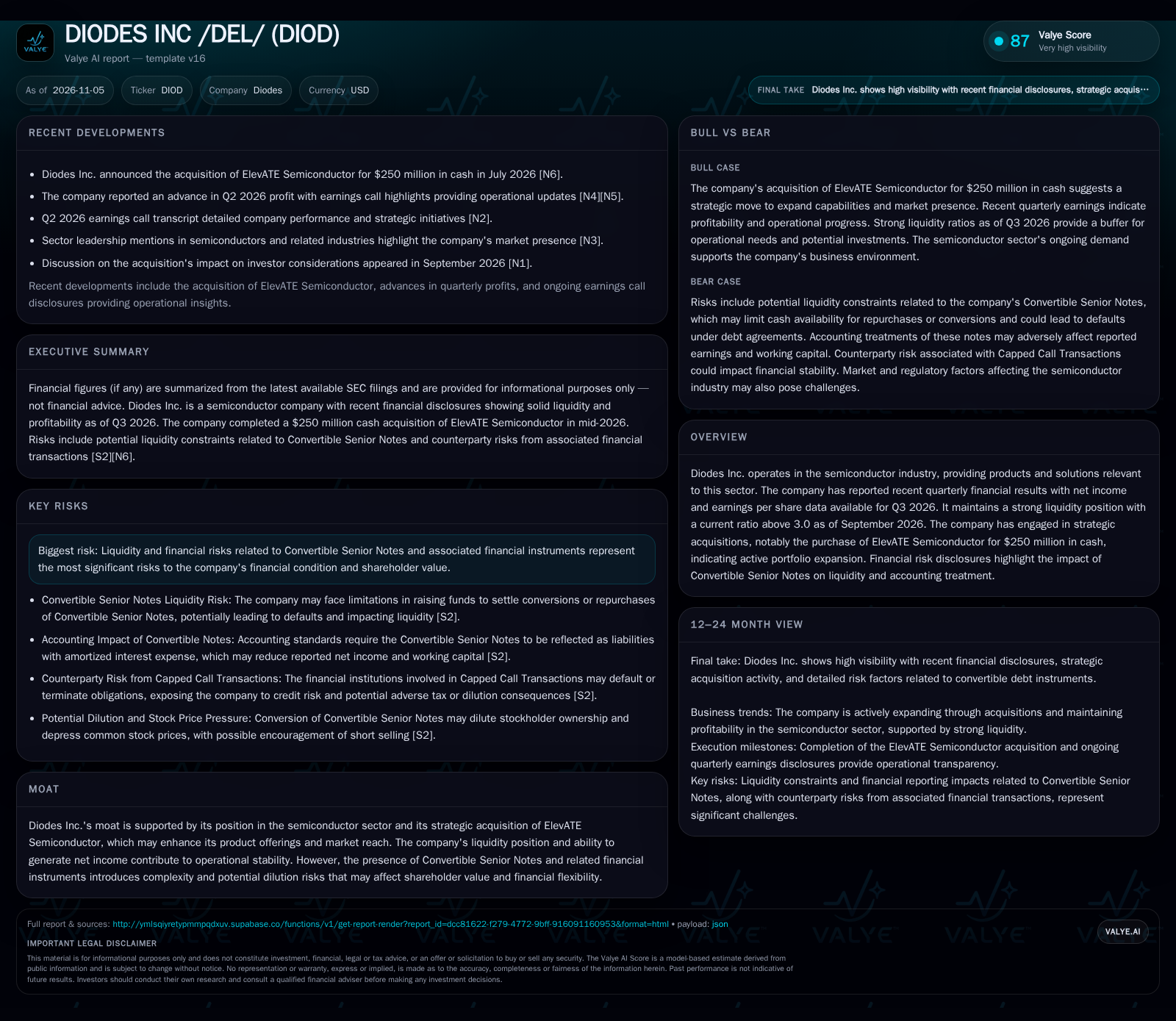
Diodes Inc. reported net income of $43.7 million for Q3 2026 and reported liquidity-ratio trends of 3.07, with $563.4 million in cash and equivalents. The company’s ability to translate acquisitions into durable growth while managing capital structure complexity will determine its medium-term trajectory. [S2] [N6]
Diodes Inc. enters late 2026 with a blend of financial strength, expansionist strategy, and structural risk. The company’s recent profitability and liquidity profile position it to capitalize on semiconductor industry opportunities, while the $250 million ElevATE Semiconductor acquisition demonstrates ambition to broaden its offering and market reach. The company’s ability to harmonize growth initiatives with prudent capital management will be tested as it integrates new assets and navigates sector cyclicality.
Recent Financial Performance and Strategic Moves Define Diodes’ Current Landscape
For the quarter ended September 30, 2026, Diodes Inc. reported net income of $43.7 million and basic/diluted earnings per share of $0.95, indicating continued profitability in a cyclical sector [S2]. The company reported cash and liquidity metrics for the period; these figures do not by themselves establish operating runway, investment capacity, financial flexibility, or financing capacity. [S2]
Diodes’ $250 million cash acquisition of ElevATE Semiconductor represents a notable strategic expansion, aimed at broadening its portfolio and potentially enhancing its competitive positioning in the semiconductor space [N6]. This acquisition marks a significant deployment of capital and signals management’s intent to pursue inorganic growth.
However, the company’s capital structure is complicated by the presence of Convertible Senior Notes with conditional conversion features. These instruments introduce risks around liquidity, potential shareholder dilution, and accounting volatility, as well as exposure to counterparty risk through associated Capped Call Transactions [S2]. The interplay between these financial maneuvers and operational execution will be critical to Diodes’ trajectory over the coming quarters.
How Diodes’ Core Economics Could Shift Post-Acquisition and Amid Debt Complexity
Diodes generates revenue by designing, manufacturing, and selling semiconductor devices—components that are typically sold into diverse end markets ranging from consumer electronics to automotive and industrial applications. The business model is characterized by high fixed costs (fabrication facilities, R&D, SG&A) and variable costs tied to production volume, with gross margins sensitive to product mix, utilization rates, and pricing cycles.
The company’s ability to maintain profitability, as shown in Q3 2026, suggests a degree of operating leverage—where incremental revenue growth can translate into proportionally larger gains in operating income once fixed costs are covered [S2]. However, the capital intensity of the sector means that Diodes must judiciously manage inventory, capital expenditures, and working capital, particularly as it absorbs a $250 million acquisition.
The ElevATE Semiconductor purchase could improve Diodes’ product mix, potentially enabling access to higher-margin or differentiated product categories. The realization of such synergies, however, depends on successful integration and cross-selling opportunities. Meanwhile, the presence of Convertible Senior Notes introduces additional capital management complexity. If Diodes is required to settle conversions or repurchases in cash, liquidity could be pressured, potentially affecting investment in R&D or further M&A [S2]. Accounting for these notes may also depress reported earnings due to amortized interest expense, clouding the underlying business performance.
Diodes’ Market Position: Portfolio Breadth, Scale, and the Shadow of Substitution
Within the semiconductor sector, Diodes faces competition from both diversified global players and focused specialty manufacturers. Its competitive position is influenced by product breadth, supply chain reliability, pricing discipline, and customer relationships. The acquisition of ElevATE Semiconductor may strengthen Diodes’ offering in niche or high-growth segments, potentially enhancing its ability to compete for design wins and long-term customer relationships [N6].
However, the sector is marked by rapid technology change, the threat of commoditization, and frequent pricing pressure. Larger competitors may benefit from greater scale, more advanced process nodes, or deeper customer integration. Substitution risk also looms large, as customers may switch to alternative suppliers or in-house solutions if Diodes cannot maintain technological relevance or cost competitiveness.
A potential advantage for Diodes lies in its liquidity position and demonstrated willingness to deploy capital for strategic acquisitions, which could provide room to outmaneuver less well-capitalized rivals during downturns or supply disruptions. Nonetheless, the complexity of its capital structure and the risk of dilution from convertible debt could weaken its appeal to long-term shareholders if not managed carefully.
If Integration and Capital Deployment Drive Sustainable Outperformance
A bullish scenario for Diodes would see the ElevATE Semiconductor acquisition delivering meaningful revenue and margin synergies—either through expanded product offerings, entry into new end markets, or enhanced customer stickiness. If Diodes successfully integrates ElevATE’s operations and leverages cross-selling opportunities, it could accelerate top-line growth and improve profitability, particularly if the acquired business operates in higher-margin or less cyclical niches.
Further, if semiconductor sector demand remains robust and Diodes maintains pricing discipline, the company could benefit from favorable operating leverage, driving EPS above current run rates. Prudent management of convertible debt—such as opportunistic repurchases or effective hedging of dilution risk—would reinforce confidence in capital allocation.
Evidence confirming this scenario would include: sequential improvement in gross and operating margins, disclosure of successful cross-selling or new customer wins tied to the acquisition, and clear communication or action on managing convertible debt exposure (e.g., early repayments, minimal dilution). A sustained or improved liquidity position post-acquisition would further validate the upside thesis.
Operational Progress Balanced by Financing Headwinds and Sector Volatility
The most plausible near-term scenario is one of steady operational performance with moderate growth, as Diodes integrates ElevATE and navigates the ongoing realities of the semiconductor cycle. Revenue and earnings may trend in line with recent quarters, supported by the company’s liquidity and established market presence but tempered by episodic pricing pressure and inventory corrections typical of the industry.
Integration of ElevATE may proceed smoothly at the operational level, but synergy realization could take several quarters, and the full financial benefit may be offset by amortization of acquisition costs and the drag from convertible debt-related accounting charges.
Confirmation of this scenario would come from stable or modestly improving revenue and profitability metrics, limited evidence of major integration setbacks, and continued transparency around debt management.
When Debt Complexity and Sector Headwinds Collide
In a negative scenario, Diodes could face a convergence of operational and financial pressures. A downturn in semiconductor demand—driven by macroeconomic weakness, inventory corrections, or customer destocking—would erode revenue and margins, potentially exposing high fixed costs and shrinking operating leverage.
At the same time, if the company is forced to settle a significant portion of its Convertible Senior Notes in cash (whether due to investor conversions or repurchase obligations), liquidity could become strained, particularly after the outlay for the ElevATE acquisition. This could force Diodes to curtail R&D, delay further investment, or seek additional financing under less favorable terms. The risk of dilution, pressure on the share price, and negative accounting impacts could further weigh on equity valuation.
Evidence for this scenario would include a sharp decline in cash and equivalents, a falling current ratio, missed or downwardly revised earnings guidance, and disclosures of forced or distressed debt repurchases. Signs of integration difficulties or customer attrition following the ElevATE deal would compound downside risk.
Tracking the Balance: What Will Determine Diodes’ Real Value Creation?
Gross and operating margin trends, especially post-acquisition, as a test of synergy realization and pricing discipline.
Quarterly cash and current ratio evolution, particularly if conversions or repurchases of Convertible Senior Notes accelerate.
Integration progress and qualitative disclosures around ElevATE Semiconductor—customer wins, cross-selling, and retention.
Updates on Convertible Senior Notes: conversion activity, repurchase terms, and management communication on dilution risk.
Evidence of counterparty performance or issues related to Capped Call Transactions, if disclosed.
Disclosures of R&D investment and product pipeline expansion, indicating continued innovation and competitiveness.
Sector demand signals and customer inventory trends, as leading indicators for potential revenue volatility.
Board or management commentary on capital allocation priorities—further M&A, debt reduction, or shareholder returns.
Disclaimer: This is research-only, informational analysis and not investment advice. It may include AI-generated interpretation and general industry context. Always verify important details using primary sources.

Comments