
Ultralife’s Strategic Crossroads: Acquisition Momentum, Battery Tech Depth, and the Stakes of Integration
Ultralife Corporation’s recent Electrochem acquisition and its pending $320 million sale to EnerSys signal a pivotal phase, as the company balances niche battery and communications technology leadership with the challenges of revenue volatility and integration risk. The outcome will hinge on realizing operational synergies and sustaining relevance in rapidly evolving end-markets.
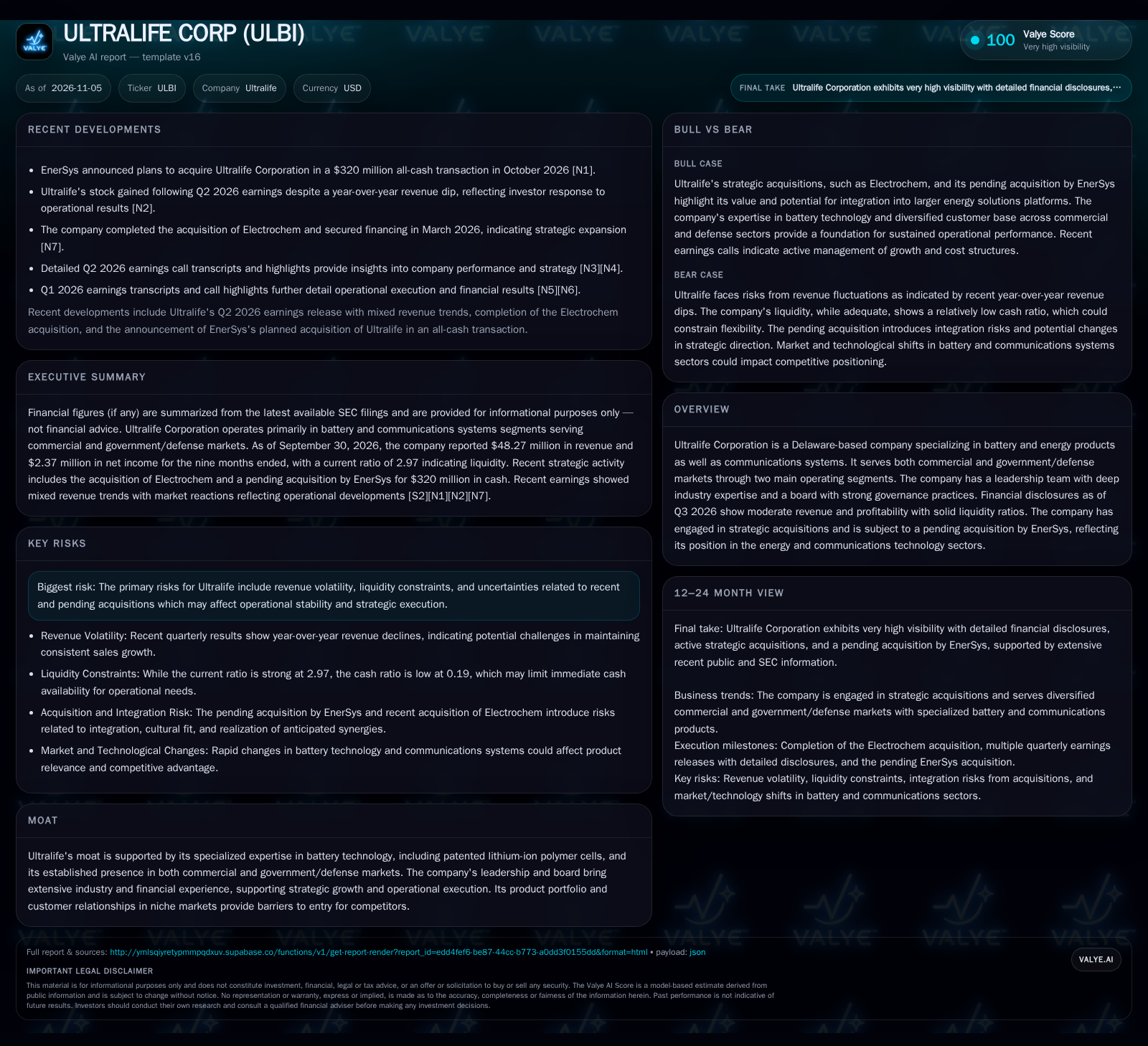
Ultralife has completed a strategic acquisition (Electrochem) and is itself the target of a $320 million all-cash buyout by EnerSys.Despite a recent year-over-year revenue decline, profitability remains positive, and the company maintains a reported current ratio. The core challenge is whether Ultralife can translate its specialized battery and communications expertise into durable value amid integration risk and fast-changing technology landscapes. [S2] [N1] [N2] [N7]
Ultralife Corporation stands at a decisive inflection point. With the March 2026 acquisition of Electrochem and an imminent $320 million all-cash buyout by EnerSys, the company is transitioning from a specialized battery and communications systems player to a potential linchpin within a larger industrial battery ecosystem. While recent financials show modest profitability and strong current liquidity, the real test will be whether Ultralife’s niche expertise and expanded portfolio can be leveraged—by itself or EnerSys—into sustained value in a market defined by technological disruption, cyclical government/commercial demand, and rising integration complexity. [S2] [N1] [N7]
Recent Acquisitions and Pending Buyout Redefine Ultralife’s Strategic Landscape
Three material developments now define Ultralife’s near-term outlook. First, the company completed its acquisition of Electrochem in March 2026, expanding its battery technology footprint and end-market reach. Third, EnerSys announced in October 2026 that it will acquire Ultralife in a $320 million all-cash transaction, subject to closing. These moves signal both confidence in Ultralife’s specialized assets and a transition toward integration into a larger battery solutions platform, with the attendant opportunities and risks. [S2] [N1] [N7]
How Ultralife’s Segment Structure and Capital Profile Shape Its Economic Engine
Ultralife generates revenue from two main segments: Battery & Energy Products and Communications Systems, serving both commercial and government/defense customers. The business is capital intensive, requiring ongoing investment in R&D and manufacturing, but also offers potential for operating leverage if scale is achieved, particularly through defense contracts or commercial design wins. The acquisition of Electrochem likely adds both high-value IP and manufacturing complexity, potentially improving gross margin mix if integration is successful.
Pricing power in battery products is typically modest outside of government/defense niches, where design-in cycles and reliability standards can create stickier revenue streams. [S2]
The capital intensity inherent in Ultralife’s operations also implies a sensitivity to macroeconomic factors such as interest rates and supply chain disruptions. If financing costs rise or component shortages persist, the company may face increased pressure on margins and investment timelines. Conversely, successful scale-up of manufacturing capabilities post-Electrochem acquisition could enable more predictable cost structures and improved bargaining power with suppliers. Moreover, the balance between R&D expenditure and commercialization efficiency is critical; excessive spending without timely product launches could strain cash flows, while underinvestment risks technological obsolescence in a rapidly evolving battery landscape.
Specialization Versus Scale: Ultralife’s Place in the Battery and Communications Ecosystem
Ultralife’s competitive edge historically derives from its expertise in advanced battery chemistries (including patented lithium-ion polymer cells) and its presence in defense and specialized commercial verticals. These niches offer higher barriers to entry and lower price competition than mass-market battery segments. However, the company faces ongoing pressure from larger battery manufacturers, contract electronics assemblers, and new entrants leveraging alternative chemistries or integrated energy solutions.
The pending integration into EnerSys suggests that scale and supply-chain leverage are increasingly important. EnerSys itself is a global player in industrial batteries, and its acquisition of Ultralife may reflect a desire to deepen technology offerings and expand into adjacent high-reliability markets. The question is whether Ultralife’s specialized offerings will retain their value and differentiation within a broader portfolio—or be commoditized by larger-scale operations.
Ultralife’s specialization in advanced chemistries and niche markets can be a double-edged sword. While it creates differentiation and higher entry barriers, it also limits the addressable market size relative to mass-market battery producers. The company’s competitive moat depends heavily on maintaining proprietary technology and deep customer relationships, particularly in defense sectors where certification and reliability are paramount. However, if broader industry trends favor integrated energy solutions or alternative storage technologies, Ultralife’s focus areas could face commoditization or displacement. The ability to adapt product offerings and innovate within these specialized verticals will be essential to sustaining competitive advantage post-integration.
Integration into a larger entity like EnerSys presents both opportunities and risks related to organizational culture and strategic focus. If EnerSys prioritizes scale and operational efficiency over niche innovation, there is a risk that Ultralife’s specialized R&D capabilities could be diluted or deprioritized. Conversely, access to EnerSys’s global supply chain and customer base could accelerate product development cycles and market penetration. The outcome will depend on alignment of strategic priorities and effective governance structures that preserve Ultralife’s technical autonomy while leveraging EnerSys’s resources. Monitoring shifts in R&D investment allocation and product roadmap decisions will provide insights into how this balance evolves.
Synergies and Market Expansion Could Unlock Step-Change Value
The best-case scenario for Ultralife (and EnerSys post-acquisition) is a seamless integration of Electrochem’s assets and Ultralife’s legacy portfolio, resulting in a broader product suite and deeper penetration of defense, medical, and industrial markets. If EnerSys leverages its global distribution and procurement scale to expand Ultralife’s addressable market, unit costs could decline and margins could improve.
Confirmation of this scenario would come from post-close disclosures of cross-selling wins, new multi-year contracts in defense or medical applications, and stable-to-rising gross margins. Falsification would be evident if integration costs spike, customer churn increases, or product development timelines slip, eroding the anticipated value of the combined entity.
Incremental Value Through Integration, but Execution Risks Remain Central
The most plausible outcome is that Ultralife’s core operations are folded into EnerSys with some incremental cost and revenue synergies, but with continued exposure to cyclical order patterns in both commercial and government sectors. Revenue may stabilize or grow modestly as EnerSys rationalizes overlapping functions and selectively invests in high-margin niches, but integration friction and the challenge of maintaining innovation velocity are likely to temper near-term gains.
Evidence supporting this scenario would include steady revenue contributions from legacy Ultralife contracts, successful retention of key technical staff, and modest margin improvement. Signs of a less favorable outcome would include post-merger customer attrition, delays in product launches, or stagnation in core segment revenues.
Integration Missteps or Market Disruption Could Undercut Strategic Value
A negative trajectory could emerge if integration with EnerSys proves more disruptive than anticipated, leading to operational disruptions, loss of niche customer relationships, or cultural clashes that sap innovation. Rapid shifts in battery technology or communications standards could also render parts of Ultralife’s portfolio obsolete, especially if R&D resources are diverted or spread too thin post-acquisition.
Confirmation would come from post-close write-downs, declining segment revenue, or public disclosures of lost contracts and delayed product introductions. If EnerSys shifts strategic focus away from Ultralife’s specialized markets, legacy value could be rapidly eroded.
Benchmarks That Will Reveal the Real Value of Ultralife’s Integration and Technology Bets
Post-acquisition revenue and margin trends for Ultralife’s legacy segments, especially in defense and medical verticals.
Retention and turnover rates among key engineering and technical staff after the EnerSys transaction closes.
Evidence of cross-selling or expanded distribution of legacy Ultralife and Electrochem products through EnerSys channels.
New multi-year contract announcements or renewals in the government/defense and high-reliability commercial markets.
Gross margin evolution following integration, as an indicator of cost synergy realization and pricing power.
Any public disclosure of integration-related costs, write-downs, or operational disruptions.
Product development and launch cadence—delays or cancellations would signal post-merger friction.
If disclosed, customer concentration metrics, to assess exposure to potential contract losses or renegotiations.
Disclaimer: This is research-only, informational analysis and not investment advice. It may include AI-generated interpretation and general industry context. Always verify important details using primary sources.

Comments