
CVD Equipment’s Strategic Reset: Asset Monetization and the Uncertain Economics of Shrinking Core Operations
Following its exit from new equipment system orders and a major restructuring, CVD Equipment Corp is liquidating assets and refocusing on lower-margin spare parts, quartz, and services.
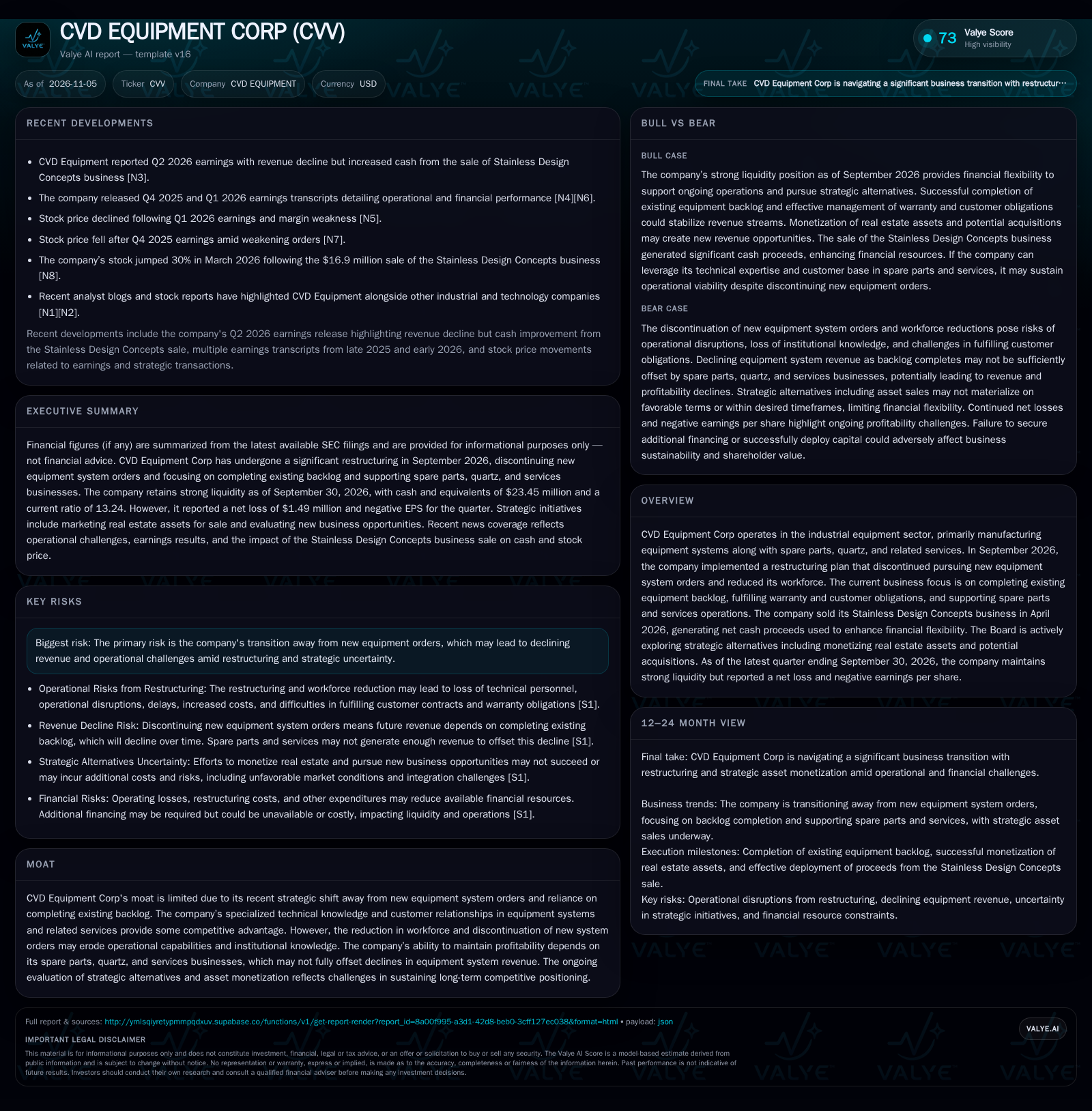
CVD Equipment Corp halted new equipment system orders in September 2026, opting for a major restructuring and workforce reduction. The company is now completing its equipment backlog, supporting spare parts, quartz, and services, and marketing real estate for sale. Despite $23.45 million in cash as of September 2026, net losses persist, and the sustainability of the remaining business lines is in question. Success hinges on asset monetization, new business initiatives, and the ability of non-equipment segments to cover declining revenues and fixed costs. [S1]
CVD Equipment Corp stands at a pivotal juncture after halting new equipment system orders and embarking on a broad restructuring in September 2026. The company is now in the process of winding down its traditional core revenue stream, with the last of its equipment backlog being fulfilled. The outcome now rests on the success of asset monetization efforts, the scalability of smaller business segments, and the ability to identify and capture new business opportunities.
Restructuring, Asset Sales, and the Decline of Core Equipment Revenue
CVD Equipment Corp implemented a major restructuring in September 2026, discontinuing the pursuit of new equipment system orders and reducing its workforce. The company’s immediate focus shifted to completing its existing equipment backlog, fulfilling customer obligations, and supporting spare parts, quartz, and related services. As the backlog is completed, equipment revenue is expected to decline sharply, leaving the company reliant on its smaller, potentially lower-margin business lines. Simultaneously, CVD is marketing real estate assets in Central Islip and Saugerties, NY, for sale and evaluating new business opportunities to redeploy capital. The company reported net cash proceeds of $15.6 million from the April 2026 sale of its Stainless Design Concepts business and ended September 2026 with $23.45 million in cash and equivalents, a current ratio of 13.24, and a net loss of $1.49 million for the quarter. [S1]
From Capital Equipment to Services: Shifting Revenue Mix and Cost Structure
Historically, CVD Equipment generated the bulk of its revenue from manufacturing and selling complex equipment systems, which tend to be high-ticket, project-based, and capital-intensive. This model typically offers high gross margins on successful projects, but is also characterized by lumpy revenue recognition, long sales cycles, and a dependency on industrial and technology sector investment cycles.
The company’s shift away from new equipment orders fundamentally alters its revenue composition. Spare parts, quartz, and services generally offer more stable but lower-margin and lower-volume revenue streams. These segments are often less capital-intensive, relying more on existing customer relationships and installed base support than on winning new large contracts. However, scale is a challenge—these segments may be insufficient to absorb the fixed costs and overhead previously supported by equipment sales. The recent workforce reduction likely reduced operating expenses, but the risk remains that the company’s cost base will remain misaligned with a smaller revenue pool.
Asset monetization, such as real estate sales, could provide one-time gains and additional liquidity, but these are not repeatable revenue sources.
Competitive Standing Erodes as Core Business Winds Down
CVD Equipment’s historical competitive advantage rested on specialized technical knowledge, engineering talent, and long-standing customer relationships in high-specification equipment systems. The decision to exit new system orders and reduce headcount risks eroding institutional knowledge and operational capabilities, potentially weakening even the spare parts and services businesses as technical expertise dissipates.
In the spare parts and services space, competition is often fragmented and price-sensitive, with less differentiation compared to proprietary capital equipment. Larger industrial suppliers and niche service providers may compete aggressively on price and responsiveness. The company’s ability to maintain a premium or defend share in these segments could be limited, especially if customers perceive a diminished long-term commitment from CVD.
If the company pursues new business lines or acquisitions, it will face the challenge of building or buying competitive advantage from scratch, likely in industries where it lacks established reputation or scale.
Unlocking Value Through Asset Sales and Strategic Redeployment
A favorable outcome for CVD Equipment would involve the successful monetization of its real estate holdings at attractive valuations, adding to its already robust cash reserves. This would provide ample capital to incubate or acquire new business lines, ideally in adjacent high-growth or higher-margin sectors where the company’s technical expertise or legacy customer relationships can be leveraged.
If the spare parts, quartz, and services businesses can be stabilized and operated profitably at a reduced scale—possibly through targeted investment in automation, digital service delivery, or niche customization—the company could create a sustainable, if smaller, cash-generative platform. Evidence supporting this scenario would include timely and profitable asset sales, stabilization or growth in services revenue, and the announcement of credible new ventures or bolt-on acquisitions with clear strategic rationale.
Orderly Wind-Down and Gradual Shrinkage of the Operating Base
The most plausible trajectory is a gradual decline in total revenue as the equipment backlog is completed and new orders cease. The spare parts, quartz, and service businesses provide ongoing but insufficient cash flow to cover legacy fixed costs, resulting in continued operating losses unless further cost reductions are made.
Asset sales may occur, but valuation and timing are uncertain, and one-time gains are unlikely to offset ongoing operational losses over the long term. Confirmation of this scenario would include sequential declines in revenue, persistent net losses, and a lack of significant new business announcements or acquisitions.
Prolonged Losses and Strategic Drift Lead to Value Destruction
The most adverse scenario involves delays or disappointments in asset sales, with properties failing to sell or only attracting buyers at distressed valuations. Meanwhile, operational disruptions from restructuring—such as loss of key technical staff, project delays, or customer dissatisfaction—could accelerate revenue declines and damage the company’s reputation, even in the services and parts business.
If new strategic directions fail to materialize or are poorly executed, the company could face a prolonged period of net losses, gradually depleting its cash reserves. In the absence of external financing or a successful pivot, CVD could be forced into further asset liquidations or, in an extreme case, wind up operations. Evidence for this scenario would be persistent and widening losses, negative cash flow, and repeated management commentary emphasizing challenges in executing strategic alternatives.
What Will Determine Whether CVD Equipment Can Reinvent Itself?
Progress and valuation achieved on the sale of Central Islip and Saugerties real estate assets—timing, price relative to book value, and cash proceeds.
Revenue and gross margin trends in the spare parts, quartz, and services businesses—if disclosed, to assess the sustainability of the remaining operations.
Updates on the completion of the existing equipment backlog, including project delivery timing, customer satisfaction, and any warranty obligations or cost overruns.
Management disclosures regarding new business development, acquisitions, or strategic partnerships—details and rationale for any proposed redeployment of capital.
Quarterly cash burn and changes in net cash position—monitoring whether operating losses are accelerating, stable, or improving.
Retention of technical and operational talent post-restructuring—if disclosed, as a proxy for the company’s ability to deliver on existing obligations and maintain customer relationships.
Customer retention and repeat business rates in the non-equipment segments—would help test whether the installed base remains a viable revenue source.
Any signals of external financing needs, covenant breaches, or operational stress beyond what current liquidity can absorb.
Disclaimer: This is research-only, informational analysis and not investment advice. It may include AI-generated interpretation and general industry context. Always verify important details using primary sources.

Comments