
ePlus: AI Infrastructure, Vendor Leverage, and the Shifting Economics of IT Solutions
ePlus Inc. is navigating a rapidly evolving IT landscape by deepening its focus on AI infrastructure, multi-vendor integration, and managed services. With substantial exposure to large enterprise and SLED customers—and a reliance on a few major accounts—the company faces both expanding opportunity and mounting risks as cloud, security, and recurring revenue models reshape the competitive field.
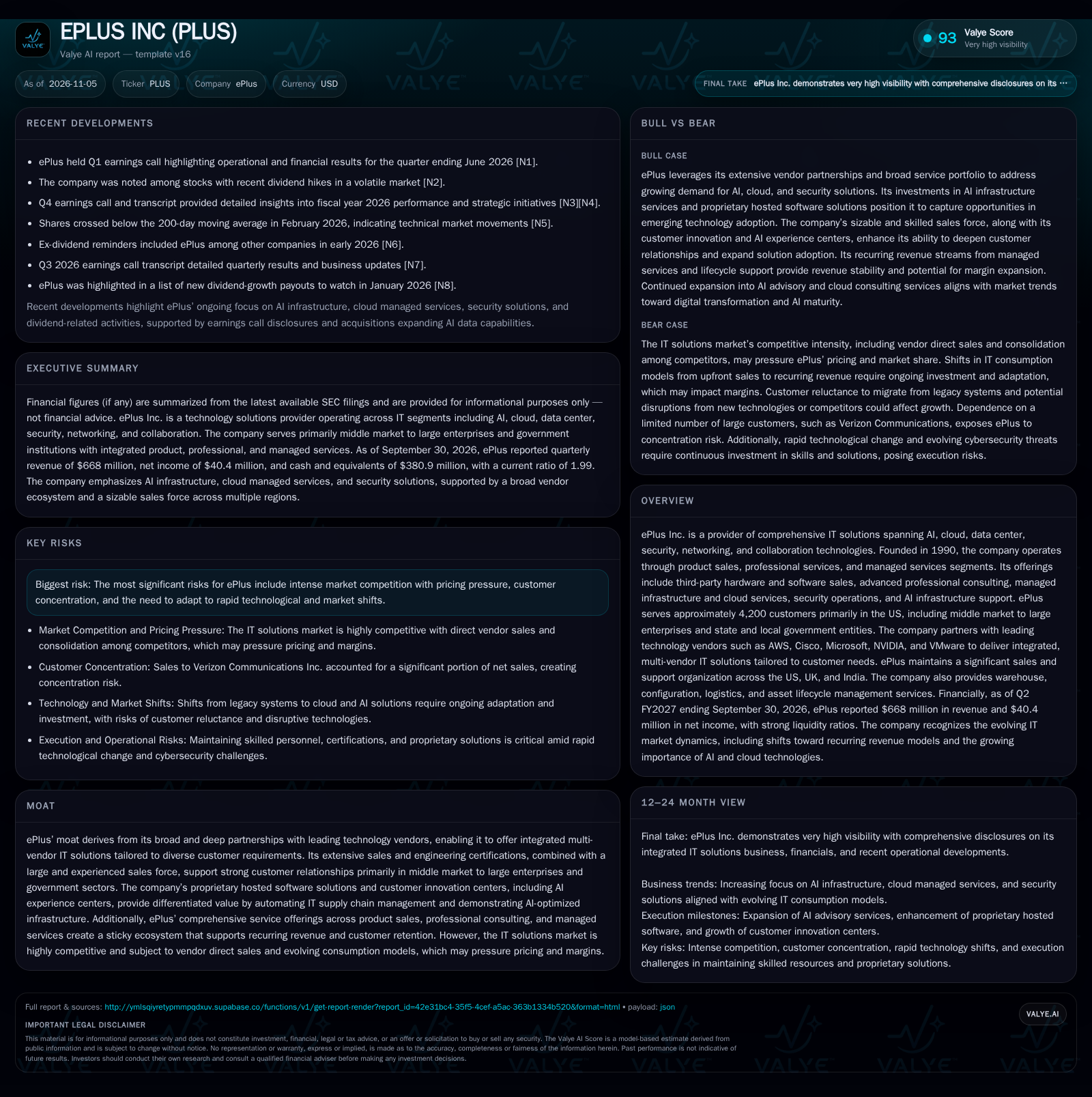
ePlus reported $668 million in quarterly revenue and $40.4 million in net income for Q2 FY2027, driven by integrated IT solutions across AI, cloud, and security. The company’s strategic emphasis on managed services and AI infrastructure aligns with industry trends, but customer concentration and competitive intensity remain central risks. Its broad vendor partnerships and recurring revenue potential may underpin future margin expansion, provided execution keeps pace with market shifts. [S2]
ePlus Inc. sits at a strategic crossroads in the IT solutions industry, balancing legacy product sales with a growing focus on managed services, AI infrastructure, and cloud-based offerings. Its latest quarterly results reflect both financial strength and exposure to evolving industry dynamics: $668 million in revenue and $40.4 million in net income for Q2 FY2027. As the company courts enterprise and government customers with integrated, multi-vendor solutions, it must navigate the double-edged sword of customer concentration and intensifying competition from both established vendors and emerging technology models. The stakes: whether ePlus can convert its position in the IT value chain into durable growth and margin expansion—or whether shifting industry economics will erode its advantage. [S2]
Recent Financial Results and Strategic Focus Shape the Opportunity Set
As of September 30, 2026, ePlus reported $668 million in revenue and $40.4 million in net income for the quarter, with a current ratio of 1.99 and cash and equivalents of $380.9 million. These results reflect stable operations and continued demand for integrated IT solutions spanning AI, cloud, and security. Notably, sales to Verizon Communications accounted for 24% of net sales for the year ended March 31, 2026, underscoring significant customer concentration. The company is emphasizing managed services and AI infrastructure as growth vectors, positioning itself to capture enterprise and public sector digital transformation budgets. [S2]
How ePlus Monetizes Integration and Managed Services in a Shifting IT Landscape
ePlus generates revenue across three main segments: product sales, professional services, and managed services. Product sales—encompassing third-party hardware, software (perpetual and subscription), and maintenance—have historically been the largest revenue driver, but are structurally more transactional and sensitive to vendor pricing and customer capex cycles. Managed services and professional services, by contrast, offer higher-margin recurring revenue streams, including infrastructure management, cloud and security operations, and advisory services.
The company’s economics are shaped by its ability to bundle multi-vendor offerings, leveraging scale and technical certifications to act as a trusted integrator for large, complex IT environments. As more customers shift from upfront hardware/software purchases to consumption-based and subscription models, ePlus may see a mix shift toward recurring revenue, potentially smoothing cash flows and improving operating leverage over time. However, this transition often involves upfront investment in talent, automation, and proprietary tools—capitalized through close vendor partnerships rather than heavy internal R&D.
Gross margins in managed and professional services are typically higher than in pure product resale, but depend on utilization rates, contract structures, and the company’s ability to differentiate through value-added integration, automation, and lifecycle support. Capital needs are moderate, focused on working capital for inventory and receivables, expansion of innovation centers, and enhancements to proprietary software platforms. The risk is that margin expansion could stall if pricing pressure intensifies or if the company cannot scale recurring services fast enough to offset legacy revenue headwinds.
Vendor Ecosystem Depth vs. Market Pressures: Where ePlus Stands
ePlus’ core competitive advantage lies in its broad and deep partnerships with top-tier technology vendors such as AWS, Cisco, Microsoft, NVIDIA, and VMware. This allows the company to offer integrated solutions that address the increasingly complex needs of enterprise and SLED customers—especially as organizations demand seamless orchestration across AI, cloud, security, and networking.
However, the IT solutions market is intensely competitive and fragmented, with counterforces including direct vendor sales, large global system integrators, cloud hyperscalers, niche managed service providers, and aggressive channel consolidation. Vendor direct sales can bypass the channel, while the rise of cloud and SaaS platforms threatens to commoditize integration and reduce stickiness. Furthermore, rapid technology shifts—particularly in AI and security—require continuous upskilling and adaptation, raising execution risk.
Customer concentration is a double-edged sword: securing large accounts like Verizon can provide revenue stability, but exposes ePlus to abrupt volume swings or contract renegotiations. The company’s customer innovation centers and AI experience centers may help deepen relationships and demonstrate value, but their impact on long-term switching costs and retention remains to be proven in a market where procurement cycles and vendor preferences can shift quickly.
If AI and Managed Services Drive a Recurring Revenue Inflection
A favorable outcome for ePlus hinges on accelerating adoption of AI infrastructure, cloud managed services, and security solutions among enterprise and public sector clients. If the company successfully leverages its vendor ecosystem and innovation centers to land multi-year managed service contracts, it could see a meaningful shift in revenue mix toward higher-margin, stickier recurring streams. Confirmation would come from sustained growth in managed and professional services revenue, rising gross margins, and evidence of expanded contract durations or renewal rates (if disclosed).
Winning large-scale AI infrastructure deployments—particularly in verticals like healthcare, financial services, and SLED—would validate ePlus’ positioning as a go-to integrator for next-generation IT architectures. A visible reduction in customer concentration (i.e., less reliance on Verizon or any single account) and an uptick in international expansion would further support the upside case. To sustain this trajectory, ePlus would need to demonstrate operational scalability, maintain technical leadership, and deepen its value proposition beyond vendor product resale.
Integrated Solutions Provide Stability, but Growth Relies on Execution and Market Timing
The most plausible outcome is that ePlus continues to deliver steady results by balancing its legacy product sales with gradual growth in managed and professional services. The company’s vendor partnerships and technical certifications should help maintain relevance with large enterprise and government clients, even as the IT landscape becomes more complex and competitive.
Revenue growth is likely to track overall enterprise IT spending and digital transformation budgets, with incremental margin improvement if recurring services gain share. However, customer concentration remains a structural risk: any pullback from major accounts like Verizon could create near-term volatility. Confirmation of the base scenario would include stable or modestly expanding services revenue, consistent gross margin trends, and continued investment in customer-facing innovation centers. Falsification would come from a pronounced drop in product sales not offset by service growth, or from evidence of margin compression due to competitive pricing.
Concentration Risk and Vendor Bypass Could Erode the Business Model
The primary adverse scenario centers on a sharp loss of business from a major customer—most notably Verizon, which accounts for nearly a quarter of annual net sales. A lost contract or volume reduction could trigger not just a revenue decline, but also operating deleverage and margin compression if fixed costs cannot be flexed quickly enough.
Simultaneously, if major technology vendors accelerate their direct-to-customer strategies or if cloud/SaaS platforms further commoditize integration and management services, ePlus could face price erosion and loss of relevance. Confirmation of this scenario would be a material decline in top-line revenue, shrinking managed services pipeline, and rising customer churn or contract attrition rates (if disclosed). Further evidence would include staff reductions, consolidation of innovation centers, or notable vendor relationship losses.
What Will Determine Whether ePlus Converts Positioning into Durable Value?
The growth rate and margin profile of managed and professional services revenue relative to legacy product sales would help test whether the business is successfully shifting to higher-value recurring streams.
Customer concentration metrics—especially the percentage of revenue from Verizon and other top accounts—are critical for understanding revenue stability and potential vulnerability.
If disclosed, contract renewal rates, average contract duration, and customer churn in managed services would provide insight into the stickiness of the company’s offerings.
Gross margin trends across segments, particularly in managed services, will indicate whether ePlus can capture value from integration and advisory work versus being squeezed by competition.
Progress on international expansion, including revenue and customer footprint outside the US, would signal the company’s ability to diversify and scale.
Investment in customer innovation and AI experience centers (e.g., number opened, customer engagements) would help gauge the impact of these initiatives on solution adoption and customer retention.
The rate of new vendor partnerships or certifications secured, as well as any notable vendor relationship changes, could affect solution breadth and negotiating leverage.
Any material changes in macroeconomic conditions, enterprise IT budgets, or public sector spending cycles could quickly alter demand for ePlus’ solutions.
Disclaimer: This is research-only, informational analysis and not investment advice. It may include AI-generated interpretation and general industry context. Always verify important details using primary sources.

Comments