
Goldman Sachs BDC: Lending Strength, Credit Dynamics, and Middle-Market Finance Realities
Goldman Sachs BDC’s strategy centers on direct origination of complex loans for U.S. middle-market borrowers—a segment underserved by banks but exposed to credit and economic risks. Despite leveraging the Goldman Sachs platform for sourcing and structuring, recent net losses and growing exposure to riskier loan types highlight both the income potential and the vulnerabilities of its model.
Goldman Sachs BDC focuses on originating secured and unsecured loans for middle-market U.S. companies, leveraging Goldman Sachs’ resources for deal sourcing and structuring. Its revenue model depends on interest income and fees from holding and leading complex loans, often with higher risk profiles like unitranche and covenant-lite structures. The company recently reported a net loss, reflecting the sector’s volatility and the challenges of managing credit risk amid competitive and regulatory headwinds. Future performance will hinge on credit quality, regulatory compliance, and the ability to balance yield with risk.
Goldman Sachs BDC, Inc. occupies a unique position in the U.S. specialty finance landscape by targeting the middle-market segment—companies too large for micro-lenders yet often too small or complex for traditional banks. The firm’s approach, built on direct origination and structuring of secured, unitranche, and select equity investments, leverages the Goldman Sachs brand and network for sourcing and execution. However, the recent net loss and increasing portfolio exposure to riskier loan types reveal the trade-offs inherent in chasing yield in a competitive and cyclical environment. The company’s future will depend on its ability to manage credit risk, maintain regulatory status, and navigate the challenges posed by leverage and market competition.
Goldman Sachs BDC’s Recent Losses and Portfolio Challenges
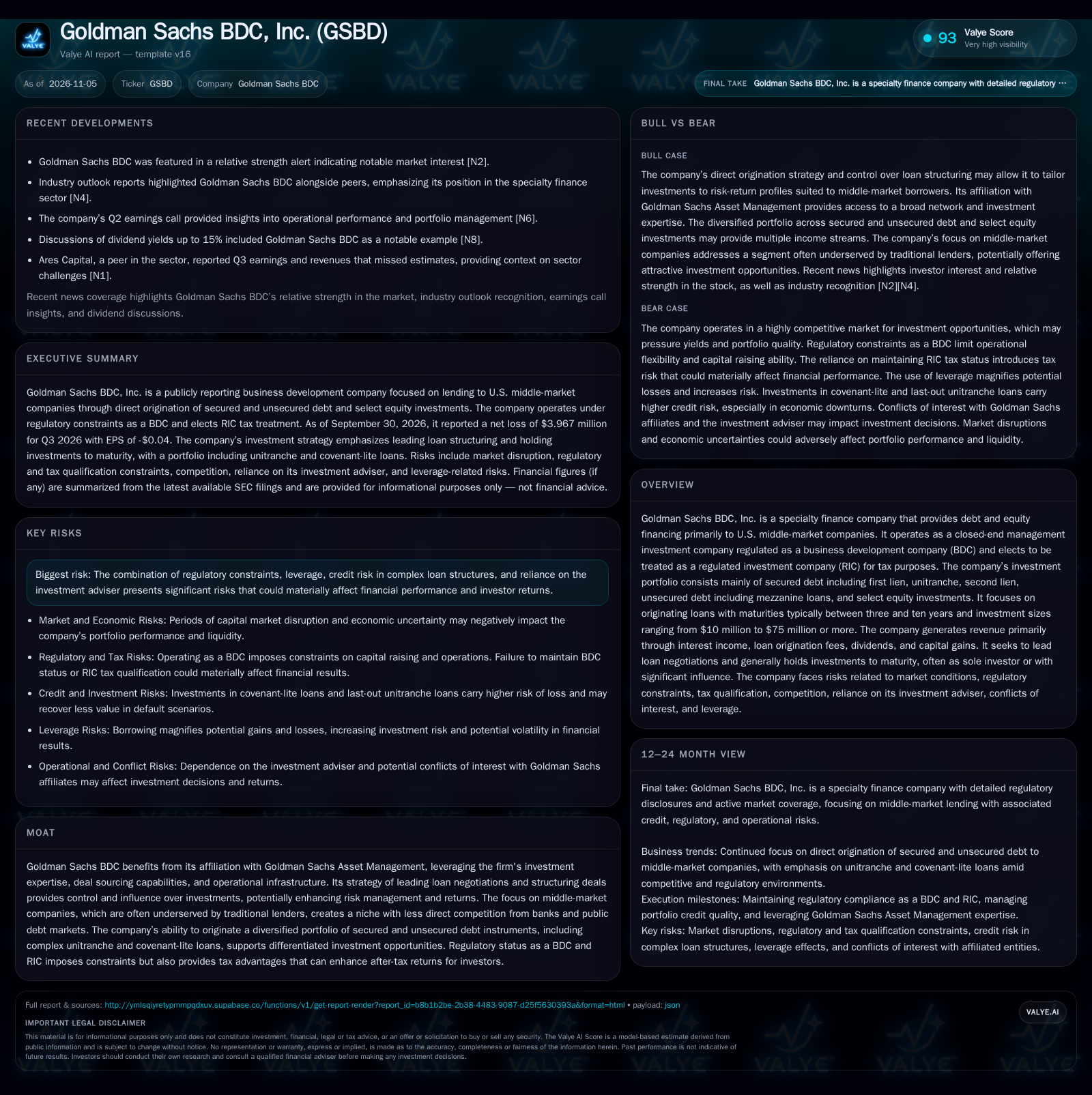
As of September 30, 2026, Goldman Sachs BDC reported a net loss of $3.967 million for the third quarter, translating to basic and diluted EPS of -$0.04 [S2]. This marks a setback against the backdrop of a portfolio strategy that has, since inception, deployed nearly $9.88 billion in aggregate principal of debt and equity investments [S1]. The company’s capitalization includes a $585.75 million revolving credit facility and over $1.2 billion in unsecured notes across staggered maturities [S1]. These facts signal a business model under strain: the net loss suggests credit performance or valuation pressures in the portfolio, while the capital structure highlights significant leverage. The company’s emphasis on complex loan structures—such as last-out unitranche and covenant-lite loans—may be contributing to volatility and risk, especially in a period of heightened competition and uncertain credit conditions.
Mechanics of Return Generation and Risk Concentration
Goldman Sachs BDC earns revenue primarily from interest on loans to middle-market companies, augmented by origination fees, dividends from equity positions, and realized capital gains [S1]. The portfolio is weighted toward direct originations, often in the form of secured first-lien, unitranche (including last-out), and second-lien loans. These instruments typically carry higher yields than broadly syndicated loans or investment-grade paper, compensating for higher credit and illiquidity risks.
The economics rely on a spread between the yield on assets and the cost of funding, with leverage employed to enhance returns. Fixed expenses include management and incentive fees paid to the external adviser (Goldman Sachs Asset Management), while variable costs are tied to portfolio performance and credit losses. The company’s use of leverage amplifies both income potential and downside risk: a deterioration in portfolio credit quality can quickly erode net investment income and equity. The prevalence of covenant-lite and last-out structures means that recoveries in default scenarios could be lower, and early warning signals weaker, compared to traditional secured lending.
Capital needs are met through a mix of revolving credit and unsecured notes, with maturities laddered over several years [S1]. The ability to raise new capital is limited by BDC regulations, including asset coverage ratios and distribution requirements, which may constrain flexibility in periods of stress.
Middle-Market Direct Lending: Competitive Strengths and Emerging Pressures
Goldman Sachs BDC’s principal advantage lies in its affiliation with Goldman Sachs Asset Management, which provides privileged access to deal flow, structuring expertise, and operational infrastructure [S1]. This enables the company to lead loan negotiations and secure attractive allocations, often acting as the sole or lead investor. The focus on direct origination and tailored structures (such as unitranche or bespoke covenant-lite loans) serves a borrower base underserved by traditional banks, especially as regulatory constraints have tightened bank lending standards.
However, the competitive landscape is intense. Other BDCs, private credit funds, and even some non-bank lenders have aggressively entered the middle-market segment, driving up competition for quality deals and pressuring yields. The rise of covenant-lite structures is partly a response to borrower leverage, but also a symptom of lenders’ willingness to accept weaker protections to win deals.
Traditional banks, while constrained, still compete for the highest-quality credits, and the public debt markets remain an alternative for the upper end of the middle-market. Moreover, macroeconomic uncertainty and potential regulatory tightening could further impact deal flow and portfolio performance. In this environment, differentiation depends on underwriting discipline, sponsor relationships, and the ability to sustain credit quality as competitive pressures mount.
Potential Upside from Credit Stability and Yield Gains
In a favorable scenario, Goldman Sachs BDC leverages its origination platform and underwriting expertise to maintain strong credit quality, even as economic growth slows. The company’s ability to structure customized loans allows it to extract above-market yields without materially increasing default rates. If competition moderates or market volatility drives more borrowers to private credit, origination volumes could rise and spreads could widen.
Confirmation of this scenario would come from a sustained recovery in net investment income, declining non-accrual rates, and improved quarterly EPS. Evidence would also include stable or rising net asset value (NAV) per share, healthy dividend coverage, and positive mark-to-market adjustments on portfolio assets. Signs of increased lead roles in syndications or exclusive deals would further support this positive trajectory.
Falsification would occur if credit losses rise, non-accruals increase, or competitive pressures force the company into riskier structures with insufficient compensation.
Most Probable Outcomes in a Competitive Lending Environment
The most plausible outcome is that Goldman Sachs BDC continues to grow its portfolio through direct originations, but faces ongoing margin pressure due to competition and borrower-friendly terms. Net investment income remains stable but does not accelerate meaningfully, as higher yields on riskier loans are offset by occasional credit losses and valuation volatility. The company maintains compliance with BDC and RIC regulatory requirements, but is constrained in its ability to expand leverage or raise new equity without diluting returns.
This scenario would be confirmed by relatively flat or slightly positive EPS, stable dividend payouts, and modest fluctuations in NAV per share. Portfolio turnover would remain moderate, with most investments held to maturity or refinanced. Credit metrics—such as non-accrual rates and realized losses—would be manageable but warrant close monitoring.
Risks from Yield Pursuit and Regulatory Challenges
The adverse scenario sees credit conditions worsening, with defaults rising in the middle-market segment and recoveries on covenant-lite and last-out unitranche loans proving weak. Competitive pressures force Goldman Sachs BDC to accept increasingly borrower-friendly terms, leaving the portfolio exposed to adverse selection. Leverage magnifies losses, and regulatory/tax compliance becomes more challenging as asset coverage ratios are tested.
This scenario would be confirmed by a spike in non-accrual loans, negative mark-to-market adjustments, shrinking NAV per share, and potential covenant breaches on outstanding debt. Management might be forced to cut the dividend, raise dilutive equity, or sell assets at depressed prices to restore compliance. Persistent net losses and a deteriorating credit outlook would reinforce the downside thesis.
Falsification would occur if credit losses remain contained, leverage ratios stay within safe bounds, and the company demonstrates resilience through cycles.
Factors Influencing the Future Course of Goldman Sachs BDC
Quarterly trends in non-accrual rates and realized credit losses—if disclosed—would provide direct evidence of credit quality and risk management.
Changes in net asset value (NAV) per share, particularly during periods of market volatility, would reflect true portfolio health.
Portfolio composition metrics, such as the proportion of covenant-lite and last-out unitranche loans, would help assess risk appetite and potential vulnerability.
Updates on regulatory compliance (BDC asset coverage, RIC tax status) and any related disclosures would signal operational resilience or emerging constraints.
Leverage metrics, including utilization of the revolving credit facility and refinancing of unsecured notes, will show potential financial flexibility or stress.
Evidence of leading new syndications or winning exclusive deals could signal competitive strength and origination momentum.
Management commentary on market conditions, competition, and underwriting discipline in quarterly filings or earnings calls would help contextualize portfolio choices.
Disclaimer: This is research-only, informational analysis and not investment advice. It may include AI-generated interpretation and general industry context. Always verify important details using primary sources.

Comments