
IBEX LTD: AI-Driven Customer Experience, Global Scale, and the Stakes of Client Concentration
IBEX leverages proprietary AI technology and a global delivery network to serve digital-first and blue chip clients in the evolving BPO landscape. Its agent-centric culture and financial resources provide a foundation for growth, but concentration risks and operational complexity remain central to the thesis.
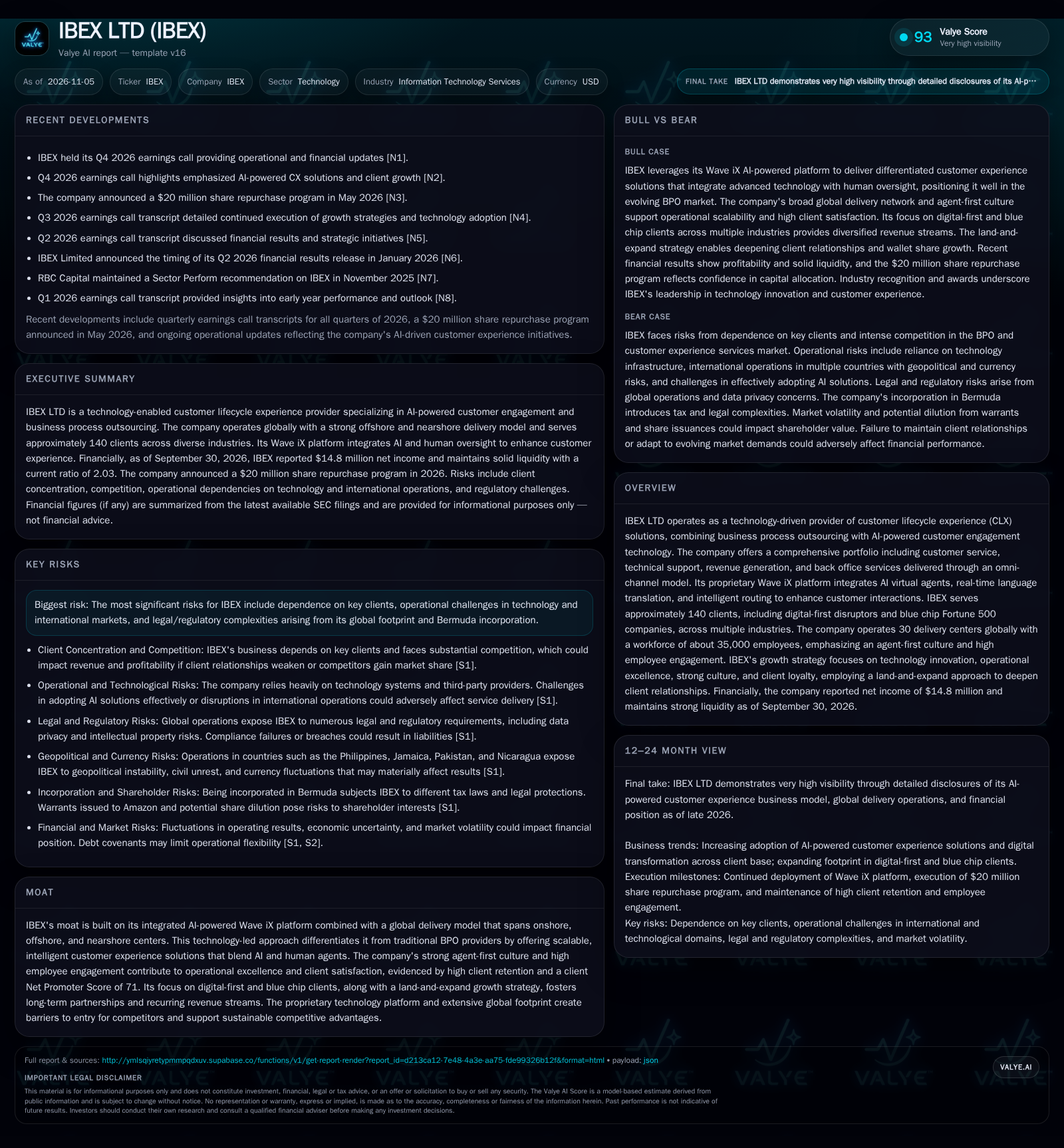
IBEX combines an AI-powered platform with a global, predominantly offshore BPO network to deliver customer engagement solutions for 140 clients, including Fortune 500 accounts. High retention and client satisfaction metrics support the company’s land-and-expand model, while profitability and a recent $20 million share repurchase highlight financial discipline. However, heavy reliance on key clients and international operations expose IBEX to concentration, geopolitical, and regulatory risks as it pursues digital transformation leadership in the BPO sector. [S1] [S2] [N3]
IBEX LTD stands at the intersection of technology-enabled business process outsourcing (BPO) and customer experience (CX) transformation. With its AI-powered Wave iX platform, the company seeks to outpace legacy BPOs by integrating automation, analytics, and omni-channel engagement. Serving 140 clients—ranging from digital disruptors to blue chip enterprises—across a global network of 30 centers, IBEX boasts high satisfaction and retention scores among both clients and employees. Recent financial results and a $20 million share repurchase underscore management’s confidence. Yet, as IBEX rides the digital transformation wave, its heavy reliance on a handful of key clients and its exposure to geopolitical and operational risks remain the most important variables shaping future outcomes. [S1] [S2] [N3]
Recent Results Reflect AI Strategy and Global Delivery at Scale
IBEX reported net income of $14.8 million for the period ended September 30, 2026, demonstrating continued profitability in a competitive sector. The company’s liquidity profile includes $36.7 million in cash and equivalents and a current ratio of 2.03. In May 2026, IBEX announced a $20 million share repurchase program, indicating management’s willingness to return capital to shareholders. Operationally, IBEX serves approximately 140 clients—including both digital-first disruptors and blue chip Fortune 500 companies—across a global network of 30 delivery centers and a workforce of about 35,000. The company’s Wave iX platform, integrating AI virtual agents and intelligent routing, remains a focal point of its differentiation strategy. [S1] [S2] [N3]
How IBEX Monetizes Intelligent CX: Service Mix, Scale, and Operational Leverage
IBEX generates revenue primarily through its Connect business, which provides outsourced customer service, technical support, revenue generation, and back office functions. These services are delivered via an omni-channel model—voice, email, chat, SMS, and social media—enabling IBEX to serve clients with complex, high-volume customer engagement needs. The company’s AI-powered Wave iX platform is designed to drive both cost efficiency (by automating routine interactions) and higher value-add (through analytics and intelligent routing). This blend may allow IBEX to command higher margins on digital-first accounts while maintaining substantial volumes from established blue chip clients.
Variable costs are dominated by labor, especially in offshore and nearshore markets where wage arbitrage supports gross margin. The company’s 97% offshore/nearshore on-site capacity enables a favorable cost structure, but also exposes IBEX to currency volatility and wage inflation in emerging markets. Fixed costs are centered on technology investment and maintaining a global delivery infrastructure, but these can support operating leverage as incremental volumes are added.
The digital marketing and e-commerce technology offerings under ibex Digital create additional revenue streams, potentially capturing a larger share of client customer acquisition budgets. However, the commercial model for these newer offerings—whether recurring SaaS, project-based, or transaction-linked—has not been fully detailed in public disclosures. Capital needs appear moderate, with technology investment supported by current profitability and cash flow. The $20 million share repurchase suggests that, at present, IBEX does not anticipate near-term capital constraints. [S1] [S2] [N3]
Defining IBEX’s Edge: AI-Driven Differentiation or BPO Commoditization?
The business process outsourcing and customer experience (CX) sector is intensely competitive, with global players ranging from traditional BPOs to emerging technology-first platforms. IBEX seeks to differentiate itself through its proprietary Wave iX platform, which integrates AI, automation, and analytics into CX delivery. This technology-led approach aims to move IBEX up the value chain, reducing client switching incentives and potentially increasing wallet share through the land-and-expand model.
The company’s global delivery footprint (30 centers, 97% offshore/nearshore) supports cost competitiveness and scalability, appealing to large enterprises seeking both efficiency and resilience. High client retention and a Net Promoter Score of 71 suggest strong satisfaction, while an agent-first culture (eNPS of 82) may help reduce turnover and maintain service quality.
However, the BPO industry is structurally prone to pricing pressure, with low switching costs in commoditized service lines. Larger incumbents and technology-native disruptors can match or surpass IBEX’s digital offerings if they invest sufficiently. The question is whether IBEX’s AI integration and focus on digital-first clients will support durable pricing power, or if competitors will erode any temporary margin advantages as automation becomes table stakes.
If AI-Led CX Adoption Accelerates: Expanding Wallet Share and Margin Uplift
A favorable scenario for IBEX would see rapid adoption of AI-powered CX solutions across its client base, especially among digital-first and blue chip enterprises seeking to modernize customer engagement. If IBEX’s Wave iX platform delivers measurable efficiency gains and improved customer outcomes, it could deepen existing client relationships and expand into adjacent service lines, driving both revenue growth and margin expansion.
This scenario would likely be confirmed by: (1) rising revenue per client, particularly from digital-first accounts; (2) evidence of multi-year contract expansions or new wins tied to AI capabilities; (3) higher gross margins reflecting automation efficiencies; and (4) continued high client and employee NPS scores. Additional proof would come from new marquee client wins in the technology or e-commerce verticals, and public referenceability of Wave iX deployments. Conversely, a lack of visible AI-driven contract wins, stagnant margins, or declining client NPS would challenge this thesis.
Sustained Growth Amidst Margin Pressures and Operational Complexity
The most plausible outcome is that IBEX continues to grow at a moderate pace, leveraging its global delivery model and AI-enabled offerings to retain existing clients and win incremental new business. Revenue growth may be driven by a mix of expanding wallet share within current accounts and selective new client wins, while profitability remains steady but not structurally higher, given ongoing pricing pressure and wage inflation in key offshore markets.
Confirmation of this scenario would include: (1) steady client retention and NPS scores; (2) incremental revenue growth in both Connect and Digital segments; (3) stable or modestly improving gross margins; and (4) continued investment in technology and delivery infrastructure without significant capital constraints. Falsification would involve an unexpected loss of major clients, significant margin compression, or operational disruptions in offshore locations that materially impact service delivery.
Concentration Risk and External Shocks Trigger Financial and Operational Strain
The adverse scenario centers on IBEX’s dependence on key accounts and its exposure to operational and geopolitical risks in offshore/nearshore markets. If a major client reduces or terminates its relationship, or if political instability, regulatory changes, or labor disruptions occur in key delivery geographies, IBEX could face abrupt revenue declines and underutilization of its fixed delivery infrastructure.
This scenario would be confirmed by: (1) disclosure of client attrition, especially among the top revenue contributors; (2) sharp declines in revenue or profitability linked to external shocks; (3) increased costs from currency fluctuations or wage spikes in the Philippines, Jamaica, or other major hubs; and (4) regulatory or legal challenges that increase compliance costs or restrict operations. Mitigating evidence would include diversification of the client base, successful navigation of geopolitical events without service disruption, or new delivery site openings in lower-risk regions.
Milestones and Metrics That Will Shape the IBEX Thesis
Net client additions and revenue per client—especially in digital-first and blue chip segments—would help test the depth and breadth of IBEX’s wallet-share expansion. If disclosed, these metrics would illuminate the effectiveness of the land-and-expand strategy.
Gross margin trends and segment-level profitability, particularly in services powered by the Wave iX platform, are critical for assessing whether AI integration is driving sustainable economic advantage.
Client retention and Net Promoter Score (NPS) movements should be monitored for early signals of competitive pressure or client dissatisfaction.
Employee Net Promoter Score (eNPS) and offshore/nearshore attrition rates, if disclosed, would provide insight into labor stability and service quality risks in IBEX’s agent-centric model.
The proportion of revenue derived from AI-powered or digital solutions versus traditional BPO would clarify the pace and magnitude of the company’s transformation.
Material client concentration—specifically, the revenue share of the top five or ten clients—remains a structural vulnerability. Any material changes in this metric should be scrutinized closely.
Updates on geopolitical or regulatory developments in major delivery markets (e.g., Philippines, Jamaica, Pakistan) could have outsized impact on both cost structure and operational continuity.
The pace of share repurchase activity and any changes to capital allocation strategy may signal management’s confidence in underlying cash flow and growth prospects.
Disclaimer: This is research-only, informational analysis and not investment advice. It may include AI-generated interpretation and general industry context. Always verify important details using primary sources.

Comments