
Visa’s Platform Evolution: Network Effects, Technology Bets, and the Stakes of a Shifting Payments Landscape
Visa’s dominant transaction network processed $18 trillion in payments and cash volume in 2026, but the company’s next phase hinges on leveraging AI, stablecoins, and modular APIs to defend and expand its role amid intensifying fintech disruption and regulatory scrutiny.
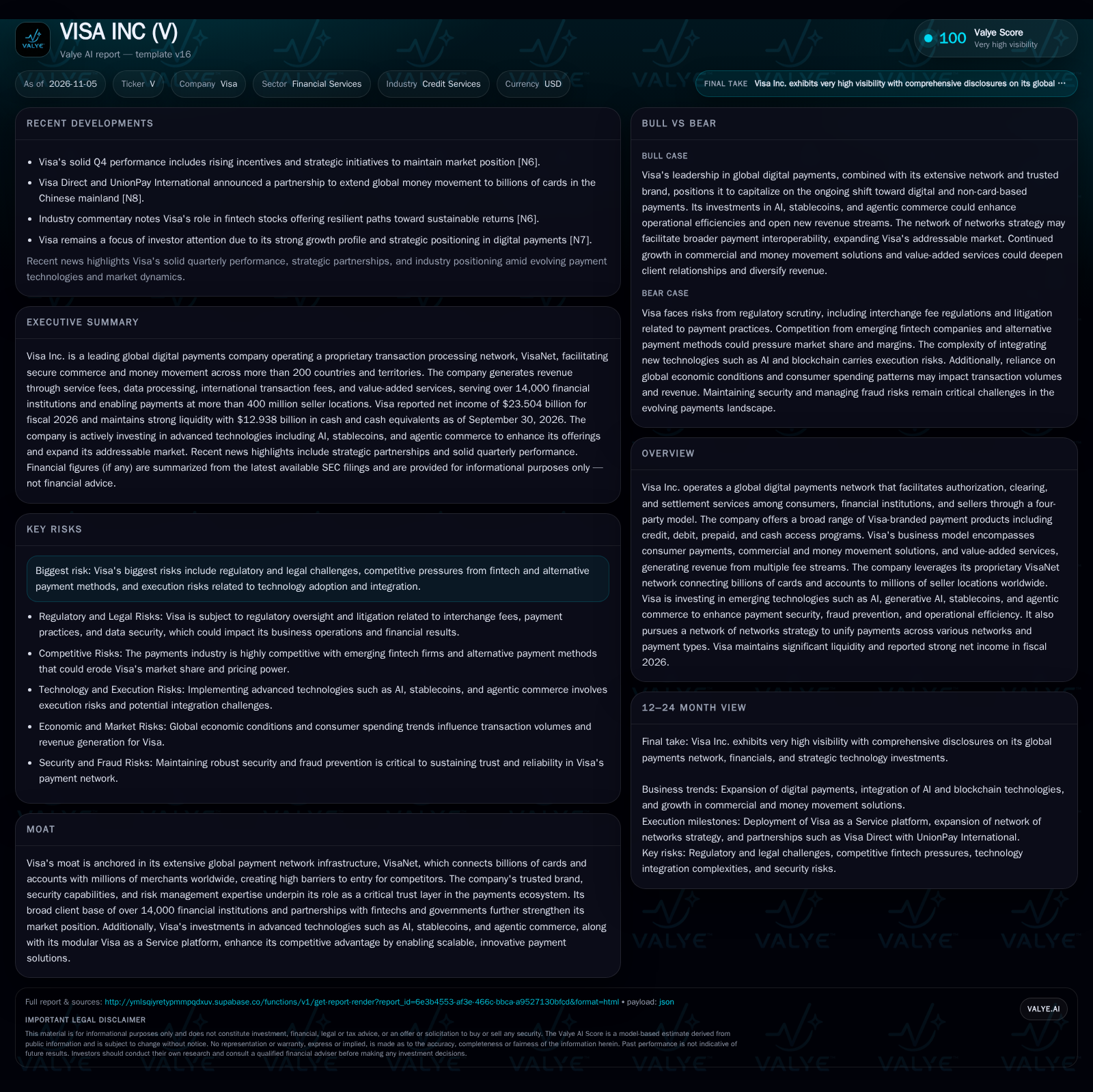
Visa processed 355 billion transactions worth $18 trillion in fiscal 2026, underlining its global payments leadership. The company’s investments in AI, stablecoins, and service modularity aim to deepen its relevance as digital payments diversify. While Visa’s network scale and trusted brand form a powerful moat, execution risks in technology integration and rising regulatory and fintech competition are central to the long-term thesis. Key milestones include the expansion of Visa as a Service, success of the network of networks strategy, and the commercial impact of stablecoin and agentic commerce initiatives. [S1]
Visa Inc. remains the archetype of global digital payments scale, processing trillions in annual volume through a proprietary network that forms the backbone of commerce for billions worldwide. As core card-based payments mature, Visa’s future will be shaped by its ability to deliver new API-driven services, harness AI and blockchain technologies, and defend its network effects against fintech insurgents and regulatory headwinds. The company’s formidable financials and entrenched infrastructure provide a foundation, but the next phase will test whether Visa can evolve fast enough to remain indispensable in a rapidly fragmenting payments ecosystem.
Visa’s Scale and Strategic Shifts in 2026
Visa processed 355 billion payments and cash transactions in fiscal 2026, with $18 trillion in total volume and 5 billion payment credentials in circulation—a scale differentiated in the global payments industry [S1]. This vast network is anchored by VisaNet, which connects over 400 million seller locations and supports a four-party model that includes consumers, issuers, acquirers, and merchants [S1].
The company reported net income of $23.504 billion for the fiscal year, with cash and cash equivalents of $12.938 billion as of September 30, 2026. The company reported cash and liquidity metrics for the period; these figures do not by themselves establish operating runway, investment capacity, financial flexibility, or financing capacity. [S1]
Visa is actively investing in advanced technologies—AI, generative AI, stablecoins, and agentic commerce—while pursuing a 'network of networks' strategy to unify payment types and rails. Notably, the Visa Direct and UnionPay International partnership is expanding cross-border money movement, particularly into the Chinese mainland [S1] [N6]. These moves signal Visa’s intent to remain the essential infrastructure for digital commerce as payments diversify beyond traditional cards.
Revenue Streams and the Leverage of Scale
Visa’s revenue is driven by transaction volumes and the breadth of its network, not by extending credit or assuming credit risk. Its core income streams—service fees, data processing, international transaction fees, and value-added services—are fundamentally volume-linked but benefit from both operating and network leverage [S1]. As more transactions flow through VisaNet, fixed costs such as technology infrastructure, compliance, and security are spread over a larger base, driving incremental margins.
The company’s business model is capital-light compared to traditional banks: it does not fund receivables or bear direct credit losses, allowing for robust free cash flow conversion when volumes are stable or rising. However, this model also makes Visa acutely sensitive to disruptions in global commerce, regulatory fee caps, or the emergence of alternative rails that could siphon volume away.
The expansion into value-added services (VAS)—including risk, security, advisory, and modular API-driven offerings—represents a bid to diversify and deepen revenue per client. Commercial and money movement solutions (Visa Direct, Commercial Solutions) may offer higher average fees, particularly for cross-border and B2B transactions, but these segments can be more price-competitive, and their economics depend on scale and the ability to integrate value beyond basic transaction processing.
Defending the Moat: Network Effects and Rising Counterforces
Visa’s moat is built on network effects: the more consumers and merchants it connects, the more valuable its network becomes, creating high switching costs for both sides. Its global acceptance, reliability, and security infrastructure have made it a default layer of trust for digital commerce [S1].
Yet, the payments landscape is fragmenting. Alternative payment methods—real-time account-to-account (A2A) transfers, digital wallets, local payment schemes, and blockchain-based rails—are gaining traction, particularly in markets with regulatory pressure or high fintech adoption. Fintechs can undercut traditional fee structures or bypass card rails entirely, threatening Visa’s pricing power and volume growth.
Visa’s response is twofold: invest in advanced technologies (AI for fraud prevention and efficiency, stablecoins for programmable money movement), and pursue a network of networks approach that seeks to aggregate and orchestrate payments across disparate rails. The effectiveness of this strategy will depend on Visa’s ability to remain the preferred integration layer for both legacy banks and new fintech entrants, and on its success in embedding its services deeper into client workflows via APIs and modular offerings.
If Visa Orchestrates the Next Generation of Payments
In an upside scenario, Visa successfully leverages its technology investments to become the indispensable orchestration layer for all forms of digital payments—card-based, A2A, crypto, and new programmable money flows. The Visa as a Service stack gains traction, embedding Visa’s infrastructure into a new wave of fintechs, platforms, and enterprise clients beyond traditional banks.
AI and generative AI initiatives drive step-changes in fraud prevention, compliance automation, and intelligent routing, reducing costs and enabling new premium services. Stablecoin and blockchain initiatives, such as the Visa Stablecoin Platform, allow Visa to intermediate programmable value transfer, capturing new flows and transaction types previously outside its reach.
Confirmation of this scenario would come from accelerating growth in value-added services revenue, rising API adoption by non-bank clients, and evidence of Visa’s share in non-card-based payment flows expanding. Partnerships like the Visa Direct-UnionPay collaboration scaling rapidly and being replicated in other markets would further validate Visa’s orchestration thesis.
Visa’s Core Business Remains Resilient, with Incremental Expansion
The most plausible mid-term outcome is that Visa continues to dominate global card-based payments, with moderate growth in transaction volumes and stable margins from its core fee-based model. Value-added services and commercial money movement solutions provide incremental revenue diversification, but remain a smaller share relative to consumer payments.
Technology investments yield incremental improvements in network security, operational efficiency, and client retention, but do not fundamentally alter Visa’s revenue mix or competitive position in the near term. The network of networks and stablecoin initiatives achieve pilot-scale adoption, but large-scale displacement of core card volumes by new rails is gradual.
This scenario would be confirmed by continued steady growth in payment credentials, seller locations, and transaction volumes, with value-added services revenue rising but not outpacing core transaction fees. Regulatory and competitive pressures are managed, but not eliminated, and Visa’s role as trusted intermediary persists—even as the payments ecosystem becomes more complex.
When Disruption Outpaces Integration: Margin Compression and Share Erosion
A downside scenario materializes if alternative payment rails (real-time payments, digital wallets, direct A2A, and blockchain-based solutions) achieve mass adoption faster than Visa can integrate or participate, leading to disintermediation and lost transaction volumes. Regulatory actions could cap fees or force open access, compressing unit economics and reducing the value of Visa’s network effects.
Technology execution risks—failed integration of AI or blockchain, security lapses, or inability to deliver value-added services at scale—could further erode client trust and differentiation. If fintechs and super-apps succeed in embedding payments infrastructure directly, Visa risks being relegated to a commoditized backend, with margin pressure and reduced pricing power.
Evidence for this scenario would include stagnating or declining payment credential growth, shrinking share of new digital payment flows, regulatory actions limiting fee-based revenues, and publicized security or technology failures undermining Visa’s value as a trust intermediary.
What Will Determine Visa’s Long-Term Strategic Relevance?
Growth rate in value-added services and commercial money movement revenue, especially as a proportion of total revenue, if disclosed.
Adoption and revenue impact of Visa as a Service and API-driven offerings, particularly among fintech and non-traditional financial clients.
Market share trends in non-card-based payment flows (A2A, wallets, stablecoins), and Visa’s participation in these new rails, if disclosed.
Expansion and commercial success of strategic partnerships such as Visa Direct with UnionPay International and similar cross-border initiatives.
Regulatory developments affecting interchange fees, network access, or new payment rails in Visa’s largest markets.
Reported advances or setbacks in AI, fraud prevention, and agentic commerce initiatives, including client adoption and operational outcomes.
Trends in payment credential issuance and active user growth, as well as changes in merchant acceptance footprint.
Incidence and impact of security breaches, technology failures, or disruptions in VisaNet operations.
Disclaimer: This is research-only, informational analysis and not investment advice. It may include AI-generated interpretation and general industry context. Always verify important details using primary sources.

Comments