
Dorchester Minerals: Distribution-Driven Model Faces Commodity Volatility and Strategic Growth Choices
Dorchester Minerals, L.P. continues to deliver quarterly cash distributions from its expansive mineral and royalty interests, but its fortunes remain tethered to commodity price swings, regulatory headwinds, and the evolving landscape for accretive acquisitions. The partnership’s debt-averse structure underpins stability, yet may limit flexibility in a competitive market for energy assets.
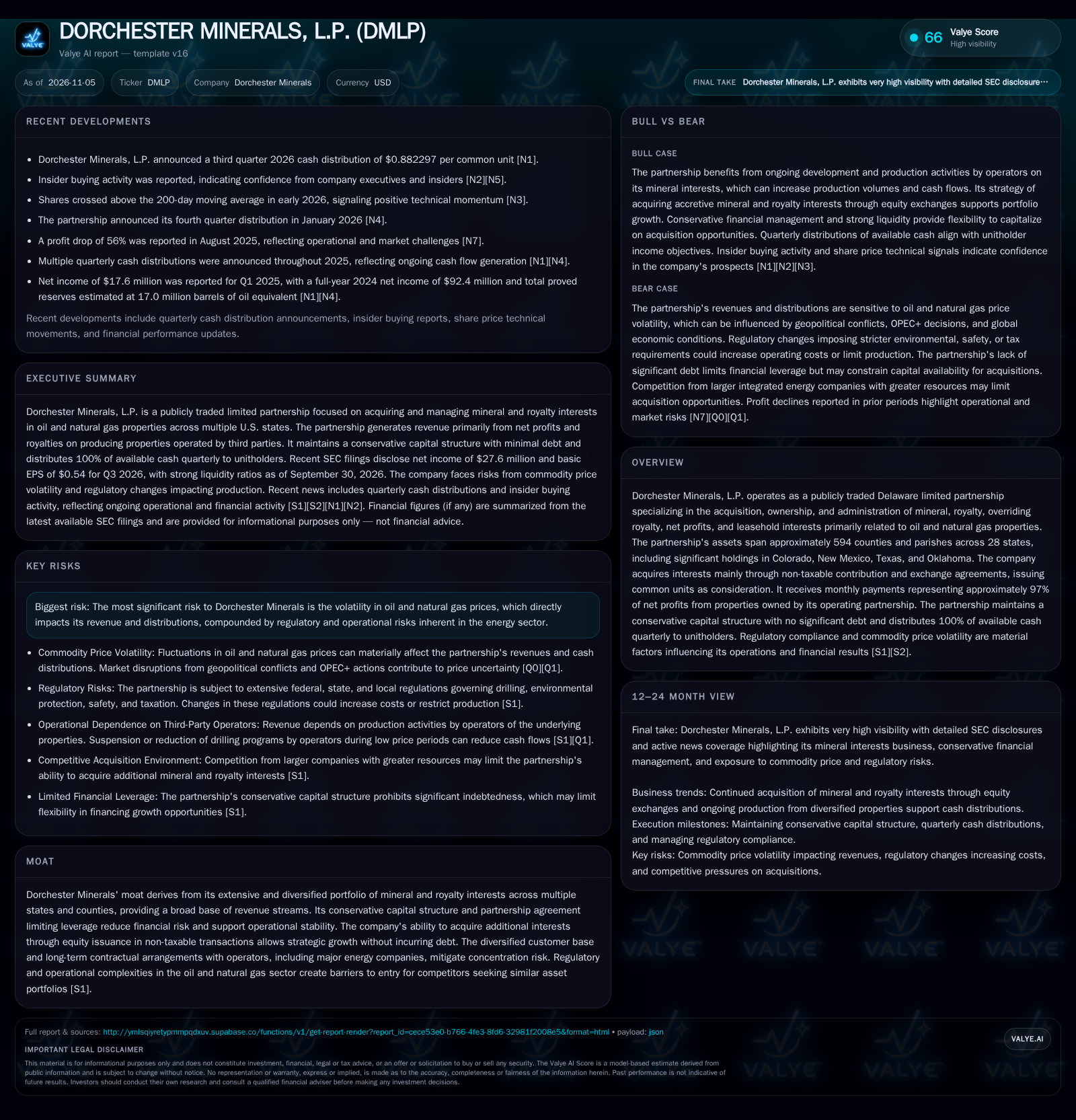
Dorchester Minerals, L.P. (DMLP) leverages a diversified portfolio of mineral and royalty interests to generate distributable cash flow, with a business model centered on quarterly payouts and minimal debt. The partnership’s current results reflect both its operational discipline and sensitivity to oil and natural gas market cycles. While recent distributions and insider buying support confidence, long-term performance depends on commodity prices, regulatory changes, and the ability to secure new accretive interests amid rising competition and limited leverage. [S1] [S2] [N1] [N5]
Dorchester Minerals, L.P. stands out in the U.S. energy landscape for its disciplined focus on acquiring and managing mineral and royalty interests, distributing all available cash to unitholders each quarter. Its wide geographic footprint and conservative financial posture offer operational resilience, yet the business is fundamentally exposed to the ebb and flow of oil and gas prices, as well as the regulatory climate. Recent results show a return to profitability and ongoing distributions, but the partnership’s long-term trajectory will hinge on its ability to navigate commodity cycles, maintain accretive growth, and adapt to external pressures.
Recent Profitability and Distribution Trends Set the Stage
Dorchester Minerals reported net income of $27.6 million and basic EPS of $0.54 for Q3 2026, reflecting a rebound from the significant profit drop of 56% observed in August 2025. The partnership announced a cash distribution of $0.882297 per common unit for the third quarter of 2026, continuing its practice of distributing all available cash to unitholders. These results underscore the company’s commitment to its distribution-driven model and signal operational resilience, but also highlight the underlying volatility tied to commodity prices and operator production schedules.Insider transaction activity was reported in the cited source; this activity does not by itself establish insider confidence. [S2] [N1] [N3] [N5] [N7]
How Dorchester Minerals Converts Royalty Streams into Payouts
Dorchester Minerals’ revenue model is built almost entirely on passive income streams—primarily royalties and net profits interests—tied to third-party production of oil and natural gas. The company’s top line is directly linked to both commodity prices and production volumes, with limited ability to influence either, as it does not operate wells itself. Each quarter, 100% of available cash (after administrative expenses and reserves) is distributed to unitholders, which shapes a capital-light and debt-averse balance sheet. This structure minimizes financial risk and operating leverage, but also precludes the use of debt to accelerate growth or smooth distributions during downturns.
The partnership acquires new mineral and royalty interests largely through non-taxable equity exchanges—issuing units rather than borrowing or using significant cash. While this approach preserves balance sheet strength, it makes scale and acquisition pace highly sensitive to the attractiveness of its units and competitive market conditions. Fixed costs are relatively low, but the business is inherently exposed to variable cash flows, with no meaningful ability to hedge or contractually lock in revenue. As a result, operating margins and distributions can swing sharply in response to commodity cycles.
Asset Breadth and Low Leverage: Durable Advantages or Limiting Factors?
Dorchester Minerals’ competitive strength lies in its broad and diversified portfolio of mineral and royalty interests across 594 counties and parishes in 28 states, reducing exposure to any single operator, basin, or regulatory regime. This scale offers a measure of resilience and helps balance production declines or regulatory changes in any given geography. The conservative, debt-light structure also differentiates Dorchester from more highly leveraged peers, minimizing financial risk.
However, the partnership faces structural constraints. Its inability to use significant debt may limit its ability to compete for large, high-quality acquisitions, especially as competition from larger integrated energy companies and private buyers intensifies. Furthermore, as a passive interest holder, Dorchester has no operational control over drilling pace, well selection, or production optimization; it is reliant on third-party operators’ capital allocation decisions. In a landscape where major players seek scale and control, this can be both a risk and a source of stability, depending on the commodity environment and M&A market dynamics.
Production Growth and Accretive Deals Unlock Higher Distributions
An upside scenario for Dorchester Minerals would be driven by a sustained recovery or rally in oil and natural gas prices, prompting operators on its properties to ramp up drilling and production. This would directly increase royalty volumes and cash flows, amplifying quarterly distributions. Concurrently, if Dorchester can continue sourcing and closing accretive mineral and royalty acquisitions—particularly through tax-advantaged unit exchanges—its distributable cash pool could expand without incurring debt.
Confirmation of this scenario would come from rising quarterly distributions, increased net income, and announcements of significant new portfolio additions. Additional signals would include upward revisions to proved reserves, and evidence that operators on Dorchester’s acreage are accelerating drilling activity. Insider buying and positive technical momentum, as recently observed, would further support the narrative of management conviction and external confidence. [N1] [N3] [N5]
Distribution Stability Amid Commodity Swings and Measured Portfolio Growth
The most plausible medium-term outcome is that Dorchester maintains steady, though potentially volatile, cash distributions as commodity prices fluctuate within a moderate range. The partnership continues to source new mineral and royalty interests opportunistically, but the pace of portfolio growth is tempered by competition and its equity-financed approach. Production volumes remain stable overall, with some basins offsetting declines in others thanks to the company’s geographic diversification.
Evidence supporting this scenario would include continued quarterly distributions at or near current levels, periodic but not transformative acquisitions, and relatively stable net income figures. Signs that the partnership is able to maintain or modestly grow proved reserves, despite market headwinds, would also be consistent with this middle path. Conversely, a sharp drop in distributions or a drying up of accretive deals would challenge this scenario. [S1] [S2] [N1] [N4]
Commodity Downturn and Regulatory Shocks Pressure Cash Flows
A negative outcome for Dorchester would be triggered by a severe and prolonged slump in oil and natural gas prices, causing operators to curtail drilling and reduce production on the partnership’s mineral interests. This would directly lower royalty and net profit payments, compressing distributable cash and potentially leading to a marked reduction in quarterly payouts. Regulatory changes—such as stricter environmental or taxation regimes—could further increase costs or restrict development, compounding the impact.
This scenario would be confirmed by a sharp and sustained decline in distributions (mirroring the 56% profit drop reported in August 2025), downward revisions to reserves, and a lack of new accretive acquisitions. Additional warning signs would include operator bankruptcies or well shut-ins, and any indication that Dorchester is unable to replace declining production through new deals. [N7] [S1]
Testing the Distribution Model: What Will Drive Dorchester’s Future Returns?
The quarterly per-unit cash distribution and its trajectory, which directly reflects cash flow generation and commodity price exposure.
The volume and quality of new mineral and royalty acquisitions announced, particularly the terms and mix of equity versus cash consideration.
Trends in net income and basic EPS, as reported each quarter, which capture the combined effect of commodity prices, production, and costs.
Changes in total proved reserves, if disclosed, providing insight into the sustainability of future cash flows.
Evidence of drilling and production activity by operators on Dorchester’s acreage—rig counts, new well completions, or operator capital allocation commentary would all be useful if available.
Material regulatory developments or litigation affecting key producing regions, which could directly impact cash flows or asset values.
Insider transaction activity was reported in the cited source; this activity does not by itself establish insider confidence.
Competitive dynamics in the mineral and royalty market—such as deal multiples for recent transactions or entry/exit of significant buyers—that may affect acquisition opportunities and pricing.
Disclaimer: This is research-only, informational analysis and not investment advice. It may include AI-generated interpretation and general industry context. Always verify important details using primary sources.

Comments