
MKS INC’s Strategic Refocus: Semiconductor Tailwinds, Portfolio Streamlining, and the Stakes for Future Profitability
With robust Q3 2026 profitability and a sharpened focus on core photonics and semiconductor markets, MKS INC is capitalizing on secular technology demand. The recent divestiture of its Ophir Optics business raises both flexibility and concentration risks, making execution and market cycle vigilance critical.
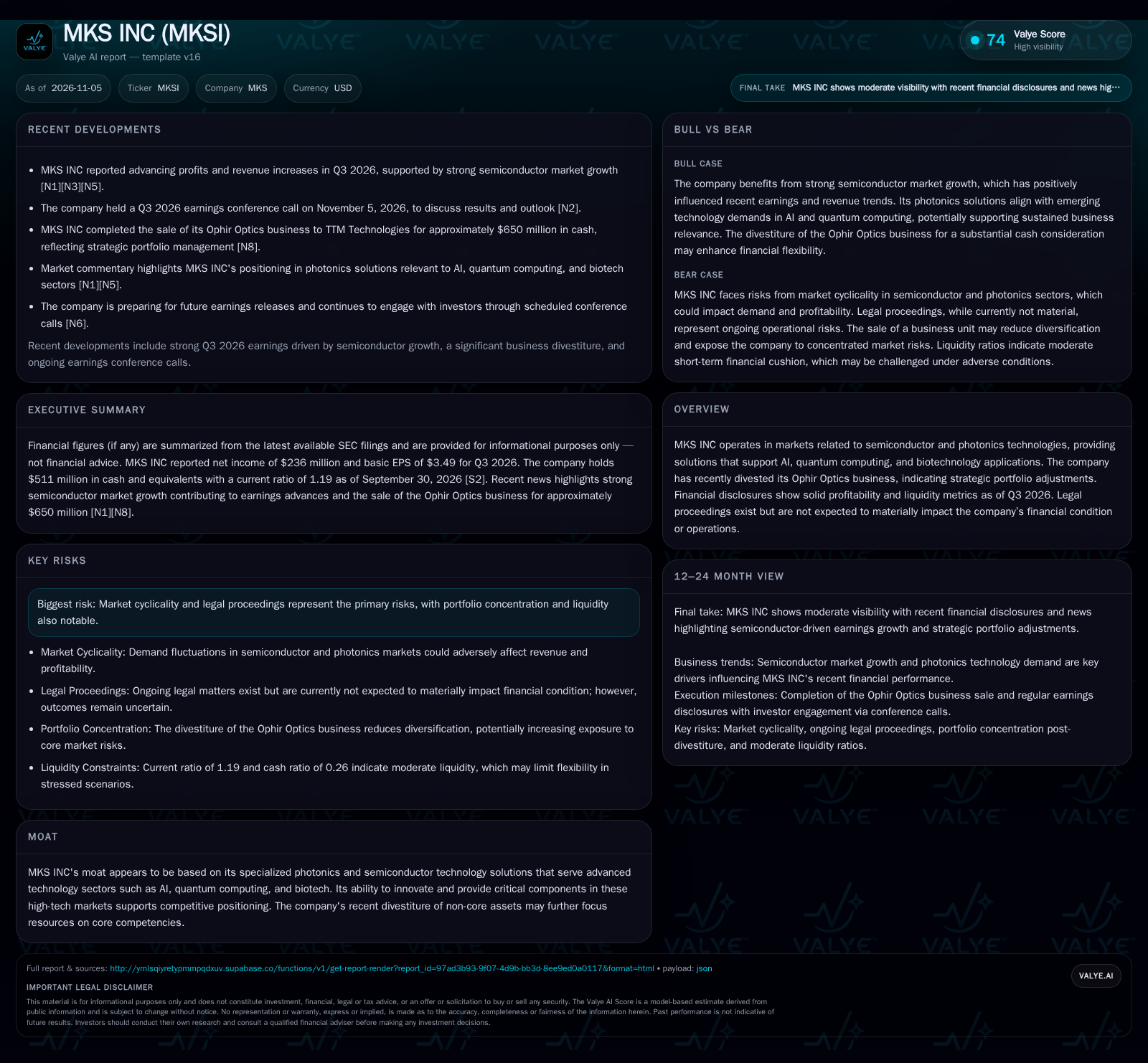
MKS INC reported $236 million in Q3 2026 net income, benefiting from strong semiconductor demand and strategic realignment after divesting Ophir Optics. Monitoring demand drivers, cash flow trends, and legal outcomes will be vital for investors as MKS INC navigates its next phase.
MKS INC is positioning itself at the intersection of high-growth technology markets by focusing on semiconductor and photonics solutions supporting AI, quantum computing, and biotech applications. The company’s Q3 2026 results underscore solid profitability, but its recent portfolio streamlining—highlighted by the sale of Ophir Optics—both sharpens its strategic focus and elevates its exposure to the inherent volatility of its core end markets.
Recent Financial Performance and Strategic Moves Redefine MKS INC’s Risk-Reward Profile
MKS INC reported $236 million in net income for Q3 2026, translating to a diluted EPS of $3.26, reflecting a period of strong profitability [S2]. These results are attributed to robust demand in the semiconductor sector, which continues to benefit from secular trends in AI, quantum computing, and biotechnology applications [N1] [N3]. The company has recently divested its Ophir Optics business, signaling a commitment to focus on core photonics and semiconductor solutions. As of September 30, 2026, MKS INC’s reported liquidity position, with $511 million in cash and a current ratio of 1.19, while management states that ongoing legal proceedings are not expected to materially impact operations [S1] [S2]. This backdrop sets up a company that is both financially healthy and strategically streamlined but more exposed to the fortunes of its primary markets.
How MKS INC Generates Value: End-Market Exposure, Operating Leverage, and Potential Financial Flexibility
MKS INC’s revenue model is anchored in the supply of high-value components and solutions to the semiconductor and photonics industries—markets characterized by demanding technical standards and cyclical capital spending. Pricing power in these segments is often tied to product differentiation, technological complexity, and integration into customers’ critical manufacturing processes. Volume growth is heavily influenced by capital expenditure cycles in the semiconductor industry, which can swing sharply with global demand for chips and advanced electronics.
The company’s cost structure likely features a mix of high fixed costs—such as R&D and specialized manufacturing facilities—alongside variable costs tied to raw materials and production volumes. This creates significant operating leverage: when demand surges, incremental revenue can disproportionately improve margins, as seen in the strong Q3 2026 profitability [S2]. However, this structure also amplifies downside risk in cyclical downturns, where underutilization can compress margins quickly.
The recent sale of Ophir Optics likely provided a cash infusion and reduced operational complexity, but it may also increase exposure to the cyclical core segments. The company reported cash and liquidity metrics for the period; these figures do not by themselves establish operating runway, investment capacity, financial flexibility, or financing capacity. [S2]
Specialization Versus Scale: Where MKS INC Stands in Advanced Manufacturing Ecosystems
MKS INC competes in a landscape dominated by technologically sophisticated players serving semiconductor, photonics, and advanced manufacturing customers. Its competitive positioning appears to rest on the ability to deliver specialized, high-performance solutions that are integral to customers’ production processes, particularly in leading-edge applications such as AI hardware, quantum devices, and biotech instrumentation.
This specialization can increase switching costs for customers, especially if MKS’s products are deeply integrated into equipment or workflows. However, the company faces counterforces from larger diversified suppliers that can offer broader portfolios, pricing flexibility, and global service networks. The recent divestiture of Ophir Optics narrows MKS INC’s scope, potentially enhancing focus and innovation in its core markets but reducing diversification that could buffer against sector-specific downturns.
Technology substitution is a persistent threat; rapid advances in semiconductor manufacturing or photonics could erode the value of MKS’s existing product set unless it maintains a leading innovation pace. The company’s long-term moat, therefore, likely depends on continued investment in R&D and close alignment with evolving customer requirements.
Benefiting from Secular Technology Demand: What Could Drive Outperformance for MKS INC
If the secular growth in AI, quantum computing, and biotechnology continues to accelerate, MKS INC could see sustained demand for its core photonics and semiconductor solutions. This would likely manifest as higher order volumes, improved pricing power, and increased operating leverage, driving outsized earnings growth. The company’s sharper focus post-Ophir divestiture may also enable more effective capital allocation and faster innovation cycles.
Confirmation of this scenario would come from continued quarterly revenue and earnings beats, rising order backlogs (if disclosed), and evidence that MKS INC is winning share in next-generation technology nodes or applications. A further indication would be management commentary on expanding design wins or long-term supply agreements with major semiconductor and AI hardware customers.
Falsification would be signaled by stagnating or declining sales despite favorable end-market trends, or a loss of key customer relationships to competitors with broader portfolios or newer technologies.
Navigating Cyclical Markets with a Leaner Portfolio: Most Likely Outcomes for MKS INC
The most plausible path for MKS INC is continued exposure to the cyclical ups and downs of its core semiconductor and photonics markets, punctuated by periods of robust earnings during industry upswings and margin compression during downturns. The recent portfolio streamlining is likely to yield some operational efficiencies and improved focus, but also heightens sensitivity to shifts in customer capital spending.
In this scenario, MKS INC maintains modest growth and profitability, supported by ongoing demand for advanced manufacturing technologies, but experiences periodic volatility in results.
Evidence confirming this scenario would include continued, albeit volatile, profitability; stable or slightly improving gross margins; and management commentary emphasizing operational discipline and targeted innovation. Falsification would occur if the company is unable to maintain profitability through a full industry cycle or if liquidity metrics deteriorate significantly.
Cyclicality and Concentration Risk: How MKS INC Could Be Exposed in a Downturn
A sharp downturn in global semiconductor or photonics capital spending could quickly erode MKS INC’s revenue and margins, given its concentrated exposure following the Ophir Optics divestiture.
If legal proceedings escalate in cost or scope, or if unexpected liabilities arise, the impact could further constrain potential financial flexibility. Additionally, any loss of key customers or failure to keep pace with technological shifts could accelerate revenue declines. In this scenario, MKS INC may be forced to seek external financing—potentially on unfavorable terms—or consider additional asset sales or restructuring.
Evidence of this downside would include sudden drops in revenue and margins, significant reductions in cash or current ratio, negative cash flow from operations, or new legal disclosures indicating material adverse impacts.
Thesis-Testing Markers for MKS INC’s Strategic Realignment and Market Exposure
Quarterly revenue and gross margin trends—especially their sensitivity to semiconductor and photonics market cycles—will be crucial to assess the company’s ability to manage cyclicality.
Order backlog and new design win disclosures (if provided) would help gauge forward demand visibility and competitive traction.
Cash flow from operations, particularly during industry downturns, will test the resilience of the company’s business model and liquidity.
Updates on the use of proceeds from the Ophir Optics divestiture—whether for debt reduction, R&D investment, or share repurchases—would clarify capital allocation priorities.
Legal proceeding updates, especially if any case escalates or results in material charges, could alter the risk profile.
R&D spending trends and evidence of successful product launches or customer adoption in AI, quantum computing, or biotech applications would support the innovation thesis.
Any changes in customer concentration or the loss of major accounts would signal increased vulnerability to market shifts.
Disclaimer: This is research-only, informational analysis and not investment advice. It may include AI-generated interpretation and general industry context. Always verify important details using primary sources.

Comments