
Primerica’s Insurance Model: Operational Momentum, Resilience Levers, and the Stakes of Cybersecurity Governance
The company’s network-driven insurance distribution model and experienced management set a durable baseline, but the interplay of competitive pressures, technology risk, and market cycles will shape its future trajectory.
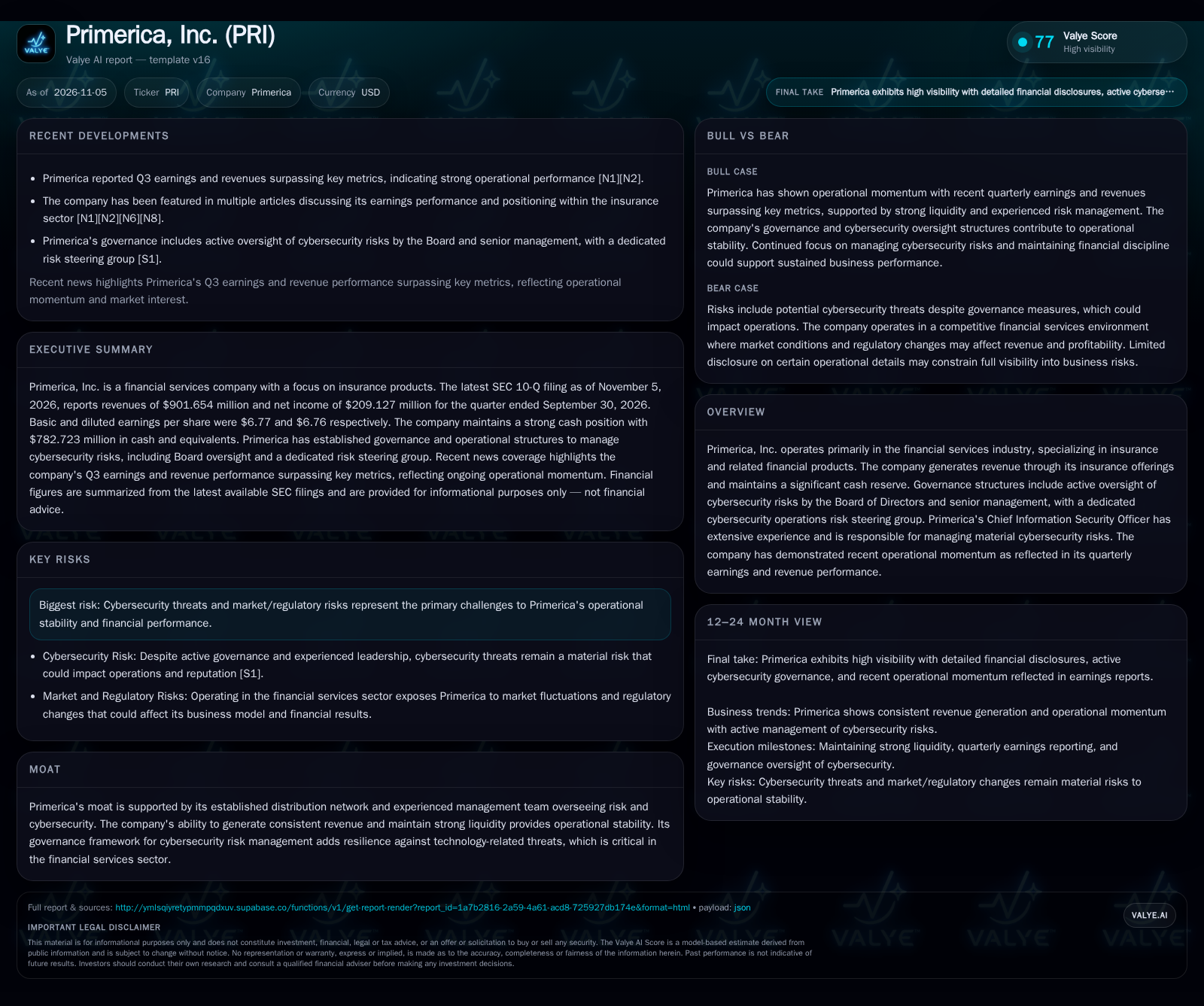
Primerica’s Q3 2026 results show revenues of $901.7M and net income of $209.1M, reflecting operational momentum and earnings above expectations. The outlook depends on sustaining agent productivity, managing cost discipline, and adapting to sector competition and regulatory changes. [S2] [N1] [N2]
Primerica, Inc. is demonstrating notable operational momentum in the financial services sector, with its Q3 2026 results surpassing key revenue and earnings benchmarks. However, as a network-driven insurer operating in a highly competitive and regulated environment, Primerica’s long-term performance will hinge on its ability to sustain agent productivity, adapt to shifting consumer preferences, and navigate evolving market and regulatory landscapes.
Primerica’s Recent Earnings Outperformance and Governance Emphasis
Primerica reported Q3 2026 revenues of $901.654 million and net income of $209.127 million, with earnings per share of $6.77 (basic) and $6.76 (diluted), exceeding analyst estimates and reflecting operational momentum. Cash and cash equivalents stood at $782.723 million as of September 30, 2026. The company’s governance structure includes Board-level oversight and a dedicated cybersecurity risk steering group, with an experienced Chief Information Security Officer at the helm. This combination of financial performance and risk governance signals a period of strong execution, but also sets expectations for continued discipline amid sector volatility. [S2] [S1] [N1] [N2]
How Primerica’s Agent Network Drives Economics and Margin Potential
Primerica’s business model is based on the sale of term life insurance and related financial products through a large, independent contractor sales force. The company typically earns revenue through policy premiums, product fees, and overrides from agent sales. Variable costs are closely tied to agent commissions and sales incentives, while fixed costs include corporate overhead, technology infrastructure, and compliance. The agent-centric model allows for scalability with relatively lower capital intensity compared to traditional branch-based insurers, but also introduces volatility tied to agent recruitment, retention, and productivity cycles.
Operating leverage can be significant if sales volumes grow faster than fixed costs, and the company’s recent momentum suggests favorable mix or volume dynamics. In the longer run, margin expansion could be driven by increased cross-selling, higher persistency, or improved agent efficiency, but these are contingent on execution and competitive dynamics.
The scalability of Primerica’s agent network also hinges on the balance between recruitment costs and long-term agent productivity. While onboarding new agents can temporarily increase variable expenses, the lifetime value of a high-performing agent can justify upfront investments in training and support. However, this dynamic is sensitive to retention rates; if attrition accelerates, the company may face a recurring cycle of recruitment and training expenses that compress margins. Moreover, fluctuations in economic conditions can influence agents’ ability to close sales, as consumer demand for insurance products often correlates with broader financial stability and disposable income trends.
Distribution Reach, Technology, and the Pressures of a Crowded Insurance Market
Primerica’s primary edge lies in its established agent network, which provides broad reach into middle-income households—a segment often underpenetrated by traditional insurers. This network can create switching frictions for clients through personal relationships and community presence. However, the insurance sector is highly competitive, with direct-to-consumer digital carriers, large multi-line incumbents, and fintech entrants all targeting similar demographics. These competitors may offer digital convenience, pricing transparency, or bundled products, challenging Primerica’s traditional model.
Defensive advantages may include agent loyalty, brand trust, and regulatory expertise, but these can erode if digital adoption accelerates or if new entrants achieve scale. Primerica’s active cybersecurity governance is notable, as technology risk is increasingly material in financial services—both as a threat and as a potential differentiator if handled well. The company’s breadth of offerings and distribution reach are strengths, but the pace of innovation and customer expectations in the sector are rising.
Technology adoption within the agent network is a double-edged sword. On one hand, digital tools can enhance agent productivity by streamlining client onboarding, policy management, and communication, potentially reducing the time and cost per sale. On the other hand, the pace of digital transformation requires continuous investment and change management to avoid alienating agents less comfortable with technology. Competitors with fully integrated digital platforms may attract tech-savvy consumers seeking seamless online experiences, raising the stakes for Primerica to balance personalized agent relationships with digital convenience. The company’s ability to integrate cybersecurity measures within these digital platforms also influences client trust and regulatory compliance.
Harnessing Agent Productivity and Digital Tools to Unlock Earnings Upside
Primerica’s most favorable trajectory would see it leveraging its agent network for higher policy sales, improved persistency, and greater share of wallet from existing customers. If recent earnings momentum is sustained, it may indicate success in recruiting and retaining productive agents, deploying digital platforms that enhance agent efficiency, and cross-selling new financial products. Further, effective cybersecurity management could prevent operational disruptions, preserving customer trust and regulatory standing.
Confirmation of this scenario would include accelerating policy sales per agent, rising retention rates, and evidence of digital adoption improving agent productivity. Expansion into adjacent financial products or successful new product launches could further drive revenue and margin growth. Falsification would be signaled by declining agent headcount, stagnant sales metrics, or customer attrition outpacing new business.
If Primerica successfully leverages data analytics alongside its agent network, it could unlock new avenues for targeted marketing and risk assessment. Enhanced data capabilities would allow agents to identify cross-selling opportunities more effectively and tailor product recommendations to individual customer profiles, increasing conversion rates and policy persistency. Additionally, predictive analytics could help optimize recruitment by identifying agent candidates with higher likelihoods of long-term productivity. However, realizing this potential requires robust data governance frameworks and investment in analytics infrastructure, which must be balanced against cost considerations and privacy regulations.
Sustaining Modest Growth Amid Sector Cyclicality and Competitive Evolution
The most plausible near-term path for Primerica is one of steady, moderate growth, reflecting continued agent-driven sales with incremental improvements in technology and operational discipline. Revenue is likely to track with agent productivity and customer retention, while expenses remain stable as the company invests in cybersecurity and compliance. This scenario assumes no major competitive shocks or regulatory disruptions, but recognizes that the sector’s cyclicality and evolving customer expectations create persistent headwinds.
Evidence supporting this trajectory would be quarterly revenues and net income tracking slightly above or in line with historical trends, stable or improving agent retention, and manageable expense growth. Falsification would occur if there is a sustained drop in sales productivity, outsized expense increases, or a material cybersecurity incident causing reputational or financial damage.
Vulnerability to Cyber Events, Agent Attrition, or Regulatory Headwinds
A less favorable chain of events would involve a major cybersecurity breach, regulatory tightening, or a sharp decline in agent productivity. Any material cyber incident could erode customer trust, trigger legal or remediation costs, and disrupt operations. Alternatively, if the agent network contracts due to recruitment challenges or increased competition from digital-first insurers, Primerica could face declining premium volumes and fee income.
This downside would be confirmed by unexpected spikes in expenses, adverse regulatory actions, negative press coverage relating to technology failures, or a rapid deterioration in agent or customer counts. Early warning signs might include rising compliance costs, slowing policy sales, or increased customer complaints.
Testing the Durability of Primerica’s Growth, Resilience, and Risk Controls
Quarterly trends in agent headcount and average policy sales per agent—if disclosed—would help assess the health of the distribution network.
Customer retention and persistency rates, especially for core insurance products, would clarify stability of the revenue base.
Expense growth relative to revenue, particularly in technology and compliance, would indicate underlying operating leverage or cost pressures.
Evidence of digital adoption by agents—including usage rates of proprietary platforms or digital tools—would signal adaptability to changing market expectations.
Incidence and impact of cybersecurity events, along with Board-level disclosures about risk management effectiveness, would reveal operational resilience.
Regulatory developments or fines in the insurance sector that affect Primerica’s product offerings or sales practices could materially alter the outlook.
Market share estimates within core demographic segments—if available—would help contextualize competitive positioning and switching friction.
Disclaimer: This is research-only, informational analysis and not investment advice. It may include AI-generated interpretation and general industry context. Always verify important details using primary sources.

Comments