
American Financial Group: Specialty Insurance, Catastrophe Risk, and the Dynamics of a Cyclical Market
AFG’s Q3 2026 results highlight robust profitability and a special dividend, but the company’s fate remains tied to the unpredictable interplay of catastrophe risks, specialty market cycles, and the evolving economics of risk management.
However, the company’s exposure to catastrophic events, competitive industry dynamics, and mass tort liabilities continue to shape both its upside potential and downside risk.
American Financial Group’s most recent quarter underscores both the strengths and vulnerabilities inherent in the specialty property and casualty insurance business. Yet, AFG’s fortunes remain tightly bound to the unpredictable nature of catastrophic events, the cyclicality and competitiveness of insurance markets, and the evolving landscape of risk—where advances in analytics and risk transfer may be tested by climate, litigation, and market forces.
Recent Results and Dividend Signal Financial Strength—But Not Immunity to Volatility
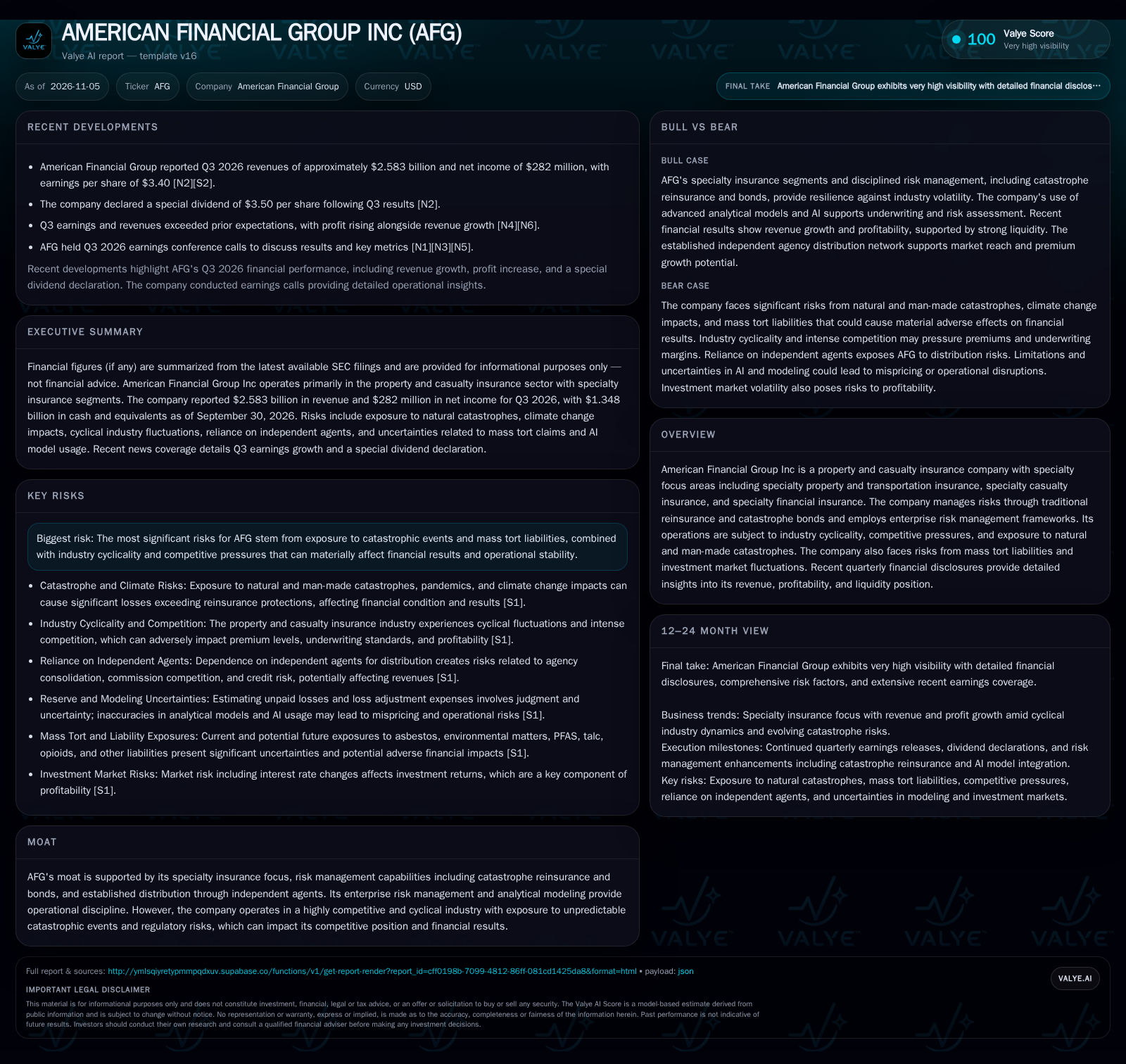
American Financial Group reported Q3 2026 revenues of $2.583 billion and net income of $282 million, translating to $3.40 in basic and diluted EPS [S2] [N2] [N6]. The company declared a special dividend of $3.50 per share following these results [N2]. As of September 30, 2026, AFG held $1.348 billion in cash and cash equivalents [S2]. These figures point to a period of strong profitability and liquidity, supporting the notion that the company’s specialty insurance focus can generate attractive returns. However, the cyclical and risk-intensive nature of the property and casualty sector means these financial outcomes can shift rapidly in response to catastrophic events, market competition, or adverse litigation trends.
How Specialty Insurance Economics Create Both Opportunity and Exposure
AFG’s business model centers on underwriting specialty property, transportation, casualty, and financial insurance risks—segments that often command higher premiums and less direct price competition compared to standard lines, in part due to tailored coverage and expertise. The company’s revenue mix is thus influenced by both pricing (premium rates) and volume (policies written), with the potential for favorable underwriting margins if risks are accurately priced and well-diversified.
However, the economics are inherently volatile: large catastrophic losses, mass tort developments, or adverse claims trends can quickly erase underwriting profits. To manage this, AFG makes use of catastrophe reinsurance and fully collateralized catastrophe bonds, which transfer a portion of tail risk to third parties [S1]. The cost and availability of such risk transfer tools can fluctuate, impacting net margins and capital requirements.
AFG also generates income from its investment portfolio, which is subject to interest rate and market risks [S1]. Operating leverage is present, as fixed costs in underwriting and administration can be spread over a larger premium base in strong years, but sharp increases in claims or declines in investment returns can lead to rapid margin compression. Capital needs are dictated by regulatory requirements, risk appetite, and the need to withstand extreme loss events—requiring substantial liquidity and prudent portfolio management.
Specialty Focus and Distribution Model: Advantages and Frictions in a Crowded Arena
AFG’s competitive position is built on its specialty insurance expertise, risk selection discipline, and established relationships with independent agents [S1]. This focus can enable deeper knowledge of niche markets, more tailored products, and the ability to underwrite complex or emerging risks that larger, more commoditized insurers may avoid. The use of analytical models and AI in underwriting and reserving may improve risk selection, though the effectiveness of these tools depends on data quality and model calibration.
Nonetheless, countervailing forces are strong. The property and casualty insurance industry is cyclical and highly competitive, with new entrants and established players often competing aggressively on price, terms, and commission structures. Reliance on independent agents introduces distribution risk, as agents may shift business to competitors offering higher commissions or broader product suites. Additionally, specialty insurers face competition from managing general agents (MGAs), insurtech firms leveraging digital distribution, and global reinsurers seeking direct relationships with commercial clients.
Switching frictions for customers are moderate: while specialty products can be sticky due to customization and claims handling reputation, price sensitivity and agent influence can drive churn, especially in soft market conditions.
Disciplined Growth and Catastrophe Containment Could Unlock Sustained Outperformance
The most favorable scenario for AFG involves a continuation of disciplined underwriting, benign catastrophe activity, and effective use of risk transfer mechanisms—enabling the company to deliver consistent profits and return excess capital to shareholders (as signaled by the recent special dividend) [N2]. Advances in AI-driven analytics could further sharpen risk selection and reserving, supporting superior loss ratios and profitability.
A supportive interest rate environment would bolster investment returns, adding to earnings power. If AFG can retain key agent relationships and expand its specialty footprint into higher-margin or underpenetrated segments, premium growth could outpace industry averages.
A benign catastrophe year or successful containment of mass tort liabilities would reinforce the thesis of resilience and differentiated economics.
Navigating Cycles: Profitability Amid Volatility and Competitive Pressures
The most plausible medium-term outcome for AFG is a continuation of cyclical, but generally profitable, performance driven by specialty underwriting, prudent catastrophe risk management, and a balanced investment portfolio. The company will likely experience periodic earnings volatility due to weather events, litigation, or shifts in investment returns, but core specialty segments should provide a buffer against severe industry swings.
Competitive pressures may constrain premium growth and compress margins in some lines, especially if market conditions soften or agent consolidation increases bargaining power. Nonetheless, AFG’s risk management framework, ongoing AI model refinement, and diversified specialty mix should allow it to adjust underwriting standards and risk appetite as conditions change.
Falsification would involve a material deterioration in underwriting results, adverse reserve developments, or persistent loss of agent-driven premium volume.
Severe Catastrophe Losses or Mass Tort Surprises Could Overwhelm Risk Controls
The most adverse scenario for AFG centers on a combination of outsized catastrophe losses (from hurricanes, wildfires, or other severe events) and negative surprises on mass tort or environmental liabilities—potentially exceeding the protection provided by reinsurance and catastrophe bonds [S1]. This could rapidly deplete earnings, reduce capital, and force AFG to raise additional funds or curtail shareholder returns.
Such an event could coincide with unfavorable investment market conditions, amplifying the impact on profitability and solvency. Additionally, if analytical models or AI tools fail to anticipate loss frequency or severity, mispricing could further erode margins.
Evidence of this scenario would include a spike in combined ratios or loss ratios (if disclosed), a suspension or reduction of dividends, adverse reserve adjustments, or the need for capital infusions. Regulatory scrutiny or ratings downgrades could also signal that risk controls have proven inadequate in the face of extreme volatility.
Milestones That Will Shape AFG’s Specialty Insurance Trajectory
Quarterly and annual trends in underwriting profit and combined ratios (if disclosed) would help gauge the effectiveness of risk selection and pricing.
The frequency, magnitude, and drivers of catastrophe losses—especially relative to reinsurance and catastrophe bond coverage—will test the resilience of AFG’s risk transfer strategy.
Growth or contraction in specialty premium volume, particularly in targeted niche segments, would signal the company’s ability to outpace or lag market cycles.
Retention and productivity of independent agents, or any major shifts in agent relationships or commission structures, could materially impact distribution reach.
Developments in mass tort and long-tail liability reserves, including any adverse legal or regulatory trends, would affect capital adequacy and future profitability.
Trends in net investment income and the composition of the investment portfolio will influence overall earnings stability amid market volatility.
Advancements in the use of AI and analytical models for underwriting and reserving, and any disclosed impact on loss ratios or claims outcomes, would help test the thesis that technology can materially improve specialty insurance economics.
If disclosed, the scale and terms of future catastrophe bond issuances or reinsurance renewals would offer insight into risk appetite and capital management flexibility.
Disclaimer: This is research-only, informational analysis and not investment advice. It may include AI-generated interpretation and general industry context. Always verify important details using primary sources.

Comments