
American Homes 4 Rent: Navigating Growth Constraints and Operational Scale in a Changing Regulatory Landscape
AMH’s scale, integrated development, and internal management have underpinned its single-family rental strategy, but the imminent ROAD Act introduces a structural cap on acquisition-led growth. The company’s ability to pivot toward internally developed inventory and drive operating leverage will be tested as expansion through bulk purchases is curtailed.
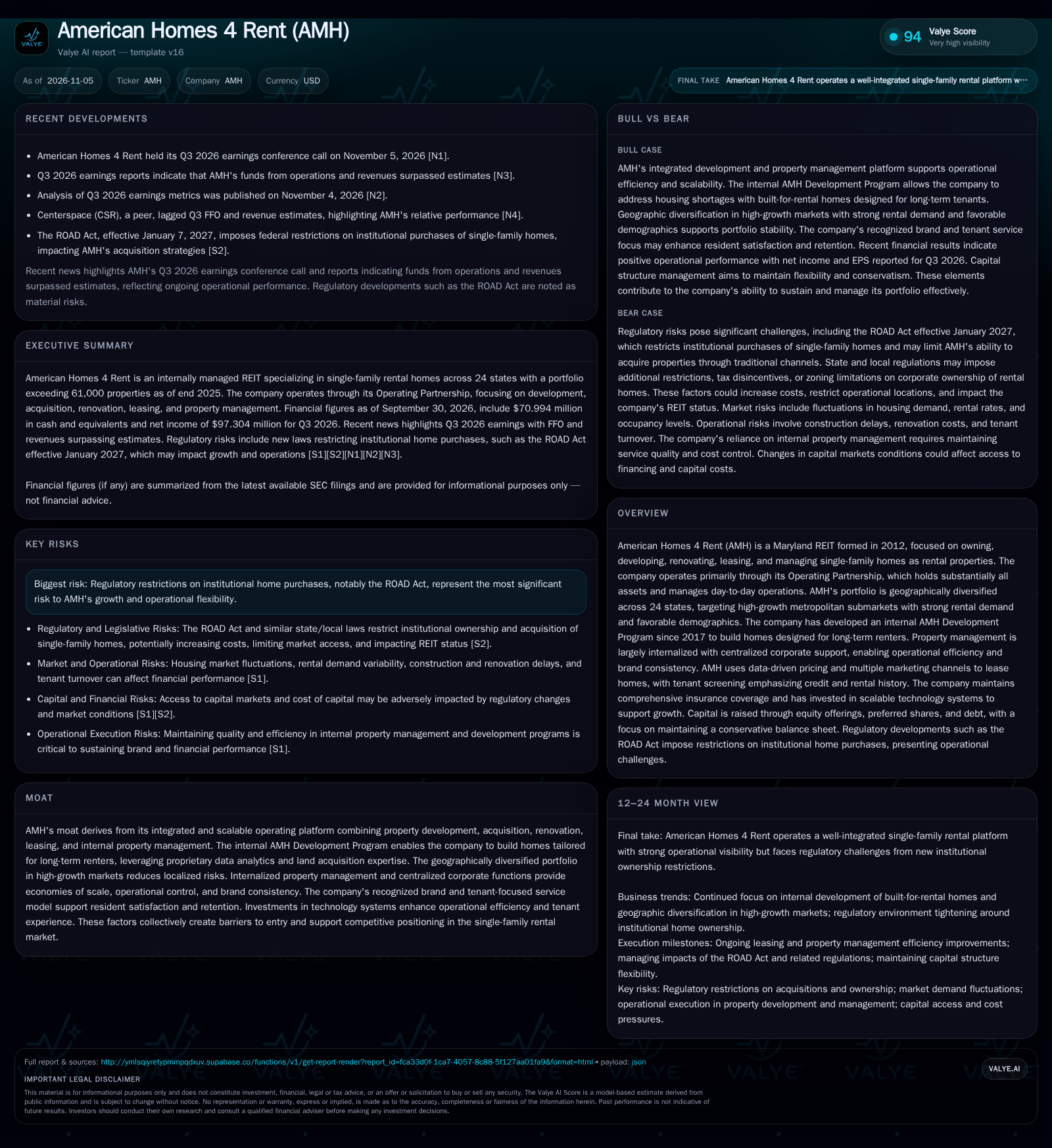
American Homes 4 Rent (AMH) manages over 61,000 single-family homes in 24 states, with a business model built on internal development, acquisition, and vertically integrated property management. The upcoming ROAD Act, effective January 2027, will restrict institutional purchases of single-family homes, directly challenging AMH’s traditional growth strategy. With Q3 2026 net income at $97.3 million and a cash balance of $71 million, AMH enters this period with operational scale but faces a strategic inflection point: can it offset acquisition limits by ramping up its internal development and extracting more value from its existing portfolio? [S1] [S2]
American Homes 4 Rent has become one of the dominant players in the U.S. single-family rental (SFR) sector by leveraging scale, integrated operations, and an internal development engine. As of late 2026, the company manages a geographically diversified portfolio of over 61,000 homes, supported by a workforce of nearly 1,600 and a focus on high-growth, high-demand markets. However, the regulatory environment is shifting: the ROAD Act will soon limit the ability of REITs like AMH to grow through institutional acquisitions, forcing a strategic rethink. The question now is whether AMH’s development capabilities and operational platform can compensate for restricted external growth, and how these shifts will affect long-term economics, competitive positioning, and shareholder returns. [S1] [S2]
Regulatory Constraints Shape the Next Phase for AMH
As of December 31, 2025, American Homes 4 Rent owned 61,479 single-family homes, with 56,756 occupied, reflecting a high utilization rate and significant operational scale. The company also manages nearly 3,800 properties in unconsolidated joint ventures, extending its reach beyond wholly owned assets. Financially, AMH reported $97.3 million in net income and $70.994 million in cash and equivalents for Q3 2026, suggesting ongoing profitability and operational continuity [S1] [S2].
However, the most consequential recent development is the passage of the ROAD Act, which will take effect in January 2027 and impose federal restrictions on institutional purchases of single-family homes. This legislation directly targets the core growth engine of AMH and similar REITs, potentially curtailing their ability to expand portfolios through bulk acquisitions and raising questions about the sustainability of past growth rates [S2].
How AMH’s Operating Model Drives Revenue, Costs, and Returns
AMH’s business model is built around the acquisition, internal development, renovation, and leasing of single-family homes at scale. Revenue is generated through rental income, with the potential for ancillary income streams such as fees, but the core driver is occupancy and rent levels across its portfolio. The company’s internal AMH Development Program—launched in 2017—enables it to construct homes tailored for long-term rental, which can improve durability, reduce turnover, and lower maintenance costs over the asset lifecycle [S1].
Vertically integrated property management, with nearly all services handled in-house, enables AMH to capture more margin relative to third-party management models, but also means a higher fixed-cost base. Economies of scale are realized through centralized leasing, marketing, and maintenance systems, supported by data-driven pricing tools. This structure allows AMH to adjust rents dynamically and optimize occupancy, but exposes it to operating leverage if rental demand or occupancy weakens.
Capital is deployed both for acquisitions and new development, funded through a mix of equity, preferred shares, and unsecured debt. While this provides flexibility, the capital intensity of acquiring or building homes means that regulatory and market shocks can quickly alter the risk/reward profile. The ROAD Act’s restrictions may push AMH toward greater reliance on internally developed inventory, which typically involves longer lead times and different margin dynamics compared to opportunistic acquisitions.
Competitive Edge or Commodity Model? Evaluating AMH’s Position
AMH’s scale, brand recognition, and integrated operations have historically created barriers to entry in the fragmented single-family rental sector. Its ability to source, develop, and manage homes in high-growth markets has enabled it to compete effectively with both smaller landlords and other institutional players. The internal development program is a differentiator, allowing customization for tenant preferences and potentially higher long-term returns [S1].
However, the ROAD Act could erode some advantages by limiting the ability of all institutional players to grow via acquisition, compressing the field and potentially shifting the competitive battleground to development execution and tenant experience. Smaller operators and local landlords, who are not subject to the same institutional purchase restrictions, may see renewed relevance if institutional capital is sidelined. The risk is that, with external growth capped, the SFR sector could become more commoditized, intensifying competition on service quality, pricing, and retention rather than sheer asset accumulation.
Unlocking Value Through Internal Development and Operational Efficiency
In a favorable scenario, AMH successfully pivots from acquisition-driven growth to scaling its development pipeline, leveraging its AMH Development Program to deliver purpose-built rental homes at a pace that sustains or even accelerates portfolio growth. If the company can further optimize its internal operations—reducing maintenance costs, minimizing tenant turnover, and extracting higher rents through data-driven pricing—operating leverage could improve even with slower overall unit growth.
This upside would likely be confirmed by a rapid increase in the number of homes delivered through internal development, sustained high occupancy rates, and evidence that rent growth and margins remain robust despite the acquisition slowdown. Additional signals would include improved tenant retention metrics, positive same-property NOI growth, and the ability to maintain or increase dividends despite regulatory hurdles.
Adapting to a Slower-Growth Environment with Stable Returns
The most plausible near-term outcome is that AMH transitions to a lower external growth rate, offsetting acquisition limits with gradual increases in internally developed inventory. Portfolio churn (from sales or joint-venture activity) and organic rent growth become more important drivers of results. Operating efficiency and tenant retention, rather than asset accumulation, become the primary levers for maintaining earnings and shareholder returns.
Confirmation of this scenario would come from a stabilized or modestly growing home count, consistent occupancy and rent collection rates, and steady cash flow generation. Metrics to watch include the pace of new developments, maintenance of high occupancy, and the ability to keep costs in check as the company’s fixed-cost base persists. Evidence that regulatory headwinds are being managed—such as successful navigation of the ROAD Act’s exceptions or alternative growth structures—would reinforce this outcome.
Regulatory Headwinds and Margin Compression Challenge the Model
In a negative scenario, the ROAD Act and potential state-level restrictions sharply curtail AMH’s ability to add new homes, while rising costs (labor, property taxes, insurance) and softening rental demand put pressure on occupancy and margins. If internal development cannot ramp up sufficiently, or if its economics prove less attractive than legacy acquisitions, the company could face portfolio stagnation or contraction.
This scenario would be confirmed by declining or stagnant home counts, falling occupancy rates, increased tenant turnover, and margin erosion due to higher operating or capital costs. Additional warning signs include reduced or suspended dividends, negative same-property NOI growth, and difficulty accessing capital on favorable terms. Regulatory or legal challenges to the company’s REIT status or business model would further exacerbate downside risks.
Testing the Resilience of AMH’s Operating Platform and Growth Model
The pace of internal development completions and new home deliveries—if disclosed—will indicate whether AMH can offset acquisition restrictions.
Occupancy and tenant retention rates across the portfolio; a useful metric would be same-property occupancy trends by market.
Year-over-year rent growth, both on new leases and renewals, to track pricing power amid regulatory and market shifts.
Same-property net operating income (NOI) growth, as a measure of core portfolio performance.
Changes in the total number of owned and managed homes, especially net additions from development versus acquisitions.
Progress and clarity on ROAD Act exemptions, legal challenges, or alternative acquisition structures.
Cost trends in property maintenance, insurance, and property taxes, which could impact margins if inflation persists or regulatory burdens rise.
Disclaimer: This is research-only, informational analysis and not investment advice. It may include AI-generated interpretation and general industry context. Always verify important details using primary sources.

Comments