
FIRST US Bancshares: Navigating Regulatory Complexity and Earnings Volatility in a Competitive Banking Landscape
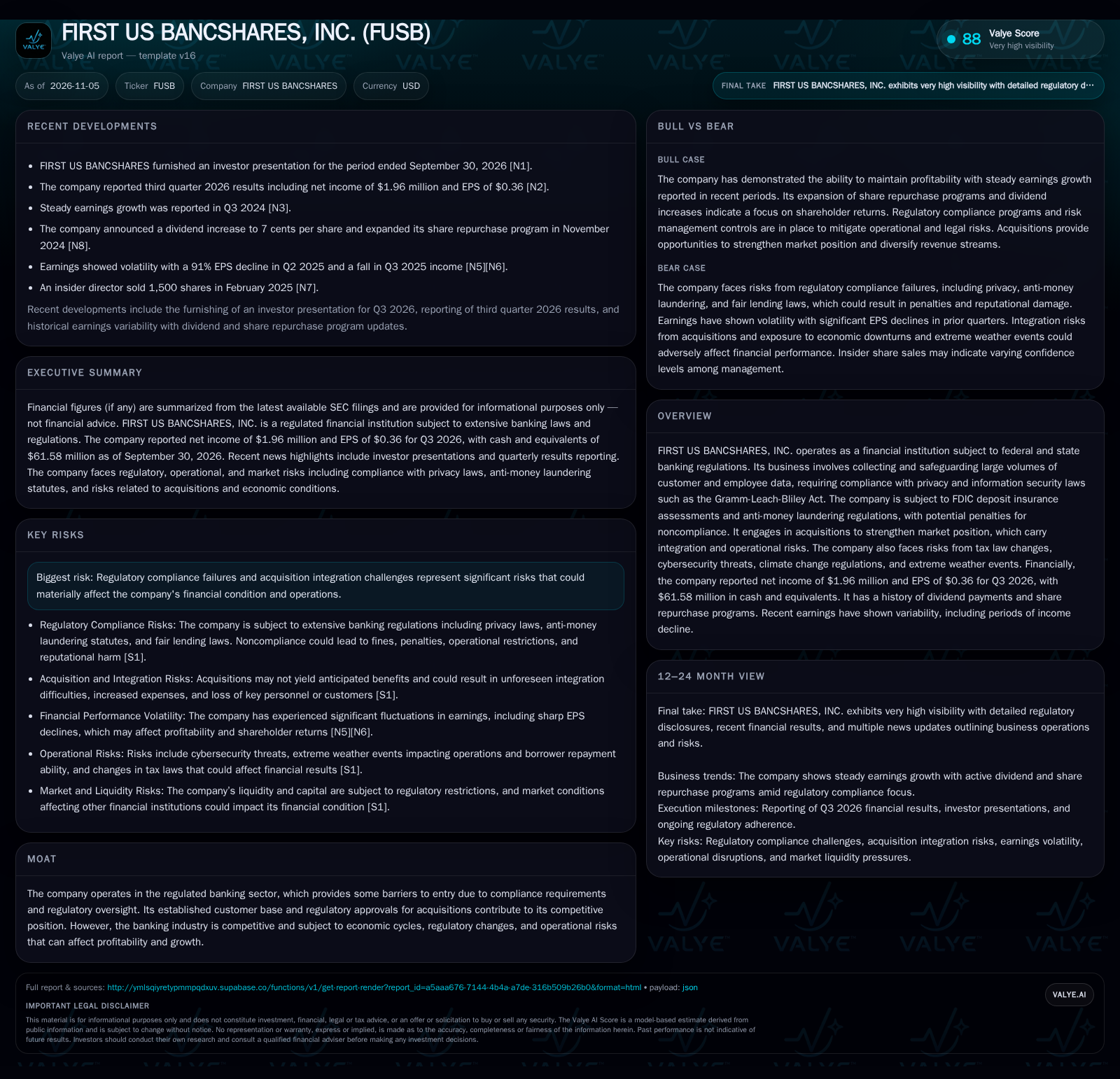
FIRST US Bancshares reported $1.96 million in net income for Q3 2026 amid a history of earnings swings and ongoing regulatory scrutiny. As the company balances acquisition-driven growth with compliance demands and operational risks, the interplay between integration, risk management, and market cycles will shape its future trajectory.
FIRST US Bancshares faces a delicate balancing act: maintaining profitability while managing rigorous regulatory requirements, integrating acquisitions, and navigating volatile earnings. [S2]
FIRST US Bancshares, Inc. stands at a crossroads defined by both opportunity and risk. The company posted $1.96 million in net income for the third quarter of 2026, but this achievement follows a period marked by significant swings in profitability, including a 91% EPS drop in Q2 2025 and a subsequent decline in Q3 2025. The bank’s $61.58 million in cash and cash equivalents underscores its capacity to absorb shocks, yet does not insulate it from the challenges of regulatory compliance, integration of acquisitions, and a competitive banking environment. How effectively FIRST US Bancshares can manage these crosscurrents will determine its ability to deliver sustainable value to shareholders. [S2] [N5] [N6]
Earnings Swings, Regulatory Focus, and Acquisition Ambitions Define the Current State
FIRST US Bancshares reported net income of $1.96 million and EPS of $0.36 for Q3 2026, a positive result in the context of recent earnings volatility, including a 91% EPS decline in Q2 2025 and a further drop in Q3 2025. These swings highlight the company’s sensitivity to market and operational factors.
The company continues to pursue acquisitions as a growth lever, but acknowledges material risks tied to integration, operational disruptions, and regulatory compliance, including privacy and anti-money laundering laws [S1]. Insider activity—specifically a director’s sale of 1,500 shares in early 2025—adds another layer of complexity to perceptions of management confidence and future outlook [N7].
How FIRST US Bancshares Makes Money: Spread, Scale, and the Cost of Compliance
Like most community and regional banks, FIRST US Bancshares generates revenue primarily through net interest income—the spread between interest earned on loans and investments and interest paid on deposits. Fee-based income, while potentially present, is typically a smaller contributor unless the bank expands into wealth management, mortgage origination, or other service lines. The company’s earnings capacity is thus highly sensitive to interest rate cycles, loan demand, asset quality, and funding costs.
Operating leverage in banking is complex: fixed costs from regulatory compliance, technology, and branch infrastructure are high, but scale can drive marginal profitability if deposit growth and loan origination remain robust. However, compliance with privacy, anti-money laundering, and consumer protection laws imposes substantial ongoing expense, and periodic regulatory changes can spike costs unpredictably [S1].
Acquisition-driven growth could improve scale and diversification, but integration introduces execution risk, potential for duplicative costs, and the challenge of harmonizing risk cultures.
The sensitivity of FIRST US Bancshares’ earnings to interest rate fluctuations also underscores the importance of effective asset-liability management (ALM). If the company can optimize the duration and repricing characteristics of its loan and deposit portfolios, it may better mitigate margin compression during periods of rising or falling rates. Conversely, inadequate ALM could exacerbate earnings volatility, especially if funding costs increase faster than asset yields. Additionally, the evolving regulatory environment often demands enhanced capital buffers and liquidity coverage ratios, which can constrain the bank’s ability to deploy capital toward higher-yielding assets, thereby limiting return on equity. Understanding how FIRST US Bancshares balances these regulatory capital requirements with growth ambitions is critical to assessing its medium-term profitability prospects.
Barriers, Substitutes, and the Pressure of a Crowded Banking Sector
FIRST US Bancshares operates within a highly regulated industry that erects moderate barriers to entry through compliance, chartering, and capital requirements. This regulatory shield provides some insulation from new entrants, but does not fully protect against competition from existing banks, credit unions, and increasingly, fintech firms.
The company’s established customer relationships and regulatory approvals for acquisitions do confer advantages, but these are counterbalanced by the commoditized nature of core banking products and the ease with which price-sensitive customers can switch providers. Digital banking trends and fintech innovations increase the threat of substitution, especially among younger or more tech-savvy demographics.
Peer competition is likely to center on deposit pricing, loan rates, customer experience, and the ability to offer integrated digital services. In this environment, operational efficiency, technology adoption, and disciplined risk management are as important as scale for maintaining profitability.
Integration Success and Risk Management Could Unlock Consistent Profitability
If FIRST US Bancshares can successfully integrate acquisitions—achieving cost synergies without major customer attrition or operational missteps—the company could realize improved scale and a more diversified revenue base. Strong risk management, especially in regulatory compliance and credit underwriting, would further reduce the likelihood of costly penalties or asset impairments.
Upside would be confirmed by a stabilization of quarterly earnings, improvement in efficiency ratios, and sustained growth in both net interest and non-interest income. Evidence of successful digital transformation, such as increased digital account openings or fee-based product uptake, would reinforce the bull case. Conversely, renewed earnings volatility, rising compliance costs, or failed integrations would undermine this scenario.
Earnings Remain Cyclical as Compliance and Integration Costs Temper Growth
The most plausible outcome is that FIRST US Bancshares continues to experience cyclical earnings, with profitability constrained by the costs and complexity of regulatory compliance and acquisition integration. While the company may achieve periods of steady growth, these are likely to be punctuated by quarters of volatility tied to credit cycles, regulatory changes, or integration challenges.
This scenario would be confirmed by continued moderate net interest income growth, periodic spikes in non-interest expense, and no clear trend in efficiency or profitability metrics. If the company can maintain asset quality and avoid major regulatory or operational missteps, it should be able to preserve capital and weather moderate downturns. Evidence to the contrary would include a structural decline in earnings, rising non-performing assets, or significant regulatory penalties.
Compliance Failures or Integration Missteps Could Trigger Lasting Value Destruction
The primary risk is that a major regulatory compliance failure—such as a breach of anti-money laundering protocols or a significant data privacy lapse—results in substantial fines, reputational harm, and operational restrictions. Alternatively, a poorly executed acquisition could lead to customer attrition, cultural clashes, and persistent expense overruns.
Confirmation of this downside scenario would include sharp, sustained declines in net income, a spike in non-interest expenses tied to remediation or legal costs, regulatory enforcement actions, or a material deterioration in asset quality. A further warning sign would be the erosion of capital ratios or loss of access to low-cost funding, especially if accompanied by negative trends in customer growth or deposit retention.
Benchmarks for Evaluating FIRST US Bancshares’ Ability to Deliver Sustainable Value
Quarterly net interest margin (NIM) trends: A sustained NIM above peer averages would suggest pricing power or superior asset/liability management; compression could signal competitive or funding pressure.
Efficiency ratio progression: Improvements would indicate successful cost control and integration; deterioration may reveal operational or compliance drag.
Non-performing asset (NPA) ratios and credit quality metrics: Rapid increases would flag emerging asset risk, while stability would support the case for disciplined underwriting.
Quarterly non-interest expense trends, especially in legal, compliance, and integration costs: Spikes may preempt regulatory or operational problems.
Deposit growth and customer retention data (if disclosed): Positive trends would suggest competitive strength and effective relationship management.
Evidence of successful digital adoption (such as digital account openings, digital transaction growth, or app engagement rates, if disclosed): Would help test the company’s adaptability to fintech disruption.
Regulatory actions, fines, or public enforcement disclosures: Any new developments would directly test the company’s compliance risk management.
Disclaimer: This is research-only, informational analysis and not investment advice. It may include AI-generated interpretation and general industry context. Always verify important details using primary sources.

Comments