
LCI Industries: Diversification Strength, Margin Pressures, and the Crossroads of Strategic Uncertainty
Investors must weigh the company’s operational strengths against margin volatility and the strategic implications of potential ownership changes.
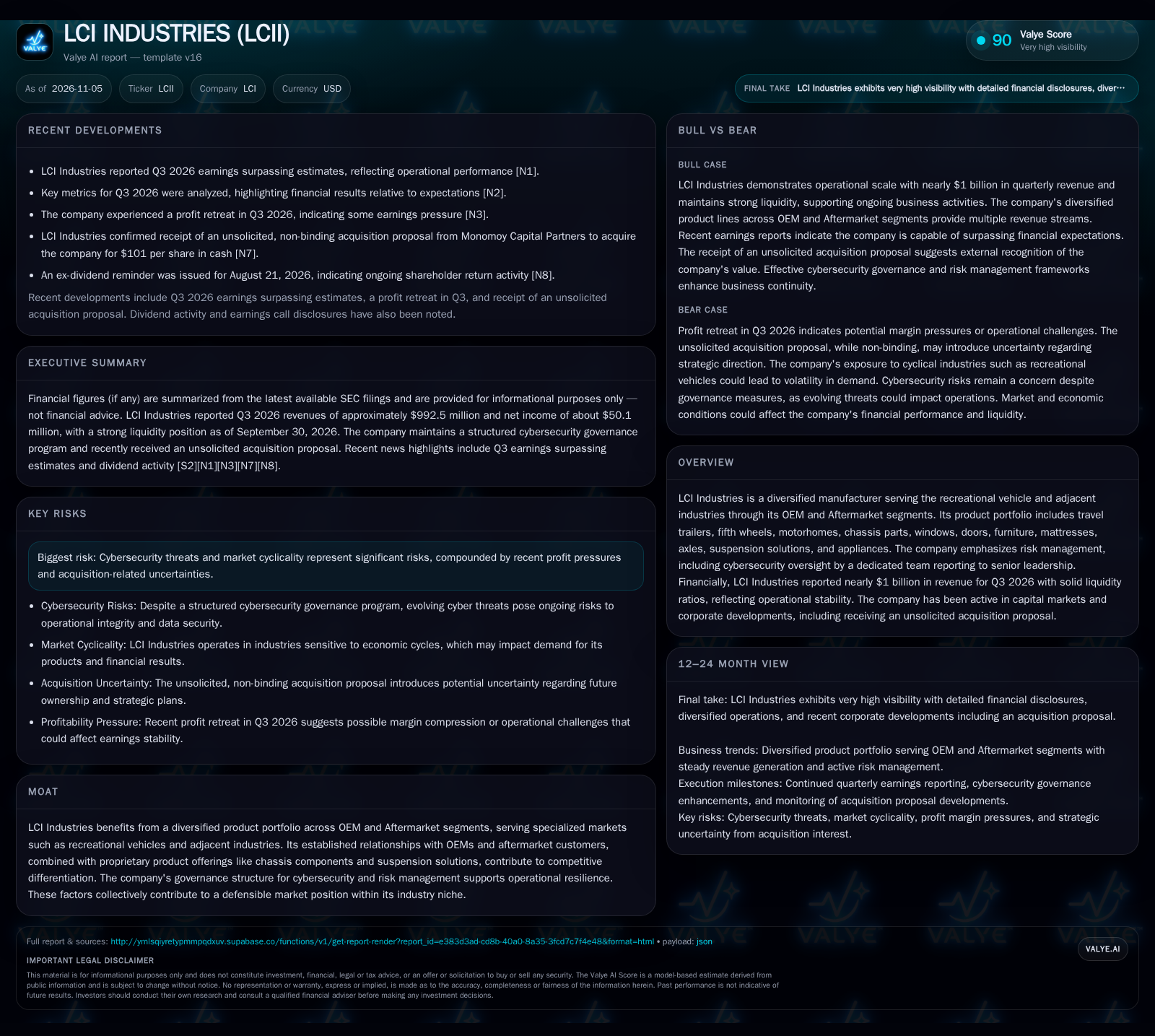
LCI Industries reported nearly $1 billion in Q3 2026 revenue, reported liquidity position, and a diversified product mix across OEM and Aftermarket segments. Despite surpassing earnings estimates, the company experienced a profit retreat, and now faces strategic uncertainty following an unsolicited $101/share acquisition proposal from Monomoy Capital Partners. The business’s ability to defend margins and navigate market cyclicality will shape value creation in the near term. [S2] [N1] [N3] [N7]
LCI Industries stands at a pivotal moment. Its nearly $1 billion in quarterly revenue and reported liquidity position reflect an entrenched presence across OEM and Aftermarket channels in the recreational vehicle (RV) and adjacent sectors. Yet this operational scale has not insulated LCI from margin pressures, as evidenced by a recent profit retreat even amid revenue outperformance. The unsolicited, non-binding $101/share acquisition proposal from Monomoy Capital Partners further complicates the outlook, introducing questions about strategic direction and long-term value realization. Understanding LCI’s business economics, market position, and the forces shaping future scenarios is essential for assessing the company’s trajectory.
Recent Results and Strategic Overtures Reshape the Narrative
LCI Industries reported Q3 2026 revenues of approximately $992.5 million and net income of about $50.1 million, translating to basic EPS of $2.06. This top-line performance surpassed market estimates, but the company also experienced a retreat in profit for the quarter, suggesting margin compression or shifting cost dynamics. As of September 30, 2026, LCI held $245.6 million in cash and reported liquidity-ratio trends of 2.82, indicating reported liquidity position. The most consequential recent development, however, is the unsolicited, non-binding acquisition proposal from Monomoy Capital Partners to acquire LCI for $101 per share in cash—a move that signals external recognition of value, while also injecting uncertainty around future strategy and control. [S2] [N1] [N3] [N7]
Revenue Streams, Operating Leverage, and the Margin Equation
LCI Industries generates revenue through two primary channels: the OEM segment, supplying components and assemblies to recreational vehicle manufacturers, and the Aftermarket segment, which targets end users and service providers. The OEM business is typically high-volume but sensitive to RV production cycles, while the Aftermarket offers more resilience and the potential for higher margins due to replacement and upgrade demand. LCI’s product mix—ranging from chassis parts and axles to furniture, doors, and appliances—diversifies risk and can help smooth revenues across economic swings.
Operating leverage is a critical dynamic: high fixed manufacturing overhead can boost profits during upswings in demand but exacerbate margin compression during slowdowns. Recent profit retreat despite strong revenue hints at cost inflation, pricing pressure, or unfavorable product mix—common challenges in cyclical, capital-intensive manufacturing businesses. The company’s liquidity position is robust, but sustaining margin improvements may require disciplined cost management, pricing power in differentiated products, or further Aftermarket growth.
Capital needs are moderate for ongoing operations but could rise if LCI pursues automation, capacity expansion, or strategic acquisitions—especially relevant if the company remains independent amid acquisition interest.
The interplay between fixed and variable costs within LCI's manufacturing operations further complicates margin dynamics. In periods of rising demand, fixed costs are spread over a larger output base, enhancing operating leverage and profitability. Conversely, during downturns, the inability to reduce fixed expenses proportionally leads to margin compression. This sensitivity underscores the importance of flexible cost structures or strategic initiatives aimed at reducing fixed overhead. Additionally, the company's pricing strategy must balance the need to maintain volume with the imperative to preserve margin integrity, especially when raw material prices fluctuate or competitive pressures intensify. Effective hedging or supply chain optimization could mitigate some input cost volatility but may not fully offset cyclical shocks.
Defensible Niche or Commodity Exposure? Assessing LCI’s Industry Standing
LCI Industries’ competitive position is anchored in its broad product portfolio and entrenched relationships with both OEMs and aftermarket distributors. In the RV supply chain, switching costs can be meaningful for OEMs due to integration complexity, but end customers in the Aftermarket may be more price sensitive. LCI’s proprietary chassis, suspension, and specialized components can confer some pricing power, yet much of the product lineup (e.g., windows, furniture, appliances) faces commoditization risk and competition from both domestic and international suppliers.
Adjacent industry exposure (such as marine, bus, or specialty vehicle components) could provide incremental growth and diversification, but also exposes LCI to a wider array of competitors and potential substitutes. The company’s focus on risk management—including cybersecurity governance—supports operational resilience, but does not directly confer a moat. Ultimately, LCI’s defensibility will hinge on its ability to innovate, maintain quality, and leverage scale to absorb cost shocks better than smaller rivals.
LCI’s competitive resilience also hinges on its supply chain management and sourcing strategies. Reliance on global suppliers may expose the company to geopolitical risks, tariffs, or logistical disruptions, which can increase costs or delay deliveries. Conversely, developing localized or diversified supplier networks could enhance supply stability and cost control. The company’s scale may provide bargaining power, but only if supplier relationships are managed proactively. Additionally, investment in digital tools for inventory management and demand forecasting could improve responsiveness to market fluctuations, reducing excess inventory and associated carrying costs. Such operational efficiencies contribute to a defensible competitive position by enabling better cost management and customer service.
Another dimension influencing LCI’s positioning is the evolution of technology and materials in the recreational vehicle space. Advances in lightweight composites, energy-efficient components, or smart features may redefine product requirements. If LCI anticipates and adapts to these trends, it can differentiate its offerings and potentially enter higher-margin niches. Failure to innovate or delays in adoption could result in loss of market share to more agile competitors or new entrants. Strategic partnerships or investments in research and development may be necessary to maintain technological relevance and meet evolving customer demands, thereby reinforcing the company’s industry standing.
Margin Recovery and Strategic Interest Unlock Shareholder Value
A favorable scenario for LCI Industries sees stabilization or recovery in RV production volumes, coupled with easing input cost pressures and improved product mix toward higher-margin Aftermarket offerings. This could restore historical margin levels and reignite earnings growth, especially if LCI leverages its scale to negotiate better terms with suppliers or passes through price increases. The unsolicited acquisition proposal could catalyze a competitive bidding process, driving a premium for shareholders or prompting management to accelerate operational improvements to fend off a takeover.
Evidence confirming this scenario would include sequential margin expansion, sustained Aftermarket revenue growth outpacing OEM, and announcements of new product launches or customer wins. A formalized acquisition offer at a higher price, or the entry of additional bidders, would further boost the bull case.
Navigating Cyclicality with a Diversified Product Mix
The most plausible near-term scenario involves LCI continuing to operate as an independent company, using its diversified portfolio to buffer against moderate declines or stagnation in RV and adjacent markets. Margins may remain under pressure from cost inflation and competitive pricing, but disciplined cost controls and incremental Aftermarket growth could help stabilize profitability. The acquisition proposal remains unresolved, acting as a potential overhang but not resulting in a near-term transaction.
This scenario would be confirmed by quarterly results showing stable or modestly improving revenues, flat to slightly compressed margins, and no significant strategic shifts. A lack of further acquisition activity or only incremental updates on the proposal would reinforce the status quo.
Cyclical Downturn and Strategic Drift Weigh on Performance
In a less favorable scenario, RV production enters a deeper cyclical downturn, sharply reducing OEM demand and exposing LCI’s fixed cost structure. If input costs remain elevated or competitive pressures force price concessions, margins could contract further, potentially eroding profitability. The unresolved acquisition proposal could distract management or create uncertainty among customers and employees, impeding execution. Cybersecurity incidents or supply chain disruptions could compound operational and reputational risks.
Signs confirming this outcome would include a sequential decline in both OEM and Aftermarket revenues, further margin compression, negative operating leverage, and lack of progress or withdrawal of the acquisition proposal. Rising inventories or working capital needs could also signal deteriorating demand.
Thesis-Testing Developments to Track for LCI Industries
Quarterly gross and operating margin trends—evidence of cost control effectiveness or further pressure would support or challenge the margin recovery thesis.
Aftermarket segment revenue growth versus OEM—if disclosed, this would clarify the extent of diversification and resilience against RV production swings.
Updates on the Monomoy Capital Partners acquisition proposal, including any competing bids or movement toward a formal offer.
New product launches, customer wins, or entry into adjacent markets, which could signal innovation and market share gains.
Evidence of cost inflation in key inputs (e.g., steel, labor) and LCI’s ability to pass through or absorb these costs.
Cybersecurity incidents or disclosures—would test the operational resilience and risk management claims.
Inventory and working capital trends, especially if rising, could indicate softening demand or execution challenges.
Disclaimer: This is research-only, informational analysis and not investment advice. It may include AI-generated interpretation and general industry context. Always verify important details using primary sources.

Comments