
Commerce Bancshares: Relationship Banking, Regional Expansion, and the Stakes of Credit Discipline
Commerce Bancshares continues to deliver solid profitability and capital strength, leveraging a relationship-driven model and diversified revenue streams. Yet, as non-interest expenses rise and credit loss estimation grows more complex, the bank’s ability to balance growth with risk management will shape its next phase.
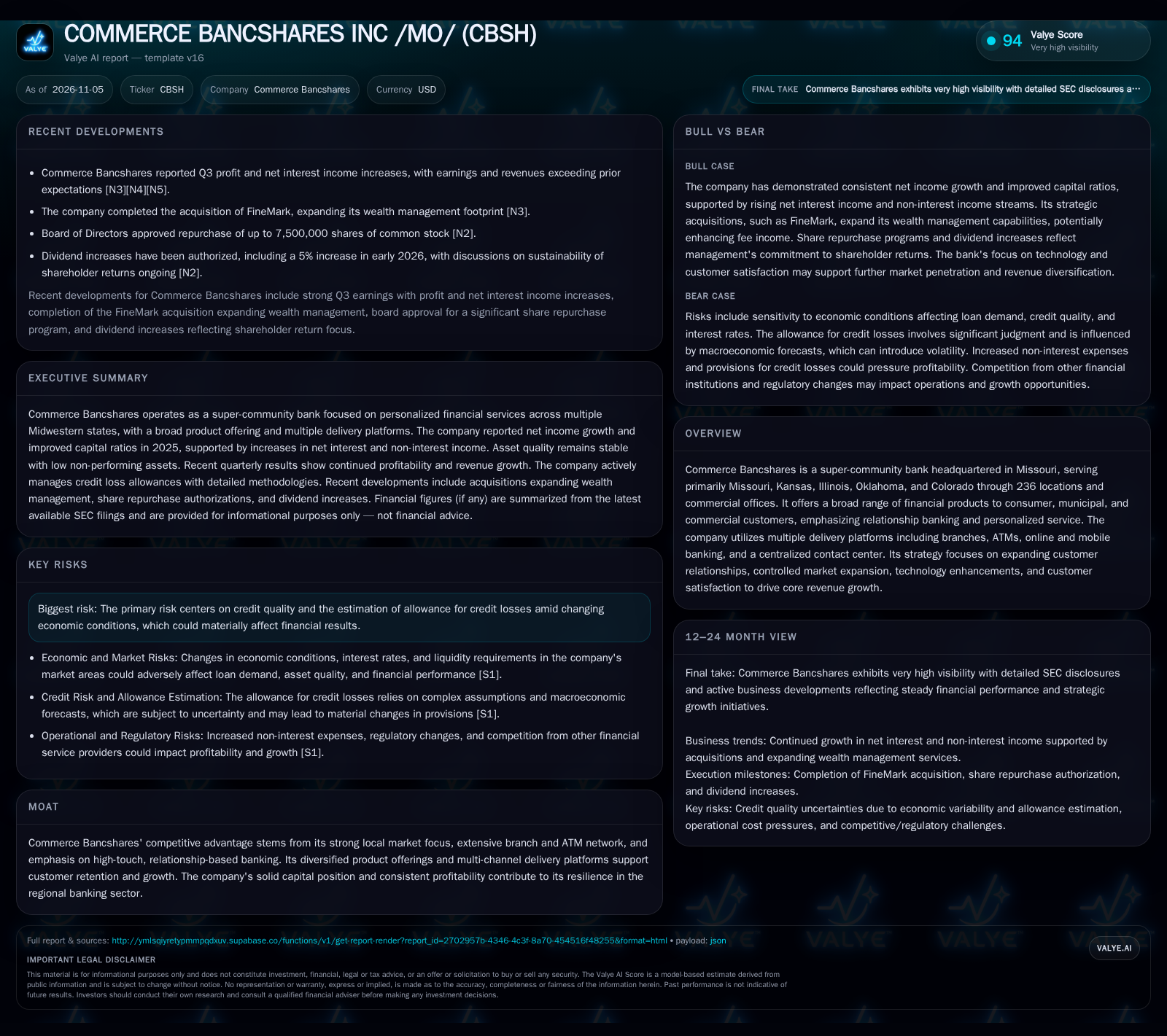
Commerce Bancshares increased net income by 7.6% in 2025, driven by both net interest and non-interest income growth, and finished the year with strong capital ratios and low non-performing assets. The company’s regional strategy and technology investments support customer expansion, but rising expenses and the inherent uncertainty in credit loss allowances highlight the importance of disciplined risk management and operational efficiency [S1] [S2].
Commerce Bancshares’ recent performance reflects a disciplined approach to regional banking: solid profitability, conservative credit management, and a multi-channel delivery model that caters to both consumer and commercial customers. The bank’s ability to generate growth in a challenging macro environment—while keeping asset quality steady and capital ratios robust—underscores the strengths of its relationship-driven strategy. However, as non-interest expenses rise and credit loss estimation becomes more nuanced, the question is whether Commerce can sustain this balance as market conditions evolve.
Recent Performance Anchors the Expansion Thesis
Commerce Bancshares reported a 7.6% increase in net income for 2025, reaching $566.3 million, with diluted EPS up 9.5% year over year. Return on average assets was 1.79%, and return on average common equity reached 15.76%—metrics that place the bank among the higher performers in regional banking [S1]. Total revenue grew by 6.5%, with notable contributions from both net interest income (up $71.6 million) and non-interest income (up $36.7 million), especially from trust and deposit account fees [S1]. Asset quality remains strong, with non-performing assets at just 0.10% of loans outstanding at year-end 2025 [S1]. The tangible common equity to tangible assets ratio improved to 11.11% [S1]. For Q3 2026, Commerce reported $154.99 million in net income and $511.8 million in cash and equivalents [S2]. These results underpin the company’s disciplined growth and capital preservation, while providing a foundation for continued regional expansion.
How Relationship Banking Drives Revenue and Cost Dynamics
Commerce Bancshares’ revenue stream is balanced between net interest income—driven by loan and securities yields minus funding costs—and non-interest income from trust, deposit, and other fee-based products [S1]. The bank’s relationship-centric model is designed to deepen wallet share through cross-selling, which can increase both the stickiness of customer relationships and the share of recurring fee income. The company’s multi-channel delivery (branches, ATMs, digital, and contact center) allows for flexibility in servicing diverse customer segments, but also introduces a mix of fixed and variable costs. Branch and personnel expenses remain significant, as evidenced by the 3.0% increase in non-interest expense in 2025, largely from higher salaries and professional services [S1]. Operating leverage is plausible if revenue growth outpaces expense increases, particularly as digital adoption reduces marginal servicing costs. However, investments in technology and compliance may temper margin expansion in the near term. Capital needs are moderate, given the company’s strong tangible common equity ratio, but credit provisioning remains a swing factor as macro conditions evolve.
Regional Focus and Multi-Channel Access: Double-Edged Sword in a Crowded Market
Commerce Bancshares’ competitive edge lies in its super-community model: strong local market presence, personalized service, and a broad product suite. Its extensive branch and ATM network in the Midwest differentiates it from digital-only entrants and national banks that may lack local touch. However, this footprint also exposes the company to regional economic cycles and intensifies fixed cost pressures. The rise of fintechs and direct digital banks increases competition for deposits and fee-generating services, particularly among younger demographics. National and super-regional banks can compete on scale, product breadth, and technology investment, while credit unions and community banks vie for loyalty and local relevance. Commerce’s emphasis on technology improvements and customer satisfaction aims to defend its franchise, but ongoing innovation and cost discipline will be required to sustain its advantage in an industry where switching barriers are modest and digital convenience is increasingly decisive.
Compounding Returns Through Fee Growth, Technology, and Pristine Credit
If Commerce Bancshares can continue to grow non-interest income—especially through trust, wealth management, and expanded fee-based products—while maintaining low credit losses and leveraging technology to drive operating efficiencies, it could generate above-peer returns on equity and assets. A favorable scenario would likely be marked by sustained double-digit growth in wealth management fees, stable or declining non-performing asset ratios, and evidence of operating leverage (i.e., revenue growth consistently outpacing expense growth). Confirmation would come from continued EPS growth above regional bank averages, further improvement in tangible common equity ratios, and a stable or rising proportion of non-interest income in the revenue mix. Conversely, if fee growth stalls, technology investments fail to deliver cost savings, or asset quality deteriorates, this scenario would be undermined.
Steady Expansion Balancing Growth, Risk, and Cost Pressures
The most plausible path for Commerce Bancshares is continued moderate growth in both net interest and non-interest income, supported by regional economic stability and incremental gains from technology improvements. Asset quality is likely to remain benign, with non-performing assets and charge-offs fluctuating within historical ranges, barring a sharp economic downturn. Non-interest expenses may continue to rise modestly as the company invests in talent and technology, but revenue growth should be sufficient to preserve margins. The allowance for credit losses will remain a key variable, with provisioning influenced by macroeconomic forecasts and portfolio mix. Confirmation of this scenario would be reflected in stable or slightly improving efficiency ratios, consistent returns on equity and assets, and continued outperformance on asset quality metrics relative to peers. Upside or downside would be signaled by material changes in these indicators.
Credit Deterioration and Cost Inflation Threaten Profitability
An adverse scenario would unfold if economic conditions in Commerce’s core markets weaken, leading to higher loan delinquencies, rising charge-offs, and a spike in non-performing assets. This would force higher provisions for credit losses, compressing earnings and potentially eroding capital ratios. At the same time, if non-interest expenses accelerate—due to wage inflation, regulatory/compliance costs, or technology overruns—operating leverage could turn negative. Confirmation would come from a material increase in net loan charge-offs, a sustained uptick in non-performing assets, worsening efficiency ratios, and a decline in return on average assets and equity. Early signals would include management commentary on deteriorating credit trends, negative revisions to macroeconomic assumptions in allowance models, or a marked slowdown in fee income growth.
Benchmarks for Testing Commerce Bancshares’ Growth and Risk Balance
Net interest margin trends—if disclosed—will help gauge Commerce’s ability to reprice loans and deposits in a shifting rate environment.
Growth rate and composition of non-interest income, particularly trust and wealth management fees, will indicate success in diversifying revenue streams.
Non-interest expense growth relative to revenue growth: sustained operating leverage would confirm cost discipline.
Net loan charge-offs and non-performing asset ratios: a spike in either would signal emerging credit stress.
Allowance for credit losses as a percentage of loans, and any significant adjustments driven by macroeconomic forecasts.
Tangible common equity to tangible assets ratio: material declines could flag capital erosion or rising risk.
Digital adoption rates and customer satisfaction metrics—if disclosed—would clarify the impact of technology investments and service model evolution.
Management guidance or commentary on regional economic trends and loan demand, which could foreshadow shifts in credit quality or growth outlook.
Disclaimer: This is research-only, informational analysis and not investment advice. It may include AI-generated interpretation and general industry context. Always verify important details using primary sources.

Comments