
CoreCivic After Facility Sales: Policy Tailwinds, Contract Fragility, and the Changing Economics of Private Detention
CoreCivic’s fortunes have surged on the back of federal immigration enforcement funding and a wave of facility sales, but contract instability and policy risk remain structural headwinds. The company’s ability to monetize assets while retaining management contracts highlights operational flexibility — yet the future revenue base is increasingly exposed to government priorities, labor pressures, and uncertain contract renewals.
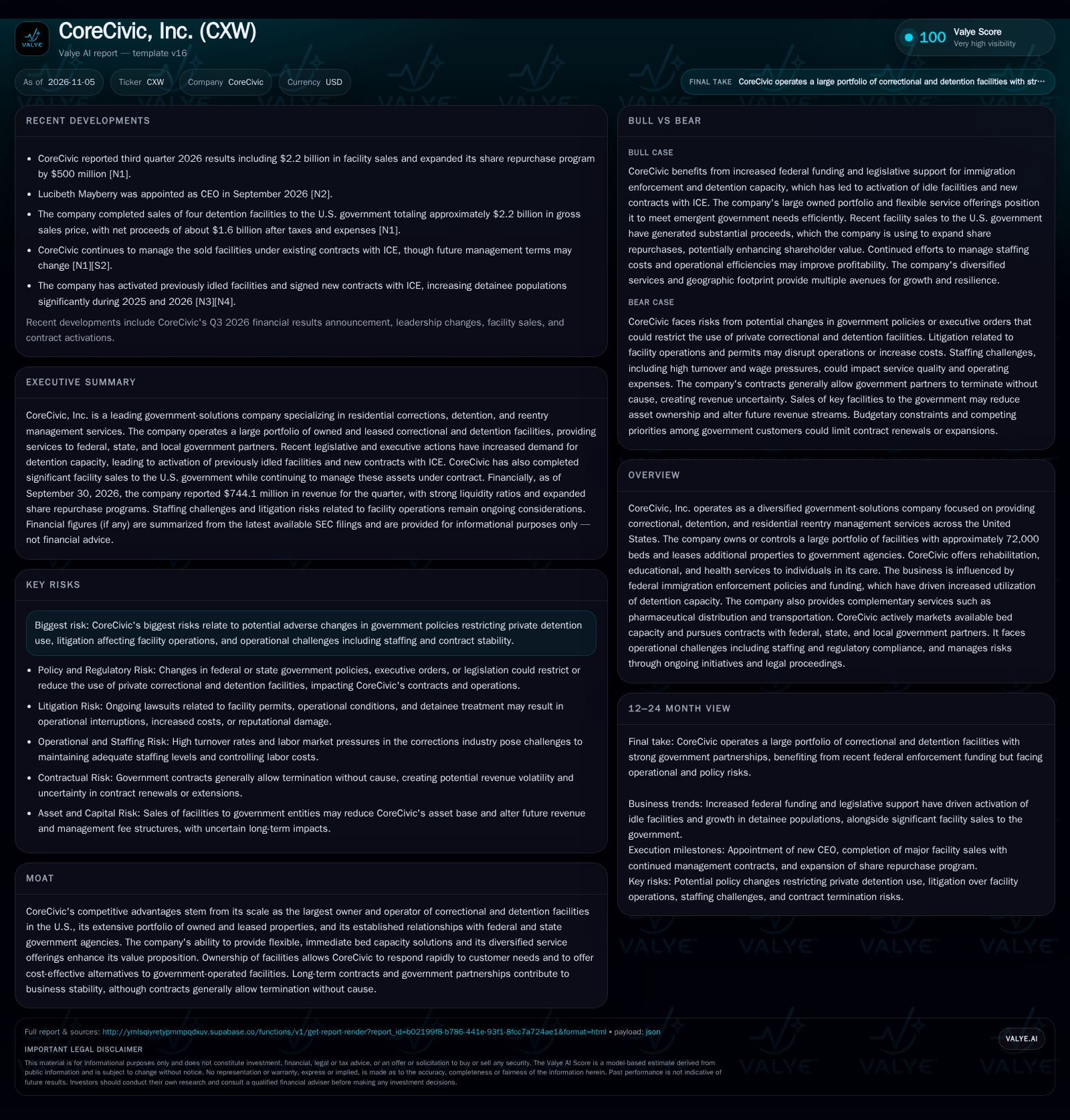
CoreCivic has capitalized on increased federal funding and the activation of idled facilities, boosting detainee populations and generating $2.2 billion from facility sales in Q3 2026. While it retains management contracts on sold properties and has expanded its share repurchase program, the company faces contract termination risk, staffing challenges, and exposure to shifting government policies. The sustainability of current margins and growth depends on continued federal demand and CoreCivic’s ability to navigate labor and regulatory pressures. [S2] [N1]
CoreCivic, Inc. stands at a pivotal juncture in 2026, having leveraged a surge in federal immigration enforcement funding to both monetize its asset base and reactivate dormant capacity. The company’s $2.2 billion in facility sales and expanded share repurchase program reflect a balance sheet transformation, while new and modified contracts with ICE have sharply increased detainee populations. However, the core business remains fundamentally tied to volatile government priorities, contract fragility, and persistent staffing headwinds. As CoreCivic shifts from asset-heavy ownership to a greater reliance on management contracts and leased assets, its long-term economics and risk profile hinge on policy continuity, contract stability, and operational execution.
Facility Sales, Contract Wins, and the Federal Policy Surge: What’s Changed for CoreCivic in 2026
CoreCivic reported $2.2 billion in facility sales in Q3 2026, generating approximately $1.6 billion in net proceeds after taxes and expenses. Despite divesting ownership, the company continues to manage these facilities under existing contracts, though the longevity of these agreements is uncertain [N1] [S2]. At the same time, the passage of the One Big Beautiful Bill Act (OBBBA) appropriating $75 billion to ICE through 2029 has driven a sharp increase in demand for detention services, enabling CoreCivic to reactivate multiple idled facilities and grow detainee populations by about 8,100 individuals (an 80.1% increase) from early 2025 through September 2026 [S1] [S2]. The company’s financials reflect this momentum: $744.1 million in Q3 2026 revenue and a current ratio of 2.41 as of September 30, 2026 [S2]. CoreCivic also expanded its share repurchase program by $500 million, signaling a shift in capital allocation priorities [N1].
Asset Monetization, Contract Economics, and the Cost Structure Puzzle
CoreCivic’s business model is built on a mix of facility ownership, long-term leasing, and government service contracts. Historically, owning physical assets provided both operational control and a stable base of fixed costs, with revenue tied to occupancy rates, per diem payments, and supplemental service fees. The recent facility sales shift part of the company’s economics toward management and service contracts, potentially reducing capital intensity but increasing reliance on contract renewals and fee structures negotiated with government partners.
The economics of these contracts are highly sensitive to utilization rates and government policy. Most contracts allow for termination without cause, introducing considerable revenue risk. Operating leverage is a core dynamic: with salaries and benefits comprising about 62% of expenses, CoreCivic’s margins are vulnerable to labor market shifts, wage inflation, and staffing shortages. If facility utilization remains high, incremental detainee volume can drive strong cash flow due to relatively fixed overhead. However, sudden contract terminations or population declines can quickly erode profitability.
Recent asset sales have injected substantial liquidity, but future earnings will hinge on the mix of management fees versus traditional facility-based revenue. The company’s expanded share buyback program suggests management sees value in returning capital to shareholders, but this also reduces flexibility for large-scale reinvestment if market conditions change.
Scale, Flexibility, and the Limits of the Private Detention Moat
CoreCivic’s scale as the largest owner and manager of correctional and detention facilities in the US provides a meaningful advantage in both negotiating with government agencies and absorbing regulatory shocks. Its portfolio of 64 facilities and approximately 72,000 beds, along with additional properties leased to government partners, enables rapid response to surges in demand—an attribute especially valuable during periods of heightened immigration enforcement [S2].
However, the private corrections industry is structurally vulnerable to policy reversals and public scrutiny. Federal and state governments can—and sometimes do—shift away from private operators due to political or reputational pressures. CoreCivic’s main competitors are other large private corrections companies and, increasingly, government-operated facilities. Substitutes include direct government construction/operation of new capacity and non-custodial alternatives (such as electronic monitoring or community supervision programs).
CoreCivic’s competitive edge hinges on its ability to offer flexible, cost-effective, and turnkey capacity, but this advantage can be eroded if governments prioritize public operation or regulatory changes restrict private sector participation. The company’s emphasis on diversified services—such as reentry management, health, education, and alternative programs—could partially mitigate these risks by broadening its addressable market.
If Federal Enforcement Policy Remains Robust, What Could Unlock Further Growth?
The most favorable outcome for CoreCivic is a sustained period of strong federal enforcement and detention funding—especially if the OBBBA’s appropriations continue to translate into high utilization rates and new contract awards through 2029. In this scenario, CoreCivic could leverage its available bed capacity, activate additional idled facilities, and potentially negotiate higher management fees or longer-term contracts. Additional federal or state appropriations for detention and reentry services could further expand the addressable market.
Evidence that would confirm this scenario includes: renewal or extension of existing management contracts (especially for the recently sold facilities), continued growth in detainee populations, and new contract wins for both facility management and ancillary services. Strong operating leverage from higher occupancy and successful containment of staffing costs would translate into margin expansion and robust free cash flow.
Transitioning Toward a Leaner, More Contract-Dependent Model
The most plausible trajectory is a period of steady but more volatile performance as CoreCivic adapts to a revenue mix increasingly weighted toward management contracts and leased assets rather than full facility ownership. While federal funding remains supportive in the near term, the company must navigate the ongoing risk of contract terminations, labor cost inflation, and potential policy shifts at the federal or state level.
In this scenario, CoreCivic maintains high utilization at its core facilities, but faces episodic pressure on margins from staffing challenges and periodic contract renegotiations. The expanded share repurchase program continues, but future capital allocation decisions become more cautious as the company monitors policy signals and adjusts its portfolio. Confirmation would come from stable quarterly revenue, modest growth in management fees, and the ability to sustain or gradually improve operating margins despite labor headwinds.
Contract Instability, Policy Reversals, and Labor Pressures: The Risk of Revenue Compression
An adverse scenario materializes if federal or state governments enact policies restricting the use of private detention facilities, or if existing contracts are terminated without cause. Large customer concentration—particularly reliance on ICE and federal agencies—exacerbates this risk, as even a single lost contract could meaningfully reduce revenue and facility utilization.
In this environment, CoreCivic could be forced to idle or repurpose facilities, absorb severance and closure costs, and face increased legal and reputational challenges. Labor market tightness and wage escalation could further compress margins, especially if lower occupancy prevents cost absorption. Evidence confirming this scenario would include a decline in quarterly occupancy rates, loss of major contracts, rising litigation costs, and a reversal in share repurchase or capital return activity.
Milestones and Metrics That Will Shape CoreCivic’s Post-Sale Trajectory
Renewal rates, term lengths, and pricing of management contracts for the four recently sold facilities: If disclosed, these would clarify the durability of the new revenue base.
Occupancy levels and utilization rates across CoreCivic’s owned and managed facilities, especially those reactivated in 2025–2026.
Quarterly labor expense trends, including wage inflation, turnover rates, and the success of workforce management initiatives.
New contract wins or expansions with federal, state, or local agencies—particularly in reentry, alternative-to-incarceration, or ancillary service lines.
Any changes in federal or state policy affecting private detention contracting, especially legislative or executive actions targeting ICE or private operators.
Legal or regulatory developments—such as lawsuits, permit challenges, or compliance investigations—that could impact facility operations or reputation.
Share repurchase and capital allocation activity, including pace and scale of buybacks relative to free cash flow and liquidity.
Disclaimer: This is research-only, informational analysis and not investment advice. It may include AI-generated interpretation and general industry context. Always verify important details using primary sources.

Comments