
Ormat Technologies: Stable Cash Flows, Geothermal Expansion, and the Stakes of Renewable Diversification
Ormat Technologies leverages its vertically integrated geothermal platform and long-term PPAs to deliver revenue stability, while expanding its energy storage and solar PV portfolio. As the company accelerates enhanced geothermal systems and hybrid project development, the interplay between capital intensity, operational execution, and competitive dynamics will shape its growth trajectory and risk profile.
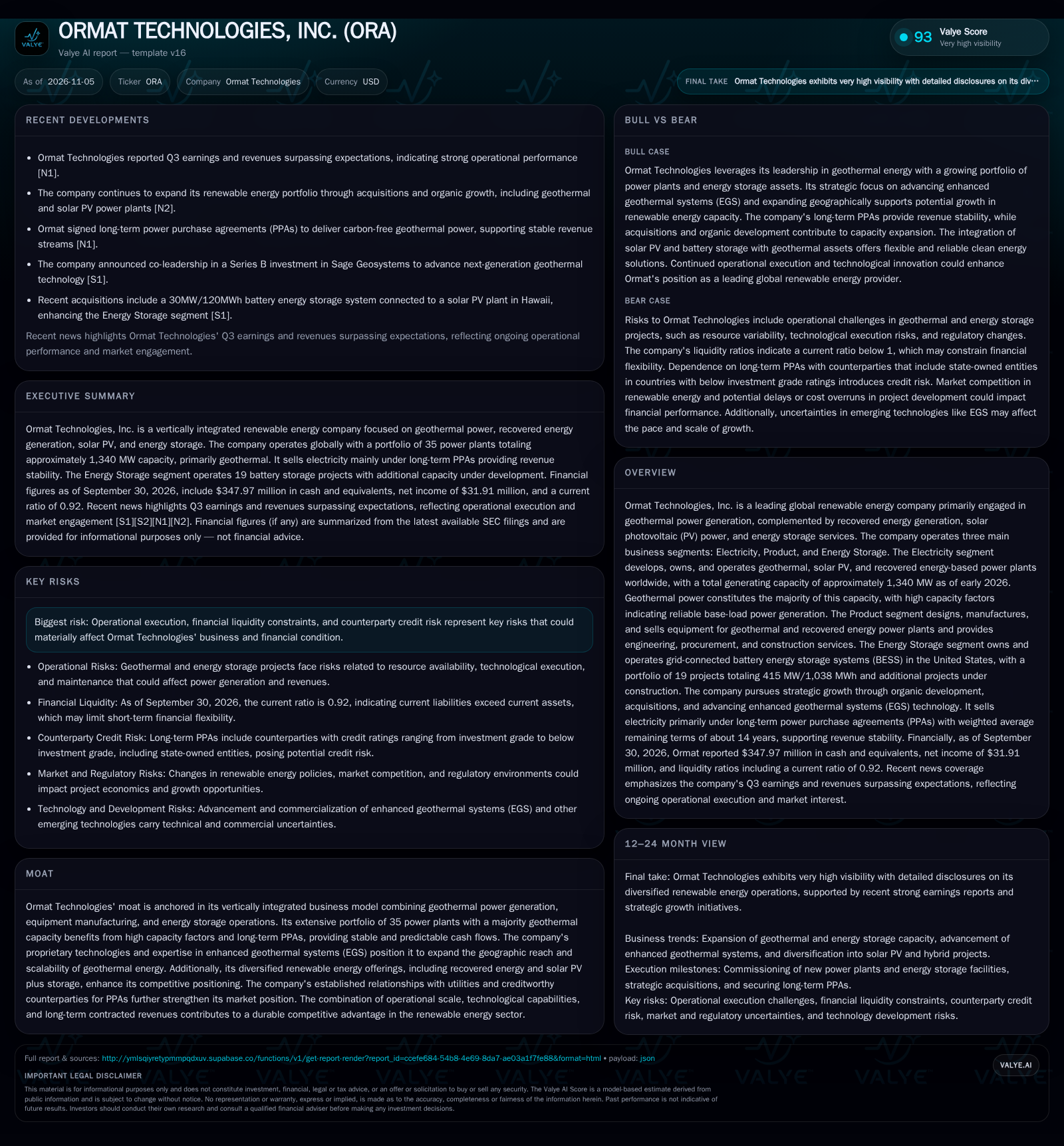
Ormat Technologies operates a global portfolio of geothermal, recovered energy, solar PV, and battery storage assets, anchored by long-term power purchase agreements. The company's ability to scale next-generation geothermal and balance capital demands with revenue stability will be pivotal in the evolving renewables landscape. [S1] [S2] [N1] [N2]
Ormat Technologies stands at a critical juncture in renewable energy. Its core geothermal power operations, supported by high-capacity factors and long-term power purchase agreements, deliver predictable cash flows in a volatile market. Recent growth in energy storage and solar PV assets, alongside investments in next-generation geothermal technology, signal a push for diversification and innovation. [S1] [S2] [N1] [N2]
Recent Operational Momentum and Financial Position: The 2026 Snapshot
As of early 2026, Ormat Technologies operates 35 power plants globally with a combined capacity of 1,340 MW, of which geothermal accounts for over 81%. The company’s portfolio also includes 19 battery energy storage system (BESS) projects totaling 415 MW/1,038 MWh, underscoring a strategic emphasis on storage alongside its core geothermal base. Ormat’s Q3 2026 earnings and revenues beat expectations, a signal of successful execution and underlying demand for its renewable offerings. Long-term PPAs, with weighted average remaining terms of 14 years, anchor future revenues but also expose Ormat to counterparty credit risks, especially where off-takers are state-owned or sub-investment grade. Recent acquisitions and capacity additions (115 MW since early 2025) reflect ongoing growth, but these expansions heighten the importance of capital stewardship and operational discipline. [S1] [S2] [N1] [N2]
Revenue Stability Meets Capital Intensity: Ormat’s Economic Model
Ormat’s economics are anchored in the sale of electricity under long-term PPAs, which provide high revenue visibility and mitigate spot price volatility. Geothermal plants offer base-load generation with capacity factors as high as 84%, making them attractive for utilities seeking reliable clean energy. These PPAs, often structured at fixed or inflation-linked rates, limit upside from surging power prices but secure predictable cash flows and support debt financing for capital-intensive projects.
The company’s vertically integrated model—encompassing project development, equipment manufacturing, and operations—enables margin capture across the value chain, though it also concentrates execution risk. Energy storage projects, while smaller in aggregate capacity, may offer higher returns per MW due to value stacking (e.g., frequency response, peak shaving) but are exposed to evolving market rules and merchant price risk unless similarly contracted.
Ormat’s capital needs are substantial: geothermal development requires high upfront investment, long permitting cycles, and resource risk before commercial operation. The expansion into enhanced geothermal systems (EGS) and hybrid solar-plus-storage projects could increase unit economics variability and execution risk. Operating leverage is present, but so is the risk of project delays, cost overruns, or underperformance, which could compress margins if not offset by scale or technological edge.
Vertical Integration, Technology, and the Shifting Competitive Landscape
Ormat’s competitive position in geothermal is underpinned by its vertical integration—combining project development, proprietary technology, and equipment manufacturing. This structure can lower project costs, accelerate development timelines, and create technical barriers for would-be entrants. High capacity factors and long-term PPAs further differentiate geothermal from intermittent renewables, appealing to utilities with base-load needs.
Counterforces include intensifying competition from wind, solar PV (often with storage), and emerging grid-scale storage providers. These alternatives benefit from rapid cost declines, simpler permitting, and shorter development cycles. In markets where regulatory frameworks favor lowest-cost renewables, geothermal’s higher upfront capex can be a disadvantage unless offset by capacity value or policy incentives. Ormat’s push into enhanced geothermal systems (EGS) aims to expand the addressable market geographically and technologically, but success is not assured given the technical and commercial challenges of EGS at scale.
Product segment activities—equipment sales and EPC services—offer exposure to broader geothermal and recovered energy markets but may have lower margins and higher cyclicality than contracted electricity sales. In the energy storage segment, Ormat faces established battery integrators and independent power producers, where project siting, market design, and integration with renewables are key differentiators. The company’s long-standing utility relationships and track record of execution are assets, but the pace of innovation in storage and hybrid solutions could erode traditional advantages if not matched by continued R&D and commercial agility.
Unlocking Growth: EGS Breakthroughs and Storage-Enhanced Hybrid Projects
A favorable scenario for Ormat sees the company successfully scaling enhanced geothermal systems (EGS), enabling entry into new geographies and accessing deeper, hotter reservoirs previously uneconomic with conventional geothermal. If EGS projects reach commercial scale with attractive economics, Ormat could significantly expand its project pipeline, increase contracted capacity, and diversify away from resource-constrained legacy operations.
Further upside could be realized if energy storage and solar-plus-storage hybrids achieve strong utilization and margin profiles, especially if regulatory and market structures provide adequate compensation for capacity and ancillary services. Strategic investments in next-generation technology companies (such as Sage Geosystems) could yield intellectual property advantages or first-mover benefits in emerging geothermal applications.
Evidence confirming this scenario would include: (1) successful commissioning and performance data from EGS demonstration projects; (2) accelerated signing of new long-term PPAs for hybrid projects; (3) upward revisions to capacity expansion targets; and (4) improving cash conversion, enabling self-funded growth despite capex demands. On the commercial side, new utility partnerships or large data center offtake agreements for carbon-free power would further bolster the growth thesis.
Sustaining Growth Through Incremental Capacity and PPA Stability
The most plausible near-term outcome is continued measured expansion of Ormat’s geothermal and storage portfolios, underpinned by long-term PPAs that provide earnings stability. Incremental growth through a mix of organic development, select acquisitions, and opportunistic investments in emerging technologies is likely to dominate, with capacity additions broadly in line with recent years.
Revenue and EBITDA visibility remain high due to the PPA structure, but margin expansion is constrained by the high capital intensity of geothermal and the necessity to refinance or roll over existing liabilities given the liquidity profile. The Product segment contributes to earnings but remains subject to project-cycle volatility. Energy storage growth is steady, but the majority of new projects are likely to be contracted rather than merchant to maintain risk discipline.
Key confirming evidence would include: (1) steady annual increases in installed and contracted capacity; (2) renewal of PPAs with favorable terms; (3) maintenance of current operating margins and credit metrics; and (4) successful refinancing or improvement in liquidity ratios. Falsifying evidence would be a material drop in contracted capacity, persistent negative free cash flow, or a spike in project execution issues.
Liquidity Constraints and Execution Risks Threaten Expansion Ambitions
In a negative scenario, Ormat’s below-1 current ratio signals sustained liquidity pressure, limiting the company’s ability to fund new projects or forcing asset divestitures at suboptimal valuations. Project delays, cost overruns, or resource underperformance—particularly in EGS or international geothermal—could erode margins and undermine the value proposition of new developments.
If a major PPA counterparty defaults or renegotiates terms (especially those with below investment grade ratings), revenue stability would be compromised and refinancing risk could intensify. Regulatory changes or increased competition from lower-cost renewables might reduce Ormat’s ability to secure new contracts on favorable terms, pressuring returns on incremental investment.
Evidence supporting this scenario would include: (1) a persistent or worsening liquidity position (current and cash ratios deteriorating); (2) significant project write-downs or impairment charges; (3) a meaningful rise in uncontracted or merchant exposure; and (4) loss of major contracts or adverse regulatory outcomes. Failure to secure new capacity additions or delays in EGS commercialization would further validate downside risks.
Milestones and Metrics That Will Define Ormat’s Next Chapter
Commissioning and performance data from enhanced geothermal systems (EGS) pilot and demonstration projects would help test the scalability and economics of next-generation geothermal.
Trends in the current ratio and cash ratio, as well as refinancing or capital-raising activity, would provide insight into the sustainability of Ormat’s growth strategy and its ability to absorb project delays or shocks.
The pace and terms of new long-term PPA signings, particularly with creditworthy counterparties, will be central to maintaining revenue stability as existing contracts mature.
Annual growth in installed and contracted capacity across geothermal, energy storage, and hybrid projects will show whether Ormat can sustain its expansion trajectory.
Updates on project execution—cost overruns, delays, or resource shortfalls—especially for international or first-of-kind EGS and storage projects, would help assess operational risk.
Disclosure of major customer or offtaker concentration, if provided, would clarify the extent of counterparty credit risk and revenue diversification.
If disclosed, segment-level margin trends (Electricity, Product, Energy Storage) would provide insight into the company’s ability to defend profitability as its mix evolves.
Disclaimer: This is research-only, informational analysis and not investment advice. It may include AI-generated interpretation and general industry context. Always verify important details using primary sources.

Comments