
Kearny Financial Corp.: Navigating Loan Growth, Margin Dynamics, and Shareholder Returns in a Shifting Banking Landscape
Kearny Financial Corp. posts a 39% year-over-year earnings increase and stable credit quality, but faces familiar pressures from interest rate volatility and operational costs. As the bank leans on diversified lending and prudent capital management, future performance will depend on its ability to balance margin resilience, asset quality, and competitive deposit gathering.
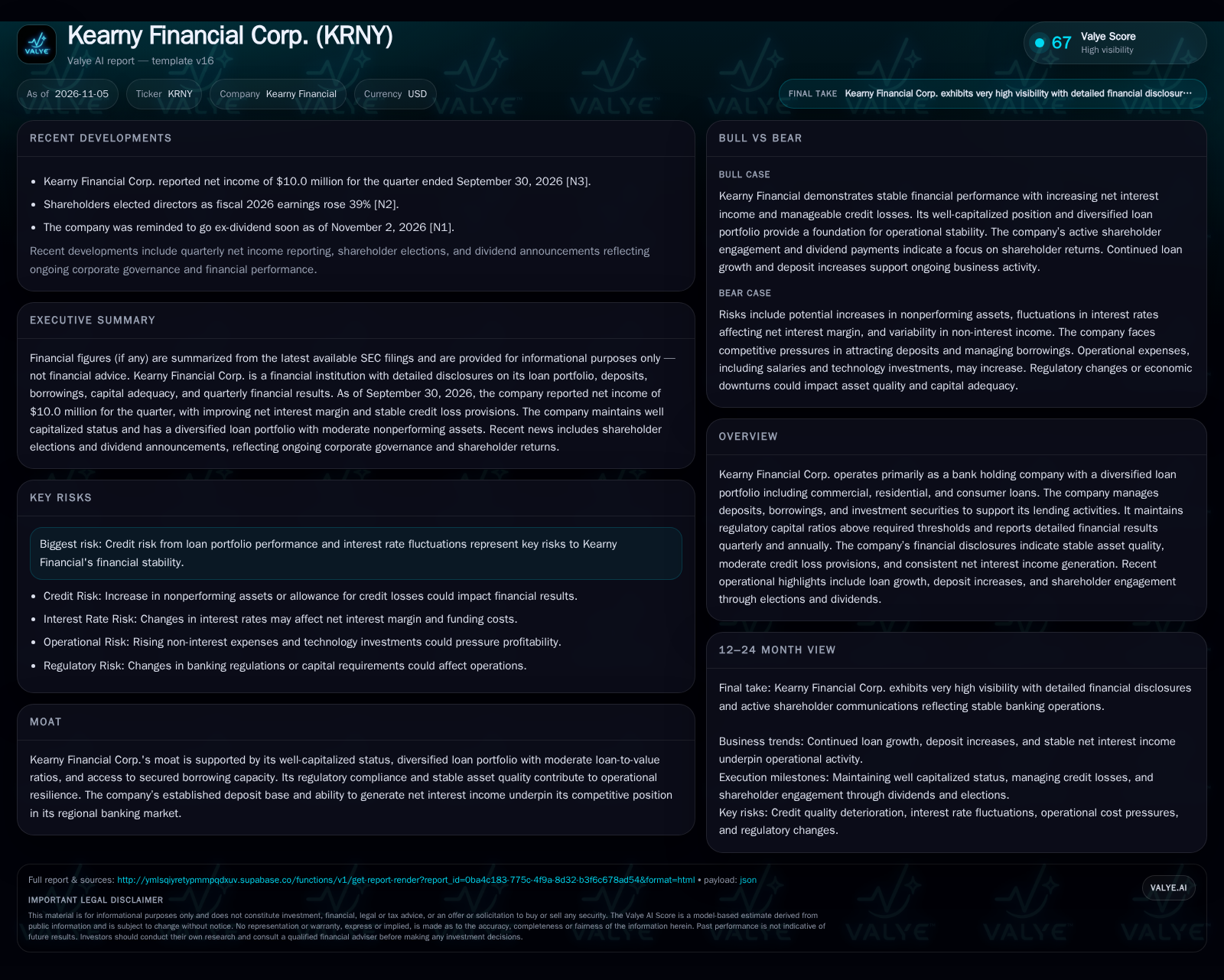
Kearny Financial Corp. reported $10.0 million in quarterly net income and a 39% increase in annual earnings, underpinned by loan growth, stable asset quality, and regulatory capital strength. While the bank continues to deliver dividends and maintain shareholder engagement, interest rate risk, credit quality, and operational cost inflation remain central challenges. The next phase will test Kearny’s ability to sustain net interest margins and manage credit losses as market conditions evolve. [N2] [N3]
Kearny Financial Corp. enters late 2026 with notable momentum: a 39% annual earnings increase and $10.0 million in quarterly net income signal resilient core banking operations, supported by loan growth and prudent credit management. Yet, the path ahead is shaped by a familiar set of challenges—interest rate pressures, deposit competition, and the need to balance operational investments with asset quality discipline. As regional banks face recalibrated market dynamics, Kearny’s next chapters will be defined by how effectively it navigates margin compression and maintains credit resilience. [N2] [N3]
Earnings Growth, Asset Quality, and Capital Strength Define Recent Performance
Kearny Financial Corp. reported net income of $10.0 million for the quarter ended September 30, 2026, with fiscal 2026 earnings up 39% year-over-year. These results stem from improved net interest margin and stable credit loss provisions, highlighting the bank’s ability to navigate a volatile interest rate environment and maintain prudent risk management. Kearny remains well-capitalized and continues to pay dividends, reinforcing its focus on shareholder engagement. The company’s diversified loan portfolio and moderate nonperforming assets provide a foundation for stability, while recent director elections underscore ongoing corporate governance. [N2] [N3] [S2]
Beyond the headline earnings and capital metrics, a deeper examination of Kearny’s asset composition and risk-weighted assets would provide insight into the sustainability of its capital strength. The quality and seasoning of the loan portfolio, particularly the mix between fixed-rate and variable-rate loans, could influence sensitivity to interest rate fluctuations. Additionally, the bank’s approach to provisioning and reserve adequacy in the context of economic cycles would affect its resilience against potential credit shocks. Understanding these dynamics helps clarify how recent performance may translate into longer-term stability under varying macroeconomic conditions.
How Kearny Makes Money: Net Interest Income, Margin Leverage, and Funding Costs
Kearny Financial’s core revenue engine is net interest income, earned from the spread between interest received on loans and investments and interest paid on deposits and borrowings. Loan growth and a diversified portfolio across commercial, residential, and consumer segments provide multiple levers for volume and mix optimization. The bank’s ability to manage funding costs—especially in a competitive deposit market—directly influences net interest margin, a critical driver of profitability. Because much of the cost base (salaries, regulatory compliance, technology investments) is relatively fixed in the short term, incremental loan growth can deliver operating leverage, provided credit quality remains intact. [S2]
The company’s capital requirements are shaped by regulatory standards, which it currently exceeds, enabling both lending activity and shareholder distributions. However, rising operational expenses and the need for ongoing technology upgrades introduce cost pressures. In periods of margin compression, the bank’s profitability depends on maintaining asset quality and controlling non-interest expenses. If nonperforming assets or credit loss provisions rise, earnings can be quickly impacted. [S2]
The interplay between net interest margin and funding cost management is particularly critical in a rising rate environment where depositors have more alternatives. Kearny’s ability to optimize its funding mix by balancing core deposits, brokered deposits, and wholesale funding sources will directly impact margin leverage. If the bank can increase its proportion of sticky, low-cost deposits, it gains a durable competitive advantage. Conversely, over-reliance on volatile or rate-sensitive funding could expose earnings to margin compression. Furthermore, the efficiency of capital deployment—how well incremental capital supports loan growth without diluting returns—remains a key determinant of profitability, especially when regulatory capital buffers tighten.
Competing for Deposits and Loans: Regional Dynamics and the Threat of Substitution
Kearny operates in a competitive regional banking environment where its primary advantages are a diversified loan book, regulatory capital strength, and established local relationships. However, the bank faces persistent pressure from fintechs and larger national banks offering higher-yield deposit products and digital convenience. Competition for low-cost deposits is particularly acute, as savers seek higher returns in a rising-rate environment, potentially increasing Kearny’s funding costs or forcing it to accept more rate-sensitive deposits with lower stickiness. [S2]
Substitution risk also exists on the lending side, with nonbank lenders and credit unions targeting both commercial and consumer segments. Kearny’s ability to differentiate through service, local knowledge, and prudent underwriting is crucial for defending market share. While its moderate nonperforming asset levels suggest current resilience, any deterioration in credit quality or loss of deposit share could erode its competitive position. [S2]
The competitive landscape’s evolution also hinges on technological adoption and digital service delivery, which increasingly influence customer retention and acquisition costs. While Kearny’s local relationships provide differentiation, the bank’s investments in digital platforms and data analytics could enhance underwriting precision and customer engagement, mitigating substitution risks. However, these investments come with upfront costs and execution risks that, if not managed prudently, could pressure near-term earnings. Additionally, the bank’s responsiveness to changing regulatory expectations around consumer protection and cybersecurity will shape its competitive positioning, as compliance failures could lead to reputational damage or financial penalties.
Margin Expansion and Asset Quality Stability Unlock Higher Returns
A favorable scenario for Kearny would see further loan growth, continued stability in credit quality, and a benign interest rate environment that supports net interest margin expansion. If the bank can attract and retain core deposits without significantly raising funding costs, incremental lending volumes could translate into higher profitability thanks to operating leverage. Prudent risk management would keep credit losses contained, allowing the company to sustain or even increase dividends. [S2]
Confirmation of this scenario would include sequential improvements in net interest margin, stable or declining nonperforming asset ratios, and evidence of deposit growth outpacing peers. A useful metric would be the proportion of low-cost, core deposits in the funding mix (if disclosed), as this would indicate resilience against funding cost pressures.
Resilient Banking Operations Amid Margin Pressures and Cost Inflation
The most plausible trajectory for Kearny is steady but moderated earnings growth, with net interest margins facing some compression from intense deposit competition and periodic rate volatility. Loan growth may continue, but at a slower pace if economic conditions soften or risk appetites tighten. Credit quality is likely to remain manageable, but isolated upticks in nonperforming assets could occur as borrowers adjust to higher rates. [S2]
Evidence supporting this view would include modest sequential changes in net interest income, stable loan loss provisions, and a steady pace of dividend payments. If operational expenses, particularly from technology or compliance, begin to rise faster than net interest income, this would pressure margins and profitability.
Credit Deterioration and Margin Compression Challenge Profitability
A more adverse scenario for Kearny would involve a sharp rise in nonperforming assets or a spike in credit loss provisions, potentially triggered by economic downturn, commercial real estate stress, or borrower defaults. Simultaneously, if deposit outflows accelerate and the bank is forced to pay materially higher rates to retain or attract funding, net interest margins could compress significantly. [S2]
Confirmation would come from a marked increase in nonperforming asset ratios, a jump in allowance for credit losses, and a decline in net interest income despite stable or rising loan balances. Early warning signs could include negative trends in loan delinquency rates (if disclosed) or a drop in core deposit levels.
Essential Developments That Could Shift Kearny Financial’s Outlook
Quarterly trends in net interest margin—sustained improvement would suggest margin resilience; compression would flag funding cost pressures.
Nonperforming asset and delinquency ratios (if disclosed)—rising levels would indicate emerging credit stress.
Deposit growth versus peer banks—a slowdown or reversal would highlight competitive funding challenges.
Changes in the composition of funding mix—higher reliance on wholesale or rate-sensitive deposits would increase margin risk.
Operational expense growth, especially in technology and regulatory compliance—outpacing revenue growth would erode profitability.
Size and frequency of credit loss provisions—significant increases may foreshadow broader asset quality deterioration.
Dividend continuity and payout ratio—cuts or suspensions could signal earnings pressure or capital constraint.
Disclaimer: This is research-only, informational analysis and not investment advice. It may include AI-generated interpretation and general industry context. Always verify important details using primary sources.

Comments