
Chevron's Growth Agenda: Integrated Scale, Asset Reshaping, and the Stakes of Energy Transition
Chevron is leveraging recent large-scale acquisitions, international upstream expansion, and a renewed focus on midstream efficiency to rebalance its portfolio and pursue both traditional and lower-carbon growth avenues. The company's ability to execute on cost reductions, regulatory compliance, and transition initiatives will determine whether its scale and integration translate into sustained value.
Chevron’s 2026 results reflect the early impact of its Hess acquisition, renewed upstream ambitions in Iraq, and a push for midstream cost efficiency. Execution risks—especially around commodity prices, regulatory matters, and transaction closures—remain central to the investment case. The evolution of its lower-carbon strategy and the ability to translate scale into cost and margin advantages will shape the next phase.
Chevron enters late 2026 at a crossroads: its integration of Hess Corporation is transforming the asset base and revenue mix, while new upstream deals and midstream cost-reduction efforts aim to unlock further growth and margin improvement. At the same time, Chevron is navigating persistent regulatory and environmental challenges and testing the commercial viability of its lower-carbon and power solutions—including a high-profile data center initiative. The interplay between scale, operational discipline, and the pace of energy transition will define Chevron’s ability to deliver durable returns in a volatile market.
Recent Moves Redefine Chevron’s Portfolio and Strategic Levers
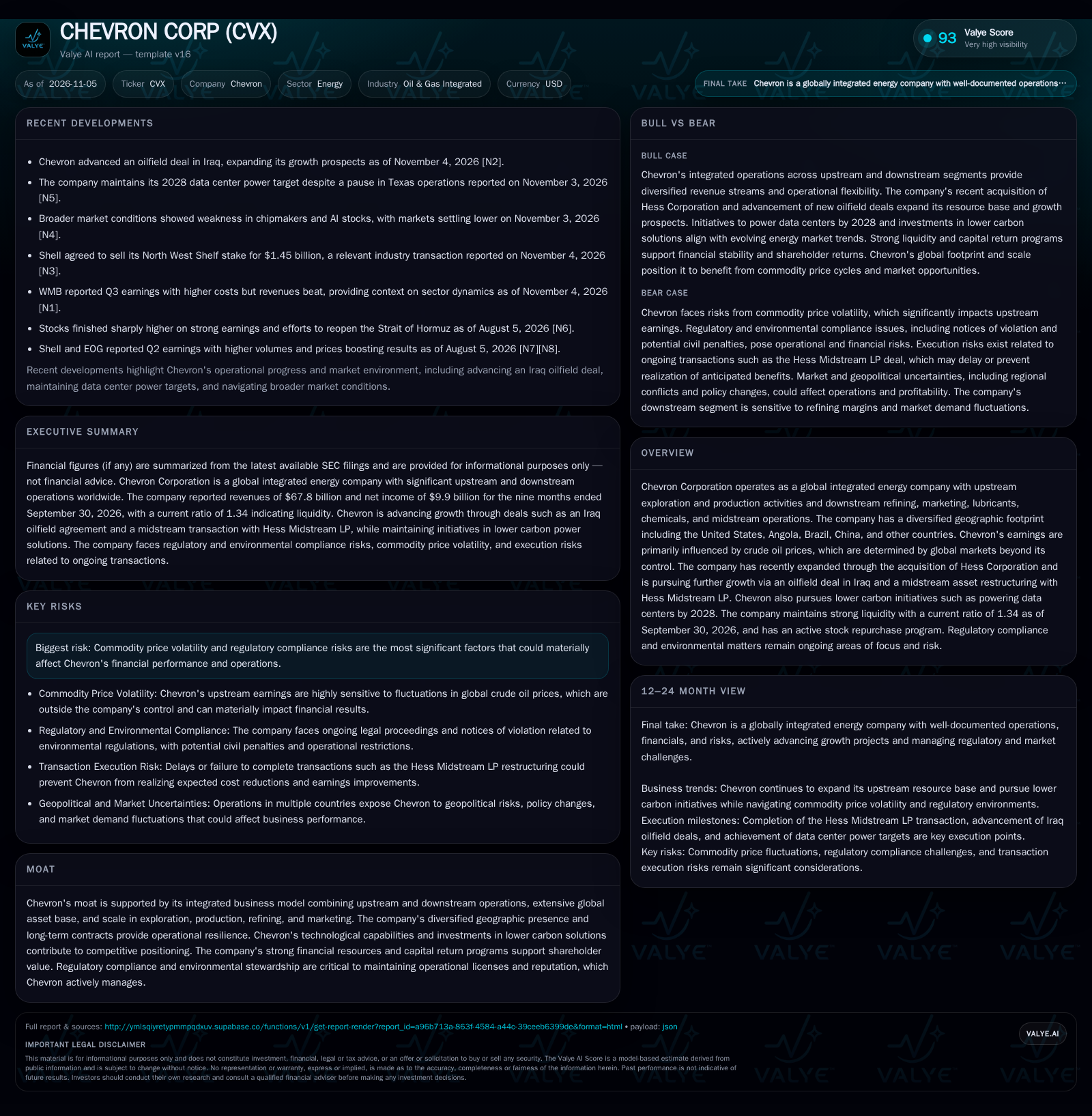
Chevron posted $67.8 billion in revenue and $9.9 billion in net income for the nine months ending September 30, 2026, supported by a current ratio of 1.34 and $4.0 billion in cash [S2]. These figures reflect the incorporation of Hess Corporation, acquired in 2025, which now accounts for 24% of total assets but only 3% of revenues, highlighting a lag between asset scale and immediate revenue contribution [S2].
Chevron is advancing an oilfield deal in Iraq to expand its upstream resource base, as reported in November 2026 [N2]. Additionally, it entered agreements in October 2026 to transfer interests in Hess Midstream LP and contribute DJ Basin crude midstream assets, aiming to reduce Bakken unit midstream costs by about 50%, pending regulatory approval [S2].
On the energy transition front, Chevron reaffirmed its 2028 target to power data centers, indicating commitment to lower-carbon initiatives despite a pause in Texas operations as of November 2026 [N5].
The company faces ongoing legal and regulatory proceedings, including environmental notices of violation in New Mexico and California, with potential civil penalties exceeding $1 million [S2]. These compliance issues and execution risks around major transactions remain central to the investment outlook.
How Chevron’s Integrated Model Drives Cash—And Where the Leverage Lies
Chevron’s integrated model—combining upstream (exploration and production) with downstream (refining, marketing, chemicals, and midstream)—offers both earnings diversification and operational synergies. Upstream profitability is fundamentally tied to global crude oil prices, which remain volatile and outside Chevron’s control. High fixed costs in exploration, production, and large-scale refining create operating leverage: rising commodity prices can significantly boost margins, but downturns compress profitability rapidly.
The Hess acquisition increases Chevron’s resource base, particularly in high-potential basins, but the fact that Hess assets represent 24% of total assets while contributing just 3% of revenues suggests a lag in production ramp-up, possible integration frictions, or a weighting toward longer-cycle assets [S2]. If realized, the planned midstream restructuring with Hess Midstream LP could halve Bakken transportation costs, directly improving per-barrel economics and cash margins for that segment [S2].
Chevron’s capital return (buybacks) and ongoing investments in lower-carbon initiatives must be balanced against regulatory costs, environmental liabilities, and the need to fund large-scale projects. The economics of supplying power to data centers by 2028 are not fully disclosed, but could hinge on Chevron’s ability to monetize excess gas or leverage renewable integration, potentially diversifying revenue streams and reducing earnings volatility if successfully commercialized.
Integrated Scale, Asset Quality, and the Pressure from Transition
Chevron’s competitive position is anchored in its global scale, integrated asset base, and ability to operate across the value chain. This provides some insulation from single-point disruptions and allows optimization between upstream production, refining, and marketing based on prevailing market conditions. However, the company competes with other global integrated majors as well as regional NOCs and independent producers, all of whom are pursuing similar asset rationalization and transition strategies.
Chevron’s recent moves—such as the Hess acquisition and Iraq oilfield expansion—could enhance reserve life and production optionality, but only if integration and development risks are managed. The planned midstream cost reductions, if executed, may yield a cost advantage in the increasingly competitive Bakken region, but are subject to regulatory and execution hurdles.
On the transition front, Chevron’s data center and lower-carbon initiatives are responses to demand for cleaner energy and new end markets. However, these efforts remain in early stages compared to some peers that have more aggressively shifted capital toward renewables and power solutions. The question is whether Chevron’s scale and cash flow allow it to pace the transition without eroding its core profitability or ceding market share in emerging segments.
If Asset Integration and Transition Bets Pay Off, Margin Expansion Could Follow
The favorable scenario is built on effective integration of Hess assets, successful ramp-up of new upstream projects (including in Iraq), and realization of the targeted 50% Bakken midstream cost reduction.
A positive surprise in the commercialization of power solutions for data centers—if Chevron can secure material long-term contracts or demonstrate cost advantages in supplying low-carbon energy—could diversify earnings and provide a counter-cyclical buffer against oil price volatility.
Evidence for this scenario would include: rapid increases in upstream production from Hess and Iraq, disclosure of substantial cost savings from the midstream restructuring, new long-term power contracts, and stable or rising return on capital employed.
Asset Integration Progresses, but Legacy and Transition Frictions Persist
The most plausible path is that Chevron gradually realizes some benefits from the Hess acquisition and midstream restructuring, but faces typical integration delays and regulatory headwinds. Upstream production grows modestly as new assets come online, but commodity price volatility continues to drive earnings swings.
Costs in the Bakken are reduced, but perhaps not to the full targeted extent or only after regulatory delays. The data center power initiative progresses, but remains a small part of the revenue mix by 2028, with limited near-term impact on overall earnings. Environmental and legal risks remain a drag, requiring periodic settlements and compliance investments.
If this scenario plays out, Chevron’s operating cash flows remain robust, but margin expansion is incremental rather than dramatic. Confirmation would come from steady production growth, partial realization of announced cost savings, continued (but not accelerated) capital returns, and no material escalation in compliance costs.
Integration Stumbles, Regulatory Costs Mount, and Transition Lags
In the adverse scenario, Chevron encounters significant integration challenges with Hess assets, leading to delayed production, higher-than-expected development costs, or asset write-downs. The midstream restructuring is either delayed or fails to deliver the promised cost savings due to regulatory hurdles or operational issues.
Commodity prices fall, amplifying the impact of high fixed costs and constraining cash generation. Environmental proceedings result in substantial penalties or new restrictions, raising operating costs and diverting management attention. The data center power initiative stalls or fails to win commercial traction, leaving Chevron exposed to traditional market cycles without meaningful diversification.
This scenario would be confirmed by negative production surprises, cost overruns, persistent regulatory setbacks, reduced or suspended buyback/dividend activity, and evidence of asset impairments or write-downs related to recent acquisitions.
What Will Distinguish Chevron’s Execution from Its Peers?
Progress and timing of Bakken midstream cost reductions, including regulatory approvals and actual realized savings, would help test the thesis.
Upstream production volumes and reserve additions from Hess assets and Iraq projects, especially relative to integration timelines and guidance, will indicate the success of recent investments.
Disclosures on the scale, economics, and commercial partners for the data center power initiative—if provided—would clarify the potential for meaningful non-traditional revenue.
Updates on environmental and regulatory proceedings, including settlement amounts and operational impacts, will show whether compliance costs are contained or escalating.
Trends in per-barrel cash margins across key assets (if disclosed) would provide insight into the effectiveness of cost control and integration.
Any changes to Chevron’s capital allocation between traditional upstream/downstream and lower-carbon opportunities would signal its conviction on transition timing and competitive positioning.
Disclaimer: This is research-only, informational analysis and not investment advice. It may include AI-generated interpretation and general industry context. Always verify important details using primary sources.

Comments