
Northwest Natural: Expansion, Regulatory Friction, and the Economics of a Diversified Utility Platform
Northwest Natural’s recent Texas expansion and ongoing infrastructure investments broaden its regulated utility base but introduce new integration and regulatory challenges. The company’s earnings improvement hinges on effective rate recovery, cost discipline, and the ability to manage capital-intensive growth amid evolving legislative constraints.
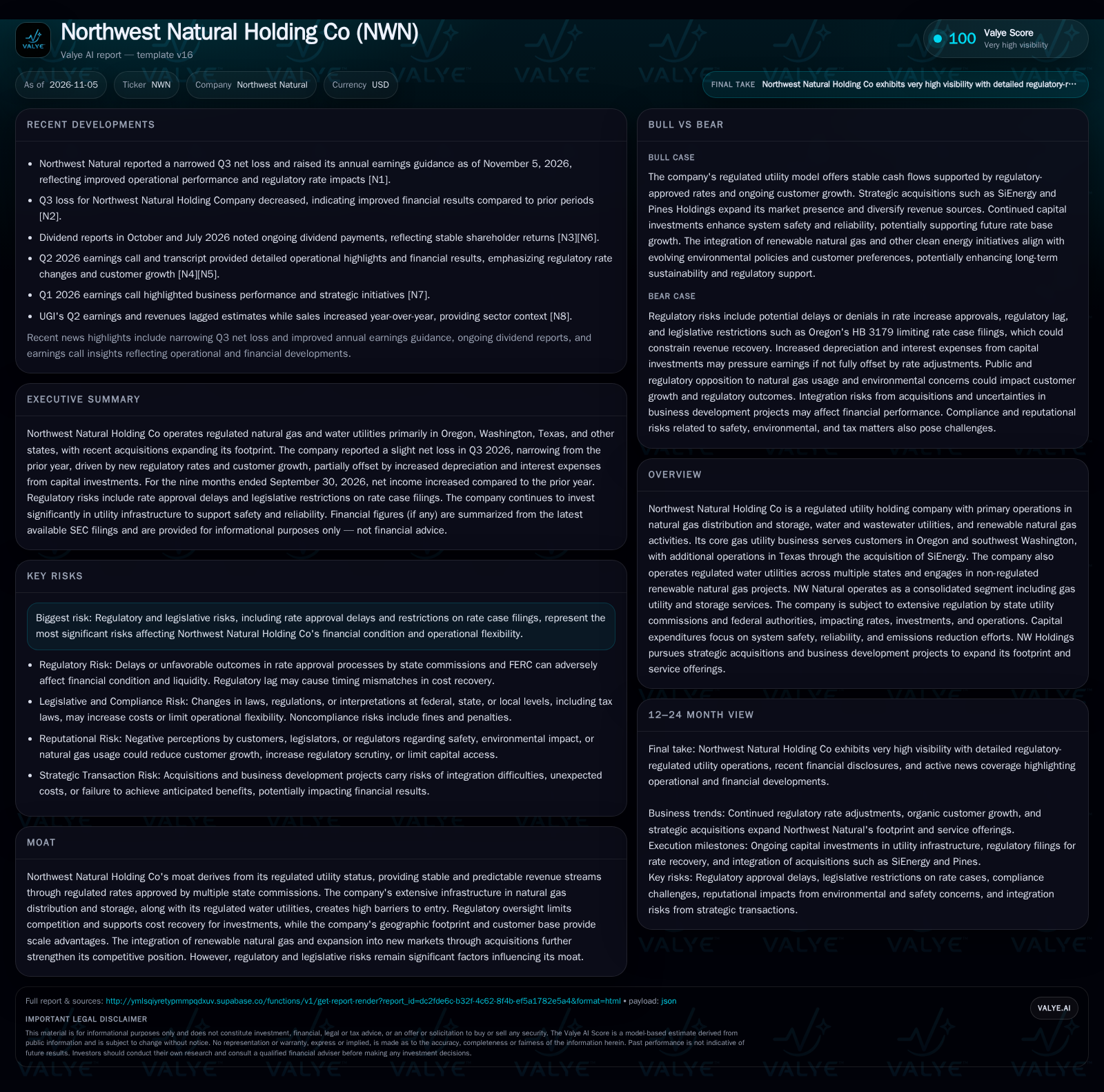
Northwest Natural's acquisition-driven expansion into Texas and increased system investment have boosted volumes and segment margins, but higher depreciation and interest costs are pressuring net income. The company’s diversified platform offers growth potential if cost recovery and operational efficiency can keep pace with capital needs and regulatory changes. [S2] [N1] [N2]
Northwest Natural Holding Co is transforming from a regional gas utility into a diversified, multi-state regulated platform with the acquisition of SiEnergy in Texas and ongoing investments across gas, water, and renewable natural gas segments. The company’s Q3 2026 results show that new rate structures and organic customer growth are helping offset higher depreciation and interest costs stemming from a heavy capex cycle. Yet, legislative restrictions on rate case timing and a thin liquidity buffer underscore the importance of execution in rate recovery, cost control, and integration—especially as capital needs remain high and regulatory complexity intensifies.
Recent Expansion and Rate Adjustments Shape Current Performance
For Q3 2026, Northwest Natural reported revenue of $243.6 million and a narrow net income of $0.6 million, translating to basic and diluted EPS of $0.01 per share. The company’s net loss narrowed primarily due to new rates in Oregon (effective October 2025) and Washington (August 2026), and a 5.7 million therm year-over-year increase in total volumes delivered, mostly to residential and commercial customers. However, these gains were partially offset by a $3.3 million increase in interest expense and a $2.7 million rise in depreciation due to continued capital investments. [S2] [N1] [N2]
The January 2025 acquisition of SiEnergy, a regulated gas utility serving approximately 90,000 Texas customers, added $171 million in goodwill and expanded the company’s regulated footprint into a high-growth region. Integration of SiEnergy and the recent Pines Holdings acquisition are ongoing, presenting both opportunities and operational risks. [S2]
Capital Intensity, Rate Recovery, and the Mechanics of Utility Earnings
Northwest Natural’s core business model is built on regulated cost recovery: the bulk of revenues derive from gas distribution and storage services in Oregon, Washington, and now Texas, supplemented by smaller water/wastewater and renewable natural gas (RNG) operations. Tariff structures and rate cases define revenue per customer, with regulatory lag and legislative constraints—such as Oregon’s 18-month rate case restriction—shaping the timing and completeness of cost recovery. This creates a delicate balance: while capital expenditures ($373.4 million for the first nine months of 2026) drive future rate base growth and earnings potential, they immediately increase depreciation and interest costs, pressuring near-term margins if not matched by timely rate adjustments. [S2]
Operating leverage in regulated utilities typically manifests as increased margins when customer growth and new rates outpace fixed costs and capital charges. However, Northwest Natural’s thin liquidity cushion and ongoing need for debt financing mean that its ability to invest in system expansion and reliability depends on regular and effective rate recovery. Non-regulated RNG and water activities offer incremental growth but are not yet large enough to materially shift the company’s overall economics.
The interplay between capital intensity and regulatory frameworks creates a nuanced risk-return profile for Northwest Natural. Capital investments expand the rate base, which theoretically enhances future earnings through higher allowed returns. However, this expansion is contingent on regulatory approval and the timing of rate cases; delays or partial approvals can compress margins and strain liquidity. Moreover, the company's reliance on debt to finance growth introduces interest rate sensitivity, where rising borrowing costs could exacerbate margin pressures. Effective capital allocation decisions must therefore weigh the incremental return on new investments against these regulatory and financial constraints to avoid overextension or suboptimal asset deployment.
Regulated Moat, Barriers to Entry, and New Market Dynamics
Northwest Natural benefits from high barriers to entry typical of regulated utility markets: extensive physical infrastructure, regulatory-approved monopolies in defined service territories, and long-lived customer relationships. The company’s moat is reinforced by its ownership of strategic assets like the Mist underground storage facility and its expanding water utility footprint.
However, entry into Texas via SiEnergy exposes Northwest Natural to a new regulatory regime (Railroad Commission of Texas) and competitive landscape. While direct competition in regulated delivery is limited, Texas’s dynamic growth market attracts both incumbent and new utility operators, and integration risks increase as the company moves beyond its historical Pacific Northwest base. The company’s push into renewable natural gas and water utilities seeks to diversify revenue streams and reduce regulatory concentration risk, but these segments remain secondary to the core gas utility business.
The company’s entry into Texas introduces not only new regulatory dynamics but also potential shifts in competitive strategy. While Texas utilities operate under different regulatory oversight, the state's deregulated energy markets and rapid population growth create both opportunities and uncertainties. Northwest Natural must adapt to a regulatory environment that may emphasize different cost recovery mechanisms and performance incentives compared to its traditional markets. Additionally, integration challenges could impact operational efficiency and customer service quality, which are critical for maintaining regulatory goodwill and minimizing political risk. Strategic diversification into renewables and water utilities may mitigate some geographic concentration risks but also require navigating distinct regulatory and operational frameworks.
Margin Expansion if Rate Recovery and Customer Growth Outpace Cost Pressures
A favorable outcome for Northwest Natural would see timely and full cost recovery through rate cases across all major jurisdictions, allowing increased capital investments to translate into higher regulated returns. If residential and commercial customer growth—especially in Texas and the Pacific Northwest—remains robust, incremental volumes and expanded rate base could drive sustained margin and earnings growth, even as depreciation and interest expense rise.
Confirmation of this scenario would come from continued increases in segment margin, evidence of successful integration of SiEnergy without major cost overruns or regulatory setbacks, and a balance sheet that supports ongoing capex without excessive dilution or leverage. Additional upside could materialize if RNG and water utility segments achieve scale or secure favorable rate mechanisms.
Balancing Growth Ambitions with Capital and Regulatory Constraints
The most plausible path is one of measured earnings growth, with periodic pressure from regulatory lag and capital cost increases. Northwest Natural is likely to achieve incremental improvements in margin as new rates are implemented and customer growth continues, but depreciation and interest expense will remain headwinds until new investments are fully reflected in the rate base.
Evidence supporting this view would be stable or slowly rising net income alongside ongoing capex and moderate dilution or debt growth. Setbacks could include delayed or partial rate recovery, integration hiccups in Texas, or increased regulatory friction in legacy markets.
Earnings Erosion if Cost Recovery Lags or Integration Falters
A negative scenario could unfold if Northwest Natural faces protracted regulatory lag—particularly under Oregon’s new 18-month rate case rule—or if integration costs and operational issues in Texas exceed expectations. In this case, rising depreciation and interest expenses from heavy capex could outpace revenue and margin gains, leading to sustained net losses.
Additional risks include failure to realize anticipated customer growth, adverse regulatory or legislative changes, or unforeseen compliance issues resulting in fines or operational restrictions. Confirmation would include declining or stagnant segment margins, persistent negative net income, rising leverage, or a cut to the dividend.
Milestones and External Factors That Will Shape Northwest Natural’s Thesis
Net income and segment margin trends by quarter, especially as new rate cases become effective and integration of Texas operations progresses. [S2]
Customer growth rates in both legacy Pacific Northwest markets and newly acquired Texas territories; a useful metric would be net new connections or meters if disclosed.
Timing, scope, and regulatory outcomes of future rate cases, particularly in Oregon and Texas, where legislative and commission processes differ.
Trends in capital expenditures and their relationship to authorized rate base growth—does incremental capex translate into higher allowed returns?
Interest expense and leverage metrics, as ongoing investment and integration are funded; watch for changes in debt covenants or credit ratings if disclosed.
Cash flow from operations relative to dividend payments and capital needs; a useful metric would be free cash flow coverage of the dividend.
Progress in scaling non-regulated RNG and water businesses, including new project announcements, contracts, or regulatory approvals.
Disclaimer: This is research-only, informational analysis and not investment advice. It may include AI-generated interpretation and general industry context. Always verify important details using primary sources.

Comments