
Kimberly-Clark’s Kenvue Integration: Leverage, Complexity, and the Stakes of Consumer Staples Consolidation
Kimberly-Clark’s acquisition and ongoing integration of Kenvue reshapes its scale and risk profile.
The path to unlocking long-term value hinges on smooth systems alignment, cost control, and mitigation of OTC product risks. [N1] [N2] [N3] [N6] [N7]
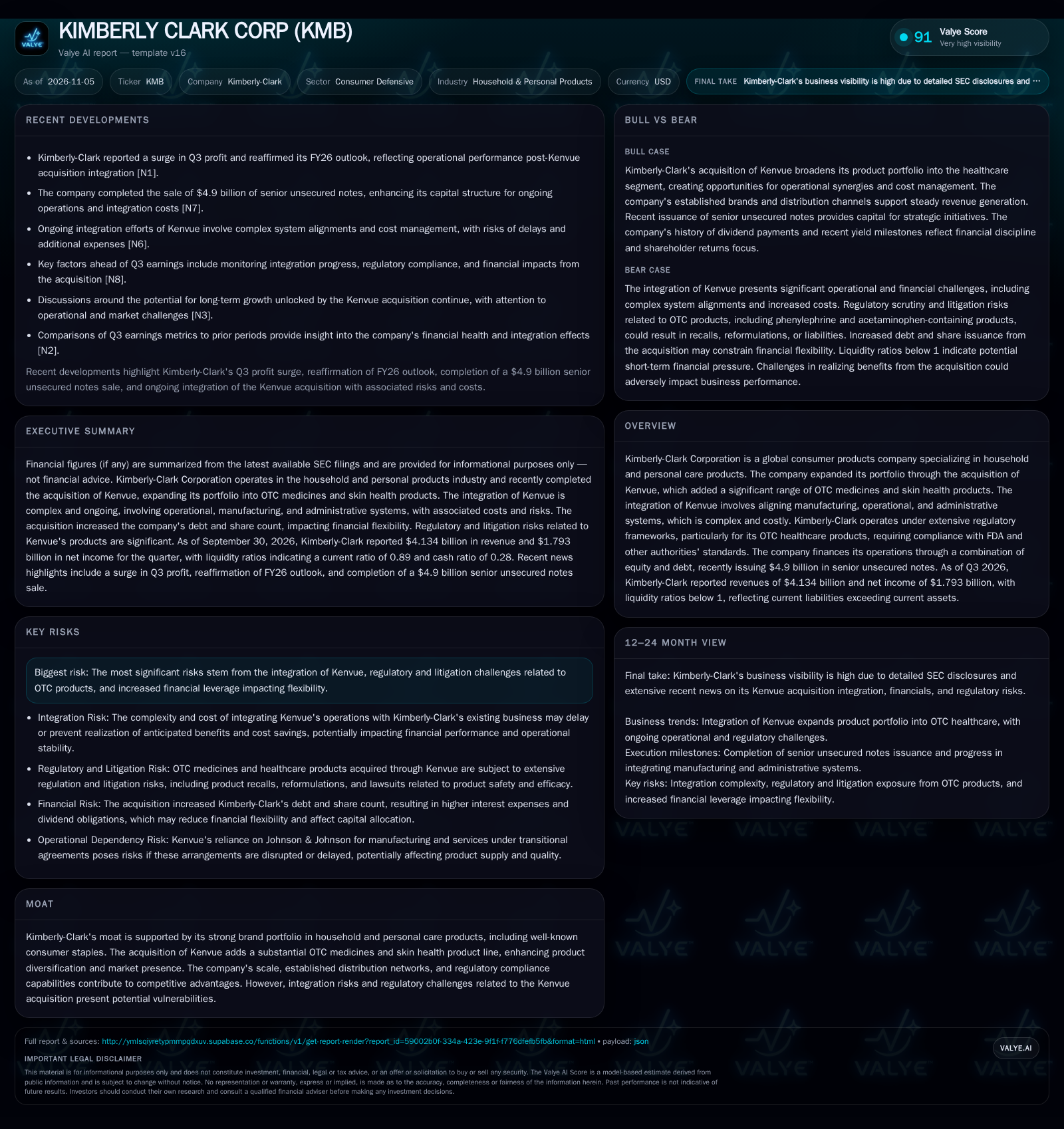
Kimberly-Clark’s transformation is entering a critical phase as it digests the Kenvue acquisition, one of the most significant moves in the consumer staples sector in recent years. The company’s strong Q3 profit and recent $4.9 billion debt raise provide financial firepower, but the challenges of integrating manufacturing, administrative, and regulatory systems are formidable. [S2] [N1] [N3] [N6] [N7]
Kenvue Integration and Financial Leverage Reshape Kimberly-Clark’s Operating Profile
Kimberly-Clark’s Q3 2026 results provide a snapshot of a company in transition. Revenue reached $4.134 billion with net income of $1.793 billion, a robust performance as the company embarks on the complex integration of Kenvue. To finance these efforts and fortify its capital structure, Kimberly-Clark recently completed a $4.9 billion senior unsecured notes sale. The acquisition brings new operational and regulatory risks, especially around Kenvue’s OTC product portfolio. [S2] [N1] [N3] [N6] [N7]
The integration of Kenvue not only reshapes Kimberly-Clark’s financial leverage but also fundamentally alters its operational risk profile. The increased debt load amplifies the importance of disciplined cash flow management, especially given the working capital demands introduced by combining two complex supply chains. Moreover, the integration timeline and the sequencing of systems harmonization will be critical in determining how quickly the company can stabilize its cost structure and realize expected efficiencies. The interplay between financing costs and operational cash generation will be a key determinant of the company’s ability to invest in innovation and marketing without compromising potential financial flexibility.
How Kimberly-Clark’s Economics Could Evolve Post-Kenvue
Kimberly-Clark generates revenue through a mix of branded consumer staples—tissues, diapers, and personal care products—typically characterized by high volumes, steady demand, and moderate pricing power. The addition of Kenvue’s OTC and personal care portfolio expands the company’s addressable market and could improve category margins if integration is smooth. However, the economics of the combined entity are now more complex: integration costs, duplicative systems, and transitional agreements (such as Kenvue’s ongoing reliance on J&J for manufacturing) introduce new variable and fixed cost layers.
The $4.9 billion in new senior notes adds interest expense and heightens sensitivity to cash flow generation and cost control. Post-merger, operating leverage could improve if synergies are realized and overlapping expenses are eliminated. Conversely, if integration delays or regulatory events (such as recalls or litigation related to phenylephrine or acetaminophen) materialize, they could erode margin and strain working capital. [S2] [N3] [N6] [N7]
Post-acquisition, the company faces a delicate balance between capturing scale benefits and managing the incremental complexity that Kenvue introduces. The expanded product mix, while offering diversification, also entails navigating disparate regulatory environments and supply chain dynamics, which could dilute margin improvements if not carefully managed. Cost synergies are conditional on the successful consolidation of manufacturing footprints and the elimination of redundant administrative functions, which often require upfront investment and careful change management. Additionally, the reliance on transitional manufacturing agreements imposes constraints on operational control and cost predictability, potentially delaying the full realization of margin enhancements.
Brand Strength and Scale Versus Integration Headwinds and Regulatory Exposure
Kimberly-Clark’s main competitive edge is its portfolio of established brands and entrenched distribution in household and personal care. The addition of Kenvue—if well-integrated—could further deepen category reach and shelf presence, offering potential cross-selling and increased bargaining leverage with retailers. In the consumer defensive sector, scale is a major advantage, supporting lower per-unit costs and marketing efficiency.
However, the company now faces new counterforces. Regulatory scrutiny over OTC products, especially those containing phenylephrine and acetaminophen, introduces litigation and recall risks not present in traditional tissue and diaper segments. Competitor categories include global staples conglomerates, private label manufacturers, and emerging wellness/OTC entrants, all of whom can exploit any integration missteps or supply chain disruptions. Furthermore, Kenvue’s continuing reliance on J&J for manufacturing under transitional agreements may impede Kimberly-Clark’s ability to fully control product quality and costs in the near term. [N3] [N6]
From a competitive standpoint, Kimberly-Clark’s enhanced scale post-Kenvue could strengthen its negotiating position with key retailers and suppliers, potentially enabling better terms and improved shelf placement. However, this advantage is contingent on the company’s ability to maintain consistent product quality and supply reliability during integration. Any disruptions could erode retailer confidence and provide openings for private label competitors or emerging niche brands to gain traction. Furthermore, the regulatory scrutiny specific to OTC products introduces a layer of reputational risk that could impact consumer trust across the broader portfolio if not proactively managed. The transitional dependence on J&J for manufacturing also limits Kimberly-Clark’s agility in responding to market shifts or quality issues in the near term.
Synergy Realization and Regulatory Containment Unlock Enduring Value
Kimberly-Clark could deliver significant shareholder value if it efficiently integrates Kenvue’s operations, extracting cost synergies and leveraging its expanded brand portfolio for incremental revenue growth. The upside scenario hinges on the company’s ability to align manufacturing and administrative systems without major disruption, realize procurement and logistics efficiencies, and cross-sell across its expanded customer base. If regulatory and litigation risks around Kenvue’s OTC products remain contained—avoiding costly recalls or settlements—margin expansion could follow as integration costs subside.
Evidence that would confirm this scenario includes consistent margin improvement, declining SG&A as a percentage of sales, and stable or rising cash flows despite increased leverage. Successful renegotiation or seamless wind-down of Kenvue’s transitional agreements with J&J would also signal operational normalization. Conversely, persistent integration charges, margin compression, or regulatory setbacks would challenge the bullish view. [N3] [N6] [N7]
Integration Friction and Elevated Leverage Define the Near-Term Outlook
The most plausible near-term outcome is a period of operational friction as Kimberly-Clark works through Kenvue integration. This scenario envisions some delays and elevated costs—common in large-scale consumer mergers—offset by resilient core demand and gradual realization of cost synergies. The company will likely operate with higher leverage and tighter liquidity until integration is substantially complete, constraining flexibility but not fundamentally threatening solvency if cash flow remains stable.
Confirming evidence includes ongoing integration-related expenses, working capital pressure, and periodic updates on progress toward systems alignment and cost reduction targets. If the company maintains its dividend and avoids major regulatory or supply chain shocks, this scenario plays out as a challenging but manageable transition. A reversal in net income or an unexpected liquidity squeeze would falsify this moderate stance. [S2] [N3] [N6] [N7]
Regulatory Shocks or Prolonged Integration Setbacks Could Erode Value
A negative trajectory could emerge if regulatory action or litigation tied to Kenvue’s OTC portfolio results in large recalls, settlements, or required reformulations—leading to revenue loss and elevated costs. Prolonged integration difficulties, especially in aligning manufacturing and administrative systems, could result in persistent cost overruns and operational disruptions. If transitional agreements with J&J are disrupted or extended, Kimberly-Clark may face ongoing dependency and cost uncertainty.
In this scenario, liquidity ratios could deteriorate further, potentially forcing asset sales, dividend cuts, or additional debt issuance. Evidence of repeated regulatory actions, unexpected spikes in integration costs, or guidance cuts would confirm this risk. Conversely, stabilization of working capital and the absence of major regulatory headlines would help falsify this downside case. [N3] [N6] [S2]
Milestones and Metrics That Will Decide Kimberly-Clark’s Post-Merger Trajectory
Progress and cost of Kenvue integration—especially updates on system alignment, manufacturing consolidation, and administrative streamlining.
Trends in SG&A as a percentage of revenue, which would indicate whether cost synergies are being realized post-merger.
Frequency and financial impact of regulatory or litigation events tied to Kenvue’s OTC product portfolio.
Status of transitional agreements with J&J, including any delays, disruptions, or successful handoffs to internal operations.
Cash flow from operations and changes in working capital, critical for managing elevated leverage and integration costs.
Quarterly updates on net income and margin trends as integration progresses.
If disclosed, unit volume and pricing metrics for both legacy and Kenvue-acquired product lines, to gauge cross-selling and market share effects.
Disclaimer: This is research-only, informational analysis and not investment advice. It may include AI-generated interpretation and general industry context. Always verify important details using primary sources.

Comments