
First Bancorp, Inc /ME/: Managing Interest Rate Exposure, Merger Dynamics, and the Next Phase of Regional Banking
First Bancorp, Inc /ME/ stands at an inflection point as it balances robust interest rate risk management, a diversified loan portfolio, and the strategic implications of a recently approved merger. The company’s near-term trajectory will be shaped by its ability to sustain earnings in a volatile rate environment, manage integration risks, and leverage ESG initiatives for future relevance.
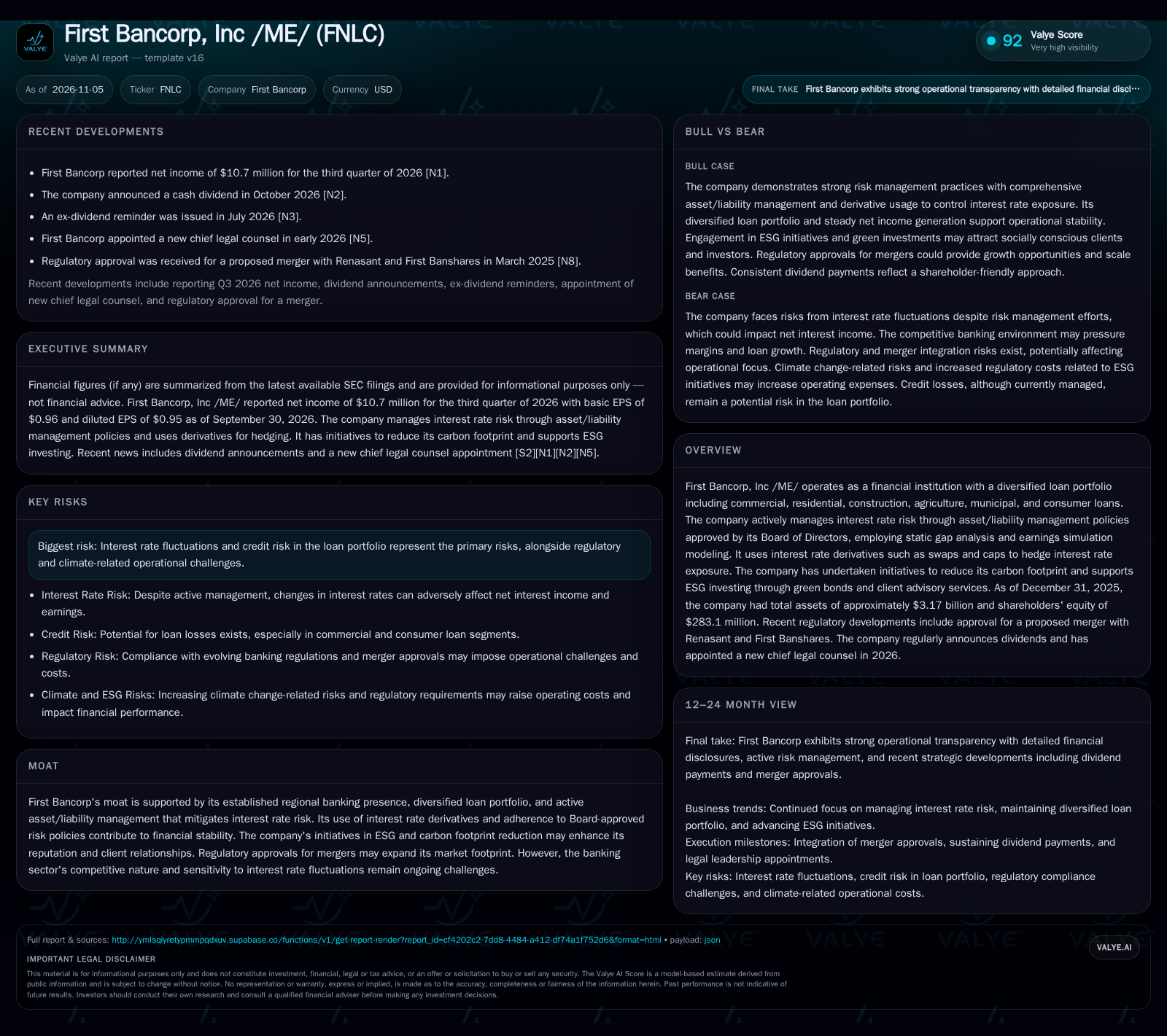
First Bancorp’s Q3 2026 net income of $10.7 million underscores operational resilience amid a challenging interest rate landscape. With regulatory approval for a merger with Renasant and First Banshares, the bank faces new scale opportunities and integration risks. Its active asset/liability management, use of derivatives, and ESG initiatives position it to navigate sector headwinds, but future performance will hinge on net interest margin stability, credit quality, and successful merger execution. [S2] [N1] [N8]
First Bancorp, Inc /ME/ enters late 2026 with a blend of stability and strategic uncertainty. The company’s $10.7 million net income in Q3 2026 reflects disciplined risk management and diversified lending, even as the regional banking sector grapples with interest rate volatility and evolving regulatory demands. Regulatory approval for its merger with Renasant and First Banshares opens the door to new scale and competitive positioning, but also introduces sizable operational and integration risks. As the company advances ESG initiatives and adapts to credit and rate cycle pressures, its ability to preserve margin, credit quality, and client loyalty will determine whether it can outgrow legacy regional bank status.
Recent Results and Strategic Milestones Set the Stage for Transformation
First Bancorp reported net income of $10.7 million for the third quarter of 2026, translating to basic EPS of $0.96 and diluted EPS of $0.95. This performance arrived amid persistent sector headwinds, including interest rate volatility and margin compression. The company’s balance sheet, as of December 31, 2025, showed total assets of $3.17 billion and shareholders’ equity of $283.1 million, reflecting a solid capital base entering the latest quarter. Regulatory approval for a merger with Renasant and First Banshares introduces a pivotal transition point, as the bank prepares to integrate new partners and potentially expand its geographic and client footprint. Together, these facts signal a bank with stable core earnings and capital, but also one facing a major operational inflection as it moves toward consolidation and scale. [S1] [S2] [N1] [N8]
How First Bancorp Generates Value: Loan Mix, Margin Dynamics, and Risk Management
First Bancorp’s revenue engine is built on a diversified loan portfolio, spanning commercial, residential, construction, agriculture, municipal, and consumer lending segments. This diversification helps buffer the company against shocks in any single sector, but also exposes it to heterogeneous credit and market risks. Net interest income remains the primary earnings driver, with profitability dependent on the spread between interest earned on assets (primarily loans and securities) and interest paid on liabilities (deposits and borrowings). In a rising or volatile rate environment, asset/liability mismatches can compress margins if funding costs outpace asset yield repricing.
To mitigate these pressures, the bank employs Board-approved asset/liability management policies, including static gap analysis and earnings simulation modeling, and uses interest rate derivatives such as swaps and caps for hedging. These tools help stabilize earnings but add complexity and require ongoing monitoring. Fixed costs include branch infrastructure, regulatory compliance, and technology investments, while variable costs are closely tied to loan origination, servicing, and deposit gathering. The company’s capital needs are moderate compared to high-growth fintechs, but integration of merger partners may require additional investment in systems, talent, and risk controls. Operating leverage can improve with scale—especially post-merger—if growth in earning assets outpaces fixed expense increases.
Competitive Edge and Sector Pressures: Regional Banking in an Era of Consolidation
First Bancorp’s competitive strengths include its established regional banking presence, diversified lending book, and a reputation for prudent risk management. The use of interest rate derivatives and sophisticated asset/liability management may confer some resilience versus less proactive peers, particularly in periods of rapid rate shifts. However, the regional banking sector remains intensely competitive, with larger national banks, community lenders, and fintech entrants all vying for share in deposits, loans, and fee-based services.
Technology adoption and customer experience are increasingly critical, as digital-first banks and non-traditional lenders erode traditional branch-based loyalty. First Bancorp’s ESG focus—through green bonds and advisory services—could attract socially conscious clients and institutional capital, but such advantages are often quickly replicated by peers. The approved merger with Renasant and First Banshares offers a route to greater scale, which may improve cost efficiency and product breadth, but also introduces integration risk and could dilute regional identity or customer intimacy if not managed carefully.
Leveraging Scale and ESG to Outperform: What a Win Could Look Like
If First Bancorp successfully integrates Renasant and First Banshares, operational synergies could drive improved efficiency ratios and expand its product set across a broader geographic footprint. Effective harmonization of risk management frameworks and IT systems would help avoid the common pitfalls of post-merger disruption, while cross-selling opportunities could lift fee income and deepen client relationships. Should the company continue to manage its asset/liability mix deftly—using derivatives and proactive Board oversight—it could sustain or even expand net interest margin relative to sector peers, especially if deposit costs are contained.
On the ESG front, if demand for green bonds and sustainable finance accelerates, First Bancorp’s early investments could position it as a go-to regional provider for environmentally conscious borrowers and investors. Evidence that would confirm this upside includes rising non-interest income from advisory services, lower efficiency ratios post-merger, stable or growing NIM in a volatile rate environment, and client growth in green finance products.
Sustaining Core Profitability Amid Integration and Margin Headwinds
The most plausible outcome over the next 12-24 months is that First Bancorp maintains steady profitability, with net income relatively stable as merger integration proceeds and interest rate volatility continues. Cost synergies from the merger may be offset by one-time integration expenses, technology upgrades, and efforts to harmonize underwriting and compliance standards. Net interest margin could remain under pressure if deposit competition persists and asset yields lag funding cost increases, but active asset/liability management and derivative usage should allow the company to avoid severe compression.
Credit quality is likely to remain manageable barring a sharp economic downturn, given the bank’s diversified loan book and history of prudent underwriting. ESG initiatives will likely enhance reputation and client engagement, but are not expected to materially alter earnings in the near term. Confirmation of this scenario would come from stable quarterly earnings, manageable credit losses, modest efficiency improvements, and no major integration setbacks.
Integration Missteps or Margin Squeeze Could Undermine Stability
A less favorable outcome could emerge if the merger with Renasant and First Banshares encounters significant integration challenges—such as technology incompatibility, cultural clashes, or regulatory setbacks—leading to elevated costs, customer attrition, and operational disruption. Simultaneously, if the interest rate environment becomes more volatile or competitive pressures drive up deposit costs faster than loan yields can adjust, net interest margin could compress sharply, eroding core profitability.
Credit losses could rise if economic conditions deteriorate, particularly in riskier segments of the loan portfolio. ESG and regulatory compliance costs may also outpace anticipated benefits, weighing on expense ratios. Evidence for this downside would include rising non-performing loans, negative operating leverage, integration-related expense spikes, and sustained declines in NIM or fee income.
Milestones That Will Shape First Bancorp’s Post-Merger Performance
Quarterly net interest margin trends, especially relative to regional and national banking peers.
Progress on merger integration, including expense synergies, technology harmonization, and customer retention rates—if disclosed.
Credit quality indicators such as non-performing loan ratios, charge-offs, and delinquency trends across loan segments.
Growth in non-interest income, particularly from green bonds, ESG advisory, and fee-based services.
Operating efficiency ratios before and after the merger, as a measure of realized cost savings and scale benefits.
Deposit growth and composition, which will signal competitive positioning in a crowded funding market.
Updates on regulatory and compliance costs tied to ESG initiatives and merger execution.
Disclaimer: This is research-only, informational analysis and not investment advice. It may include AI-generated interpretation and general industry context. Always verify important details using primary sources.

Comments