
Charlton Aria Acquisition Corp: SPAC Dynamics, Deal Execution, and Value Creation Prospects
Charlton Aria Acquisition Corp has secured a definitive agreement to take Korea’s KQC Quantum public, but with no operations, reported liquidity position, and a looming deadline extension, the SPAC’s ability to deliver value hinges entirely on closing this complex merger and the market’s appetite for quantum computing exposure.
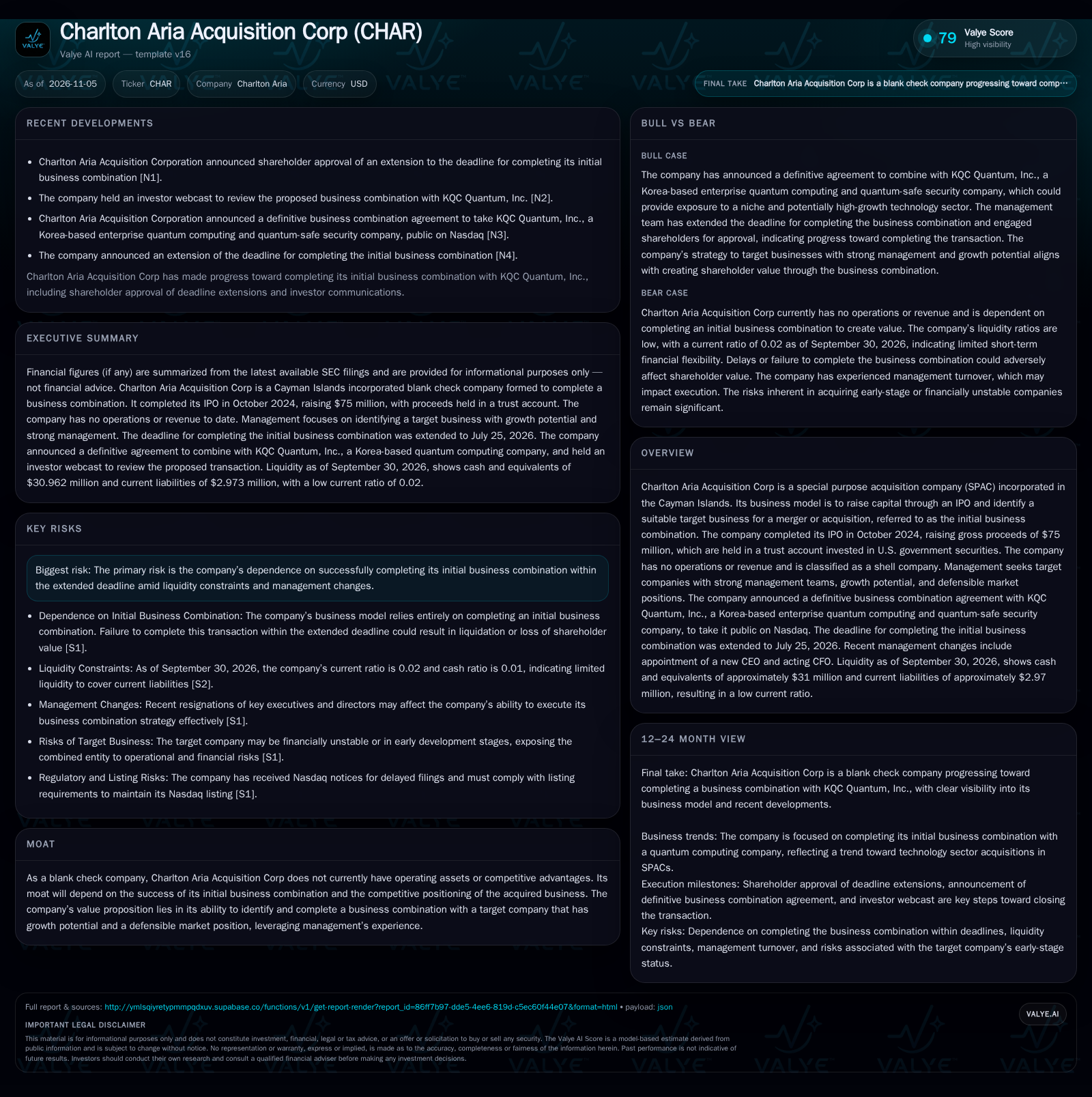
Charlton Aria Acquisition Corp is a blank check company with $75 million in IPO proceeds held in trust and no operating business. Its fate now rests on completing its announced merger with KQC Quantum, a Korean quantum computing and quantum-safe security firm, before July 2026. [S1] [N3]
Charlton Aria Acquisition Corp exemplifies the high-wire act of today’s SPAC market: flush with IPO capital but devoid of operations, the company’s entire future rides on its ability to close its announced merger with KQC Quantum. With a trust account holding $75 million and a ticking clock extended to July 2026, Charlton Aria must navigate execution, regulatory, and market risks to transform itself from a shell to a platform for quantum technology investing. The outcome will deliver either access to a potentially high-growth sector or, if the deal falters, the prospect of liquidation and value erosion.
Recent Milestones Shape the SPAC’s Core Value Proposition
Charlton Aria Acquisition Corp’s most consequential developments are tightly focused on its sole purpose: effecting a business combination. The company announced a definitive agreement to merge with KQC Quantum, a Korean enterprise quantum computing and quantum-safe security company, aiming to list the combined entity on Nasdaq [N3]. This is the company’s first and only step toward operational relevance, as it remains a shell with no revenue or active business lines [S1].
Shareholders approved an extension of the deadline to complete the merger to July 25, 2026, following additional sponsor deposits and unsecured promissory notes to support working capital [N1] [S1].As of September 30, 2026, the company reported cash and equivalents of $30.962 million and current liabilities of $2.973 million, resulting in a reported current ratio of 0.02 [S2].
The company’s fate is now directly tied to the timely completion of its merger with KQC Quantum. Failure to close the deal within the extended window would likely trigger liquidation and a return of trust funds to shareholders, erasing any residual value for sponsors and public shareholders beyond the redemption price.
Understanding SPAC Mechanics, Deal Structure, and Economic Impact
Charlton Aria’s business model is typical for a SPAC: raise capital via an IPO, park the proceeds in a trust account, and seek a high-potential acquisition. The $75 million raised is sequestered in U.S. government securities or money market funds, insulated from operating losses but accessible only upon successful deal closure [S1]. The company itself incurs minimal ongoing expenses, relying on sponsor loans and promissory notes to fund working capital until a merger is consummated.
The economics for public shareholders are binary. If the merger closes, they receive shares in the combined entity—potentially gaining exposure to KQC Quantum’s business and any future appreciation. If the deal fails, shareholders can redeem their shares for a pro rata portion of the trust account, typically close to the original $10/unit less expenses, with minimal upside but capped downside.
Sponsorship economics are highly levered: sponsors contribute capital for extensions and working capital, but their founder shares and warrants become valuable only if a deal is completed and the post-merger entity trades above the redemption value. The structure creates strong incentives to close a deal, but not necessarily to maximize long-term business quality, unless alignment mechanisms are in place.
Post-merger, the economics shift entirely to the operating model of the acquired business. For quantum computing, industry experience suggests high R&D intensity, long commercialization timelines, and uncertain near-term revenue—implying that the combined entity could face significant burn and require additional capital raises unless KQC Quantum is unusually mature or capital-efficient.
Evaluating Competitive Advantages from Shell to Quantum Player
As a blank check company, Charlton Aria currently has no operating assets or moat; its positioning will be defined by the attributes of KQC Quantum post-merger [S1]. In quantum computing, defensible advantages can stem from proprietary algorithms, hardware breakthroughs, intellectual property, and partnerships with enterprise or government customers. The sector is characterized by a small number of deep-tech competitors, including both well-funded startups and major technology incumbents.
The value proposition for the combined company will depend on KQC Quantum’s ability to demonstrate technical differentiation (such as superior qubit fidelity, error correction, or quantum-safe security protocols) and to commercialize its technology in a market where timelines are long and adoption is gradual. Switching costs for enterprise customers in quantum computing are likely to be high once solutions are integrated, but initial customer acquisition can be slow and lumpy.
The SPAC structure itself does not confer any ongoing competitive advantage. The success of the merger from a market perspective will rest on KQC Quantum’s positioning relative to both direct quantum peers and adjacent cybersecurity or high-performance computing vendors.
Merger Success Could Provide Early Exposure to Quantum Opportunities
The most favorable outcome is a timely and successful closing of the KQC Quantum merger, with the combined entity listing on Nasdaq and attracting investor attention as a rare public play on enterprise quantum computing. In this scenario, KQC Quantum demonstrates credible technical milestones, wins pilot contracts or commercial partnerships, and outlines a roadmap toward scalable revenue.
Investor enthusiasm for quantum computing and quantum-safe security—sectors with substantial long-term addressable markets—could drive a premium valuation, especially if the company can distinguish itself from less advanced or more speculative peers. The SPAC’s capital, combined with potential PIPE (private investment in public equity) financing, may give the combined entity a runway to accelerate development and customer acquisition.
Confirmation of this scenario would come from the closing of the merger, Nasdaq listing, public disclosures of commercial traction (contracts, partnerships, or pilot programs), and evidence of post-merger capital market support (such as additional financing or analyst coverage).
Deal Completion Faces Execution Challenges and Market Uncertainty
The most plausible outcome is that Charlton Aria completes its merger with KQC Quantum within the extended deadline, but the post-merger entity faces a challenging environment: limited near-term revenue, high R&D expenses, and a cautious public market that demands proof of commercial viability.
This scenario assumes that the technical and regulatory due diligence is completed, and that no major red flags emerge regarding KQC Quantum’s business fundamentals. However, investor enthusiasm may be muted by the broader SPAC market’s fatigue, skepticism toward early-stage tech stories, or concerns about dilution and capital needs.
Evidence for this path would include the successful closing of the business combination, timely SEC and Nasdaq filings, and the absence of major deal amendments or renegotiations. The combined entity would need to communicate a credible go-to-market plan and demonstrate progress against stated technical milestones to sustain post-merger valuation.
Shareholder Value Risks from Deal Breakdown or Post-Merger Performance
The primary risk is failure to complete the merger within the extended deadline, triggering the return of trust account proceeds to shareholders and leaving sponsors with unrecoverable sunk costs. In this scenario, public shareholders may recover close to their original investment, but lose any potential upside, while sponsors lose their capital and potential equity stake.
Alternatively, if the merger closes but KQC Quantum is unable to deliver technical or commercial progress, the combined entity could face rapid value erosion. This could occur due to missed technical milestones, inability to raise additional capital, regulatory setbacks, or broader market skepticism toward quantum technology SPACs.
Confirmation would come from missed deadlines, regulatory filings indicating deal termination or liquidation, or post-merger disclosures of weak customer traction, missed R&D milestones, or adverse capital market reactions (e.g., sharp stock declines, high redemption rates, or inability to raise follow-on funds).
Milestones and Risks Defining Charlton Aria’s Quantum Ambitions
Final closing and regulatory approval of the KQC Quantum merger before the July 25, 2026, deadline.
Redemption rates at the time of the merger; a high percentage of redemptions could signal weak investor confidence and limit post-merger liquidity.
Public disclosure of KQC Quantum’s customer pipeline, pilot programs, or signed commercial contracts—if disclosed.
Updates on KQC Quantum’s technical milestones and product roadmap, including evidence of quantum computing or quantum-safe security breakthroughs.
Post-merger capital market activity: PIPE financing, secondary offerings, or analyst coverage that could support ongoing R&D and operations.
Management stability and continuity, especially following recent executive changes at Charlton Aria.
Nasdaq compliance and ongoing listing status, including timely SEC filings and responses to any regulatory notices.
A useful metric would be the combined company’s quarterly cash burn and runway post-merger, as early-stage quantum ventures often require substantial ongoing capital.
Disclaimer: This is research-only, informational analysis and not investment advice. It may include AI-generated interpretation and general industry context. Always verify important details using primary sources.

Comments