
Chord Energy: E&P Resilience Hinges on Price Discipline and Asset Optimization
Chord Energy’s third quarter outperformance reflects operational discipline and robust risk management, but the long-term value proposition remains tethered to commodity price swings, reserve optimization, and the ability to contain cost inflation while navigating industry cyclicality.
Chord Energy beat Q3 2026 earnings and revenue expectations, demonstrating continued operational strength and prudent financial management. The core challenge: sustaining returns as oil and gas prices fluctuate and inflationary pressures persist.
Chord Energy’s latest quarter delivered both a headline beat on earnings and a reaffirmation of its disciplined approach to reserve management and risk mitigation. The company’s reported liquidity position and profitability metrics are notable in a sector often buffeted by commodity cycles and cost inflation. However, the durability of Chord’s value creation will be tested by its ability to optimize assets, manage impairment risks, and sustain operational efficiency as the macro energy environment inevitably shifts.
Recent Earnings Beat Underscores Operational Execution
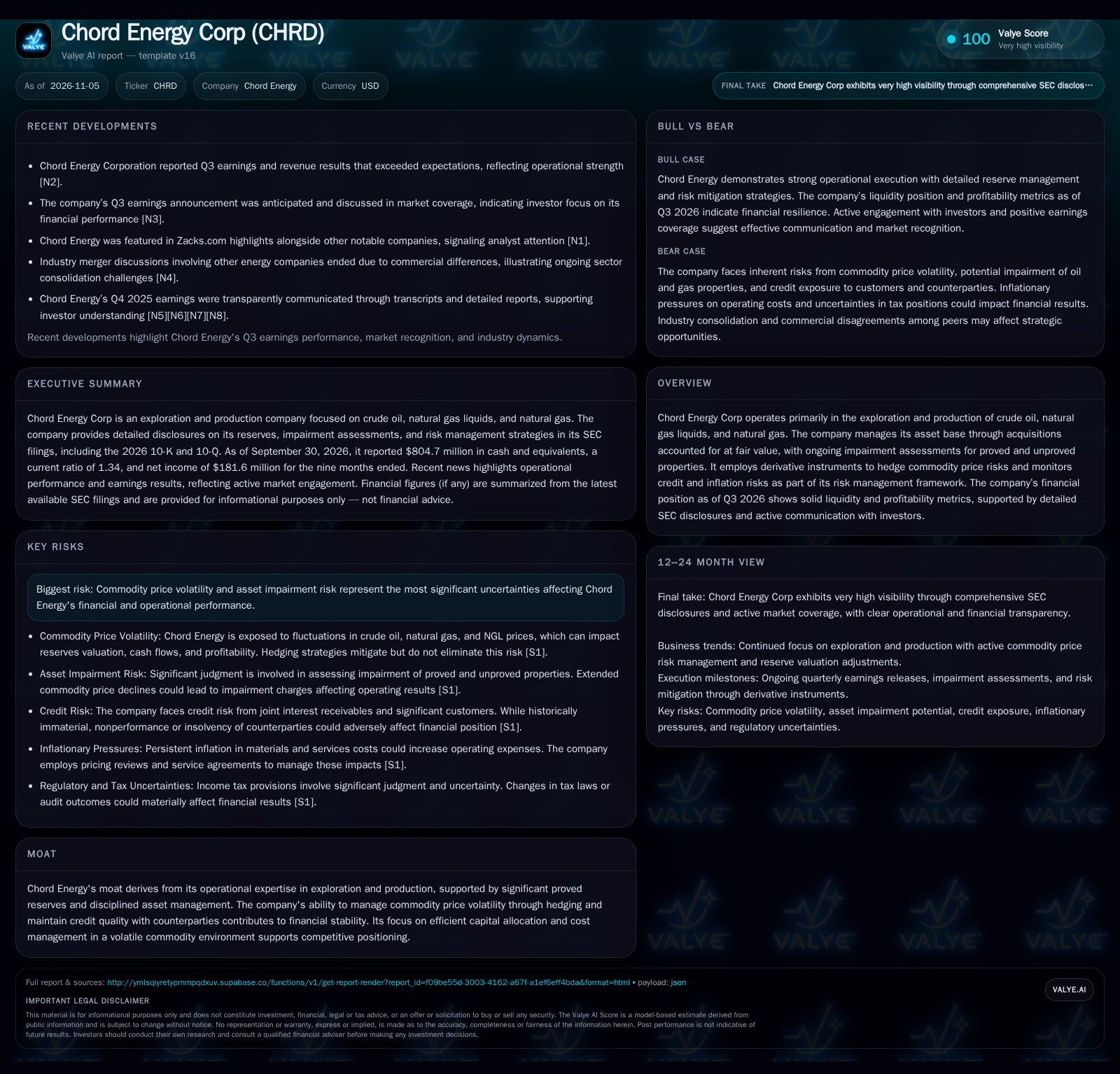
In Q3 2026, Chord Energy surpassed consensus expectations on both earnings and revenue, highlighting the company’s ability to execute in a volatile environment [N2]. As of September 30, 2026, Chord reported $804.7 million in cash and equivalents, a current ratio of 1.34, and net income of $181.6 million for the first nine months of the year [S2]. These results reflect not just favorable commodity pricing but also operational efficiency and prudent risk management, with the company maintaining detailed impairment and reserve disclosures and active use of derivative hedging [S1]. The company reported cash and liquidity metrics for the period; these figures do not by themselves establish operating runway, investment capacity, financial flexibility, or financing capacity.
Revenue Streams, Cost Structure, and the Levers of Value Creation
Chord Energy generates revenue through the sale of crude oil, natural gas liquids (NGLs), and natural gas, with realized pricing and production volumes as the primary determinants of topline performance [S1]. The company’s economics are highly sensitive to commodity price movements, which drive both cash flow and the periodic reassessment of asset values (impairments). While a substantial portion of costs are variable (linked to production and services), there is also a meaningful fixed cost base related to maintaining reserves, infrastructure, and compliance.
Hedging via derivatives helps smooth cash flows but can limit upside in strong price environments. The use of the acquisition method for business combinations and ongoing impairment testing means that reserve replacement and asset valuation are central to long-term value. Capital requirements are episodic, tied to drilling and development cycles, and the ability to flex spending is crucial for preserving balance sheet health during downturns. Operating leverage can amplify both gains and losses; thus, cost discipline and capital efficiency are persistent management priorities.
In addition to commodity price sensitivity, Chord Energy’s cost structure intricately balances fixed and variable components that influence operational flexibility. Fixed costs, including lease operating expenses and infrastructure maintenance, create a baseline expenditure that must be covered irrespective of production levels, thereby imposing a floor on profitability during downturns. Conversely, variable costs tied to drilling activity and service contracts offer levers for scaling expenses in response to market conditions. The interplay between these cost categories means that effective cost management requires both tactical adjustments to short-term spending and strategic investments in technology or process improvements that can reduce fixed cost burdens over time.
Capital allocation decisions are further complicated by the episodic nature of exploration and development expenditures. Chord’s ability to flex capital spending in response to price signals is essential to preserving liquidity and avoiding overextension during periods of price weakness. However, this flexibility may come at the expense of reserve replacement if capital cuts become too severe or prolonged, potentially leading to a decline in production volumes and future cash flows. Thus, management’s challenge lies in calibrating investment pacing to sustain long-term reserve life while maintaining financial resilience, a balance that is often influenced by access to capital markets and the cost of capital.
How Chord Energy Stacks Up in a Consolidating E&P Landscape
Chord Energy’s competitive position is defined by its operational expertise, reserve base, and risk management discipline. In the broader exploration and production (E&P) sector, players are increasingly differentiated by their ability to manage commodity price volatility, optimize reserve portfolios, and control costs amid inflation and regulatory uncertainty. Chord’s consistent communication, detailed SEC disclosures, and use of hedging instruments support investor confidence and may reduce perceived risk relative to less transparent peers [S1] [S2].
However, the sector is characterized by low switching costs and high substitutability—customers buy undifferentiated hydrocarbons, and scale or access to low-cost reserves can be decisive. Larger integrated producers may benefit from vertical integration and global market access, while smaller or more leveraged firms may be more vulnerable to price shocks. Chord’s focus on disciplined asset management, combined with historically immaterial credit losses, suggests a relatively robust risk profile, but the company remains exposed to the same structural forces—commodity cycles, regulatory shifts, and capital market sentiment—that drive broader industry consolidation and volatility.
The competitive landscape in E&P is also shaped by technological capabilities and operational scale, which can confer advantages in drilling efficiency and cost reduction. Chord Energy’s relative scale may influence its bargaining power with service providers and ability to implement advanced extraction techniques, such as enhanced oil recovery or digital field management. These factors can translate into lower per-unit costs and improved reserve recovery rates, which are critical in a sector where margins are thin and commodity prices volatile. However, smaller or more nimble competitors may exploit niche opportunities or operate with lower overhead, underscoring the importance of continuous innovation and operational discipline for maintaining competitive positioning.
Regulatory and environmental considerations increasingly affect competitive dynamics in the E&P sector. Compliance costs, emissions regulations, and evolving stakeholder expectations may impose additional operational constraints or capital requirements. Companies that proactively integrate sustainability measures and demonstrate transparent environmental governance may benefit from enhanced investor support and lower regulatory risk. For Chord Energy, this means that beyond traditional cost and reserve metrics, maintaining a forward-looking approach to environmental risk management could be a differentiator in attracting capital and securing long-term operational licenses in an evolving policy landscape.
Unlocking Value Through Sustained Price Strength and Efficient Reserve Replacement
Chord Energy’s upside scenario rests on a sustained period of favorable oil and gas prices, enabling strong free cash flow generation, opportunistic reserve replacement, and disciplined organic growth. If commodity prices remain robust, Chord can harvest cash from existing assets while selectively acquiring or developing new reserves at attractive economics. Continued outperformance on operating metrics—such as production efficiency, cost per barrel, and reserve replacement ratio—would reinforce the company’s ability to weather future downturns.
Evidence that would confirm this upside path includes: multi-quarter beats on production and earnings, rising PV-10 reserve valuations, proactive but accretive acquisitions, and a track record of avoiding significant asset impairments even as market conditions fluctuate. A notable reduction in cost inflation or service pricing, or successful renegotiation of key supply agreements, would further support margin expansion.
Navigating Commodity Cycles with Disciplined Hedging and Cost Management
The most plausible outcome is that Chord Energy continues to operate profitably but with earnings and cash flows subject to the inherent volatility of the upstream energy business. The company’s risk management—through hedging, disciplined capital allocation, and ongoing impairment assessments—should help smooth the impact of commodity swings, but not eliminate it. Reserve replacement will likely be a mix of organic drilling and opportunistic acquisitions, with capital spending flexed according to market conditions.
The base scenario would be confirmed by a pattern of positive but fluctuating quarterly earnings, maintenance of a conservative balance sheet (current ratio above 1.2 if disclosed), and ongoing transparency in disclosures and investor communications. Minor impairments could occur in weaker price environments but would not threaten overall solvency or operational continuity. Evidence against this scenario would include a sharp deterioration in reserve quality, persistent negative free cash flow, or a material increase in credit or counterparty losses.
Asset Impairments and Margin Squeeze in a Prolonged Downturn
The primary downside risk is a sustained downturn in oil and gas prices, leading to significant asset impairments, compressed margins, and a potential erosion of balance sheet strength. In this scenario, Chord’s hedging program may mitigate the initial impact but cannot fully insulate the company from prolonged price weakness. Reserve write-downs could materially reduce book value and limit borrowing capacity, while inflationary pressures on operating and service costs could further squeeze margins.
A spike in credit losses or a breakdown in major customer or joint venture relationships would further exacerbate downside risks.
Factors That Will Shape Chord Energy’s Long-Term Value Proposition
Quarterly production volumes and realized pricing by commodity, as these drive both revenue and reserve valuation.
Reserve replacement ratio and changes in PV-10 reserve valuations, which indicate the sustainability of future cash flows.
Magnitude and frequency of asset impairment charges, especially tied to lower commodity price scenarios.
Operating and capital cost trends, particularly the impact of inflation on per-unit economics.
Extent and effectiveness of derivative hedging, including disclosure of volumes, maturities, and mark-to-market values if available.
Credit losses and counterparty performance, with a useful metric being the percentage of receivables overdue or written off if disclosed.
Updates on regulatory or tax uncertainties, including any material changes in tax positions or audit outcomes.
Any material acquisitions, divestitures, or changes in reserve portfolio that could alter the company’s risk/reward profile.
Disclaimer: This is research-only, informational analysis and not investment advice. It may include AI-generated interpretation and general industry context. Always verify important details using primary sources.

Comments