
Primo Brands: Premium Water Momentum, Liquidity Friction, and the Stakes of Category Leadership
The company’s current profitability and access to capital provide near-term stability, yet future upside hinges on repeatable premium segment expansion and successful navigation of sector counterforces.
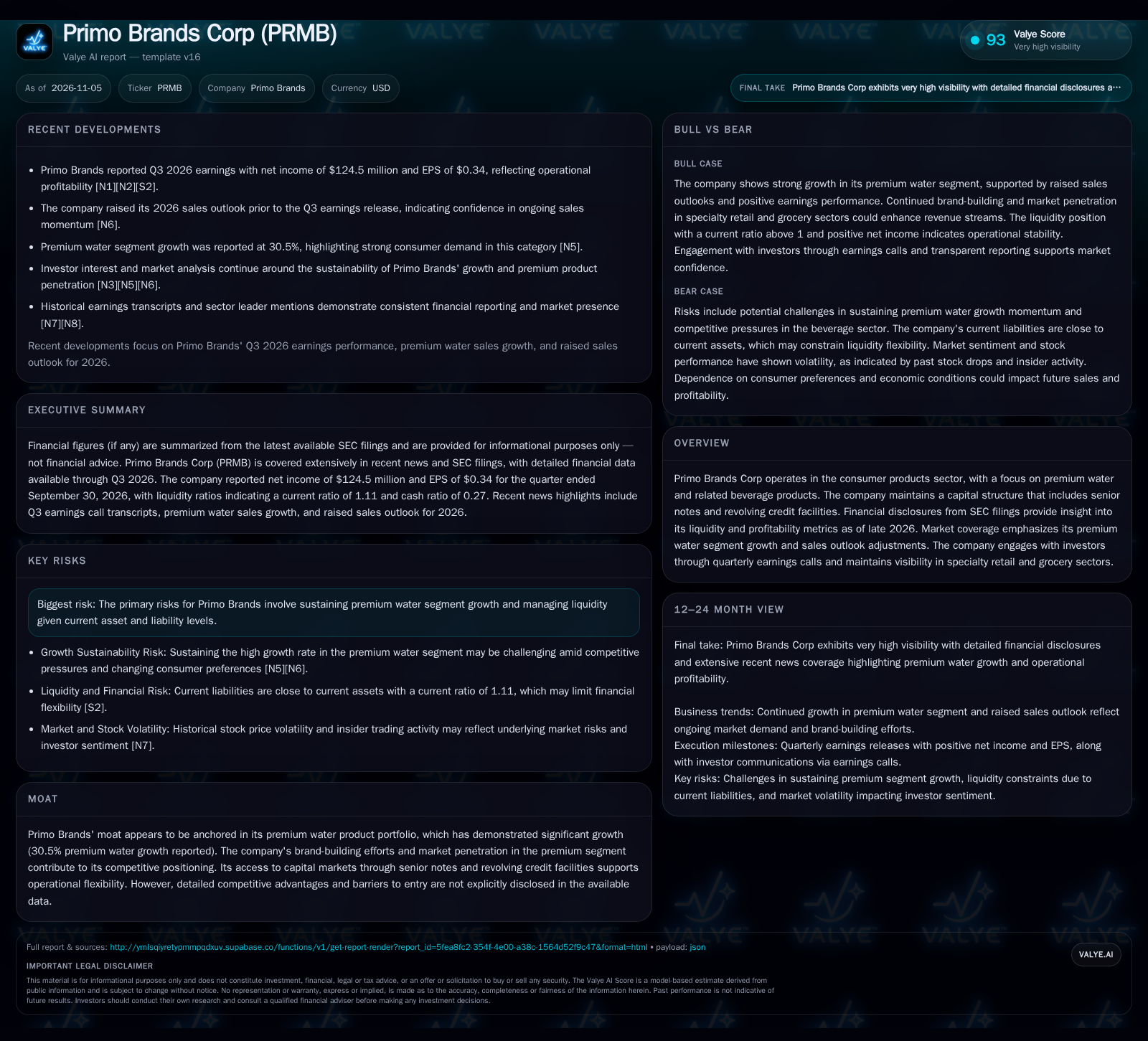
Primo Brands is showing robust premium water segment growth and posted solid Q3 2026 profitability, but its liquidity cushion is thin relative to current liabilities. The main thesis turns on whether the company can sustain premium product momentum and defend margins as competition and consumer preferences evolve. Access to capital markets offers flexibility, but sustaining growth in a crowded beverage sector remains the central challenge. [S2] [N5]
Primo Brands Corp stands at a crossroads defined by high-profile premium water growth and a tightening liquidity profile. The company’s Q3 2026 results highlight both operational profitability and the risks inherent in balancing rapid expansion with near-term financial constraints. With premium water sales surging 30.5% and net income of $124.5 million, Primo Brands commands attention as a potential category leader. Yet, its current assets only modestly exceed current liabilities, and ongoing access to capital markets remains crucial. The durability of its premium segment performance and the ability to defend pricing and margin in a competitive beverage landscape are now the pivotal questions for investors and operators alike. [S2] [N5]
Premium Water Surge and Tight Liquidity: The Latest Snapshot
Primo Brands Corp’s Q3 2026 financials reveal a company at once benefiting from strong premium water demand and contending with a narrow liquidity margin. The 30.5% growth in premium water segment sales stands out as a key driver, reflecting both consumer appetite for high-end beverage offerings and the company’s execution in this category. Net income for the quarter was $124.5 million, with basic and diluted EPS of $0.34, confirming core operational profitability. However, the company’s cash and equivalents stood at $376.7 million against current liabilities of $1.379 billion, resulting in a current ratio of 1.11 and a cash ratio of 0.27. [S2] [N5]
Decoding the Economics of Premium Beverage Growth
At the heart of Primo Brands’ business model is the pursuit of premiumization—commanding higher unit prices for branded water and beverage products. Premium water’s 30.5% segment growth suggests strong volume or mix gains, likely driven by consumer willingness to pay a premium for perceived quality, health benefits, or brand cachet. In theory, premium beverage categories can deliver high gross margins if pricing power is maintained and distribution is efficient.
The company’s cost structure likely features a mix of fixed costs (brand marketing, production infrastructure) and variable costs (raw materials, packaging, logistics). As premium volumes scale, some operating leverage may accrue, but gross margin durability depends on the ability to control input costs and resist price competition. Capital needs are nontrivial: growth may require investment in marketing, distribution, and potentially new product development, while liquidity constraints could limit the speed or scope of these investments. Senior notes and revolving credit facilities provide external funding options, but ongoing reliance on debt markets introduces interest expense and refinancing risk. [S1]
A critical unknown is the sustainability of high growth rates: if premium water adoption matures or if category pricing comes under pressure, Primo Brands could face margin compression or the need to invest more aggressively to maintain share. The question is whether the current economics—anchored in premium segment momentum—can endure as the competitive field evolves.
Brand, Shelf Space, and the Battle for Premium Beverage Loyalty
Primo Brands’ competitive positioning draws strength from its premium water brand and recent sales momentum, but durable advantages are not fully established. In beverage sectors, brand affinity, retailer relationships, and distribution breadth are critical. The company’s ability to secure shelf space in specialty retail and grocery channels underpins current growth—but these same channels are fiercely contested by both established multinationals and emerging premium entrants.
Switching costs for consumers are generally low in beverages unless brand preference is deeply entrenched or the product offers unique functional benefits. The risk is that premium water, as a category, may become commoditized if competitors match quality and branding, eroding pricing power. Category leaders with scale and marketing muscle could pressure smaller or newer entrants. Primo Brands’ access to capital markets and willingness to invest in brand-building are positives, but long-term defensibility depends on continuing to differentiate the product and deepen customer loyalty.
How Sustained Premium Momentum Could Amplify Profits
If Primo Brands can translate its current premium water growth into a repeatable, multi-year expansion, the business could achieve compounding margin and earnings gains. The upside scenario requires the company to maintain double-digit premium segment growth, defend pricing against competitors, and leverage scale to improve margins. Key confirming evidence would include continued outperformance in premium water sales, stable or rising gross margins, and successful introduction of new premium SKUs or adjacent beverage innovations.
Further, if the company demonstrates improved working capital efficiency or increases its liquidity buffer—either through higher cash flows or prudent debt management—it could reduce financial risk and support more aggressive investment in brand and distribution. A visible pipeline of retail partnerships, international expansion, or breakthrough marketing campaigns would also reinforce the case for durable premium segment leadership.
Falsification would come if premium water growth slows sharply, margins compress, or liquidity tightens further, forcing the company to scale back growth initiatives or raise dilutive capital.
Premium Growth Normalizes, Margins Get Tested, and Cash Management Takes Center Stage
The most plausible trajectory is that Primo Brands’ premium water segment growth decelerates from current highs as the category matures and competitors intensify their efforts. Revenue continues to rise, but at a more moderate pace, and the company faces periodic pressure to invest in marketing and promotions to defend share. Margins may be squeezed intermittently, especially if cost inflation or discounting rises.
The company continues to report positive net income, but EPS growth slows as investment needs and financing costs rise. Confirmation of this scenario would be a gradual decline in premium segment growth rates, stable but unremarkable gross margins, and periodic commentary from management on managing working capital and debt.
A shift in consumer preferences away from premium beverages, or a major competitive incursion, could tilt the base scenario toward the downside.
Liquidity Pinch and Competitive Overload: When Premium Weakness Exposes Structural Risks
Downside confirmation would include a marked slowdown in premium water sales, declining gross and operating margins, and new or expanded debt issuance under less favorable terms. If competitors with greater scale or lower costs take share, or if consumer preferences shift toward value brands, Primo Brands' ability to defend its premium positioning may erode rapidly.
A liquidity crunch could also limit the company’s ability to invest in brand support, accelerating a negative feedback loop: market share losses, forced cost cuts, and diminished pricing power.
What Will Validate or Challenge Primo Brands’ Premium Beverage Thesis?
Quarterly premium water segment revenue growth: Sustained double-digit growth would confirm ongoing momentum; a sharp deceleration would challenge the thesis. [N5]
Gross margin trends: Improvements suggest pricing power and cost control, while deterioration could signal competitive or input cost pressures.
Liquidity buffer (cash and equivalents vs. current liabilities): Any further shrinkage would increase financial risk and reliance on external funding. [S2]
Level of drawdown or new issuance on revolving credit facilities and senior notes: Rising leverage or higher interest expense would signal balance sheet stress. [S1]
Market share indicators in specialty retail and grocery channels (if disclosed): Gains would reinforce the brand’s competitive edge; losses would point to intensifying rivalry.
Consumer pricing sensitivity and mix shift toward value offerings (if disclosed): Evidence of trade-down would raise red flags for premium positioning.
New product launches or expansion into adjacent beverage categories: Success would indicate innovation capacity and brand stretch.
Disclaimer: This is research-only, informational analysis and not investment advice. It may include AI-generated interpretation and general industry context. Always verify important details using primary sources.

Comments