
AFLAC: Earnings Power, Investment Volatility, and the Stakes of Operational Resilience
AFLAC’s diversified insurance platform in Japan and the U.S. continues to generate substantial revenue, but the company’s Q3 2026 results highlight the growing importance of investment portfolio management, currency risk, and technology-driven operational efficiency. Regulatory restrictions and cybersecurity risks remain core challenges as the company pushes further into digital transformation.
AFLAC’s Q3 2026 results show ongoing operational strength in its core insurance businesses, but a decline in profit underscores the sensitivity to investment income and currency hedging outcomes. Strategic focus on technology and AI aims to drive efficiency and customer engagement, while regulatory and cybersecurity risks pose persistent threats to potential financial flexibility and operational stability. The company’s ability to sustain earnings growth hinges on successful investment management, digital execution, and navigation of external constraints. [S2] [N2] [N3] [N4] [N6]
AFLAC’s latest quarterly results reinforce its status as a heavyweight in supplemental insurance, with a robust presence in Japan and the U.S. and a significant investment portfolio. However, the Q3 2026 profit decline—despite beating revenue estimates—spotlights the delicate balance between underwriting, investment returns, and currency management. As AFLAC accelerates digital and AI initiatives to modernize operations and engage customers, it must also contend with heightened cybersecurity risks and regulatory constraints that could shape its future earnings power and capital allocation.
Recent Results Reveal Earnings Sensitivity to Investment and Currency Dynamics
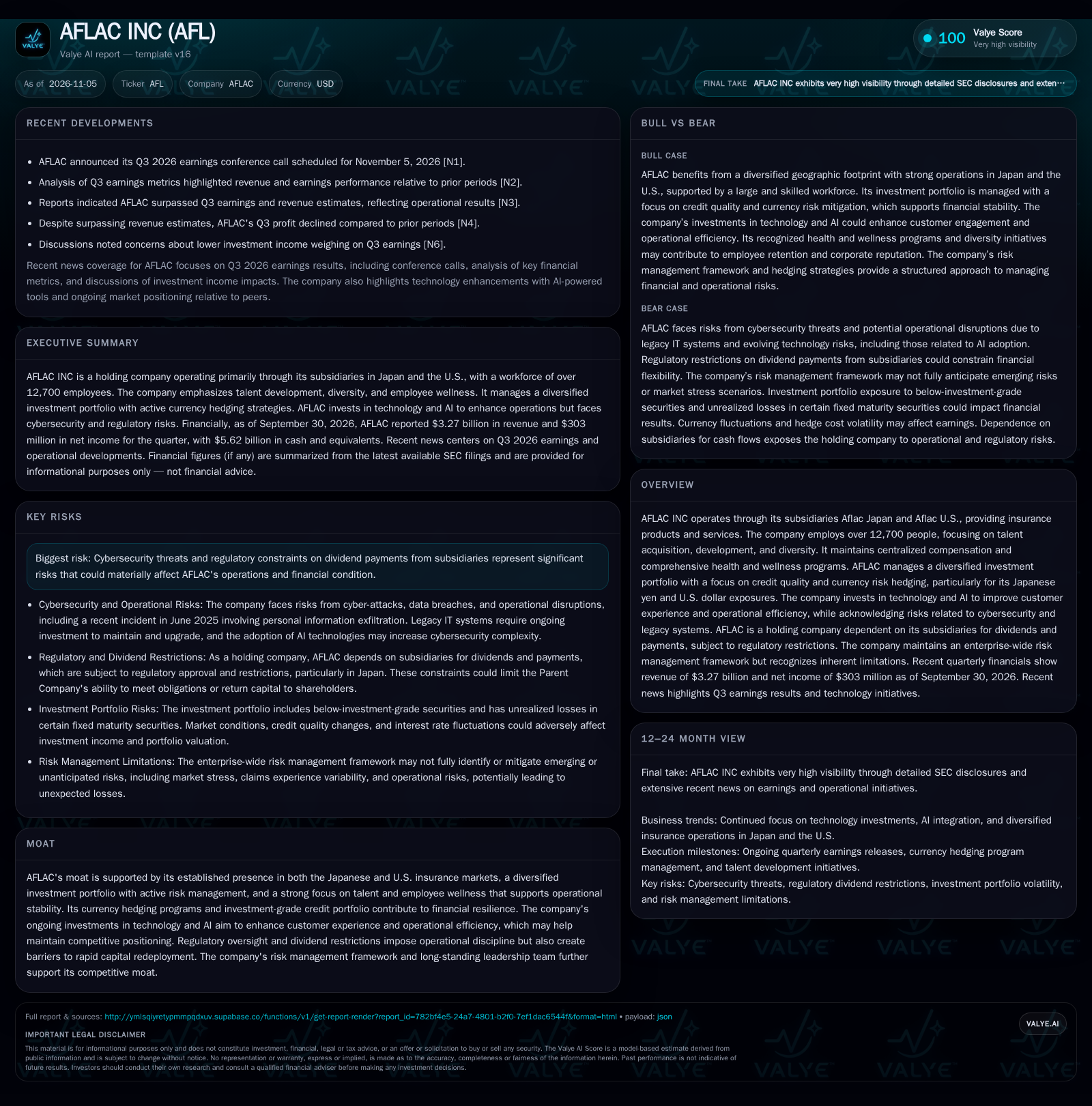
AFLAC reported Q3 2026 revenue of $3.271 billion and net income of $303 million, with basic and diluted EPS at $0.61 and a cash position of $5.623 billion as of September 30, 2026. While the company surpassed revenue estimates, net profit declined compared to prior periods, reflecting adverse trends in investment income and the ongoing impact of currency hedging costs. [S2] [N2] [N3] [N4] [N6]
AFLAC’s investment portfolio is notable both for its size and its complexity, with a significant allocation to investment-grade fixed maturities and a smaller exposure to below-investment-grade securities. Given the company’s large Japanese footprint, currency risk management is central: Aflac Japan actively hedges U.S. dollar-denominated assets back to yen, while the parent employs net investment hedging to mitigate translation risk. [S2]
The company is also in the midst of a digital and AI-driven transformation, investing in technology to improve customer experience and operational efficiency. However, these initiatives come with heightened cybersecurity risks, exemplified by a June 2025 incident involving personal data exfiltration. [S1] [N2] [N6]
How AFLAC’s Insurance and Investment Flywheels Drive—and Complicate—Profitability
AFLAC’s core economics rest on underwriting profitability from supplemental insurance products and the ability to generate investment income from premiums held before claims are paid. The company’s dual-market structure—Japan and the U.S.—allows for risk diversification, but also introduces regulatory and currency complexities.
Premium volume and claims experience drive the insurance margin, but investment returns are a crucial lever for overall profitability, especially given the long-tailed nature of many policies. AFLAC’s large investment portfolio, managed for credit quality, yield, and duration, creates both opportunity and volatility: rising rates or spread widening can pressure book values and realized gains, while below-investment-grade allocations add incremental risk.
Currency hedging is not just a technical detail—it is a material part of AFLAC’s economics, especially with roughly $28.7 billion of Aflac Japan’s U.S. dollar program requiring active management. Hedging costs can vary with market conditions, and unhedged exposures would leave AFLAC vulnerable to yen-dollar swings.
Technology and AI investments are designed to reduce administrative expense ratios and improve retention through better customer experience and digital distribution. However, these investments are largely fixed in the short run, and the payback depends on successful adoption and the avoidance of operational or cybersecurity disruptions.
Defending Share in Two Markets: Moat, Peers, and the Threat of Digital Disruption
AFLAC’s competitive position is anchored by its established brands and large customer bases in both Japan and the U.S., with deep distribution relationships and broad product portfolios. In Japan, AFLAC has long been a leader in cancer and supplemental health insurance, while in the U.S. it is a top player in worksite/voluntary benefits.
Relative to peers—domestic Japanese insurers, U.S. supplemental insurance providers, and global multiline carriers—AFLAC’s main advantages are scale, brand recognition, and a reputation for claims payment. Its diversified investment portfolio and active risk management provide a buffer against market shocks.
However, the competitive landscape is shifting. Digital-first insurers and insurtechs are pressuring incumbents to modernize distribution and customer experience. AFLAC’s technology and AI investments are critical to defending its position, but also expose it to risks from legacy systems and cybersecurity threats.
Switching costs in insurance can be modest for some products, especially as digital platforms lower friction. Retention depends on product relevance, service quality, and claims experience, so AFLAC’s continued investment in wellness, diversity, and service capabilities may help reinforce its moat—but these are not insurmountable barriers if digital disruptors execute well.
If Digital and Investment Strategies Align, AFLAC Could Unlock Higher Efficiency and Growth
A favorable scenario sees AFLAC successfully leveraging its technology and AI initiatives to drive down administrative costs, increase policyholder retention, and enhance cross-selling—particularly in the U.S. voluntary benefits market, where digital distribution could expand reach.
If investment income stabilizes or improves—whether through higher reinvestment yields, tighter credit spreads, or skillful asset allocation—AFLAC’s earnings sensitivity to market swings could diminish. Effective currency hedging and disciplined risk management would insulate reported results from major shocks.
Confirmation would come from a sustained improvement in the expense ratio, rising digital engagement metrics (if disclosed), and sequential earnings growth driven by both underwriting and investment contributions. Falsification would be evident if technology investments failed to deliver measurable cost or retention improvements, or if unexpected market events led to outsized investment losses.
Earnings Stability Hinges on Investment Outcomes, Claims Experience, and Technology Execution
The most plausible path forward is that AFLAC maintains stable premium volumes and disciplined underwriting in both Japan and the U.S., but faces continued quarter-to-quarter variability in investment income and hedging costs. Technology initiatives deliver incremental, rather than transformative, efficiency gains as the company contends with legacy system constraints and ongoing cybersecurity investments.
The company manages through market volatility with a conservative investment posture and robust risk management, but overall earnings growth is modest, reflecting both macro headwinds and the maturity of core markets.
Evidence supporting this scenario would include stable or gradually improving operating margins, continued investment in digital capabilities, and no material deterioration in claims or investment performance. A negative deviation would be seen if regulatory, investment, or technology setbacks led to a pronounced drop in earnings or capital position.
Regulatory, Investment, or Cyber Shocks Could Disrupt AFLAC’s Potential Financial Flexibility
An adverse outcome could arise if AFLAC experiences a major investment loss—via credit events, widening spreads, or a sharp increase in hedging costs—leading to a material hit to earnings and capital. Simultaneously, if regulatory authorities in Japan or the U.S. tighten dividend restrictions, the parent company could face constraints on capital deployment, buybacks, or dividend payments.
A serious cybersecurity breach, particularly one that disrupts operations or erodes customer trust, could trigger both reputational damage and direct financial losses. If technology modernization efforts stall or run over budget, AFLAC could find itself lagging digital-first competitors and losing share, particularly among younger or more tech-savvy policyholders.
Confirmation of this scenario would be a sharp decline in reported earnings, a spike in realized investment losses, regulatory announcements on dividend restrictions, or news of a major operational disruption due to cyber or tech failures.
Signals That Will Clarify AFLAC’s Earnings Power and Strategic Trajectory
Quarterly trends in net investment income and realized gains/losses, which directly affect net profit and are sensitive to both credit conditions and currency hedging costs.
Expense ratio trends, particularly any evidence of sustained improvement attributable to technology and AI investments (if disclosed).
Retention rates and digital engagement metrics in both Japan and the U.S., which would indicate customer response to modernization efforts—a useful metric would be policyholder digital self-service adoption.
Frequency and severity of cybersecurity incidents, and any associated financial or reputational impacts disclosed in filings or news.
Market share movements in key product lines and geographies, especially in the face of digital-first competitor encroachment (if disclosed).
Portfolio allocation shifts, especially any increase in below-investment-grade securities or changes to hedging strategies that could affect risk/return dynamics.
Earnings call commentary or management guidance on technology ROI, regulatory outlook, or capital allocation intentions.
Disclaimer: This is research-only, informational analysis and not investment advice. It may include AI-generated interpretation and general industry context. Always verify important details using primary sources.

Comments