
CF Industries: Decarbonization Investments, Commodity Cycles, and the Stakes of Low-Carbon Ammonia Adoption
CF Industries is executing one of the fertilizer sector’s most ambitious low-carbon transitions, with major capital projects in carbon capture and new joint ventures targeting emerging ammonia demand. The company’s earnings power remains tied to commodity cycles and input costs, but its strategic bets on clean ammonia and global partnerships could reshape both its economic model and competitive standing.
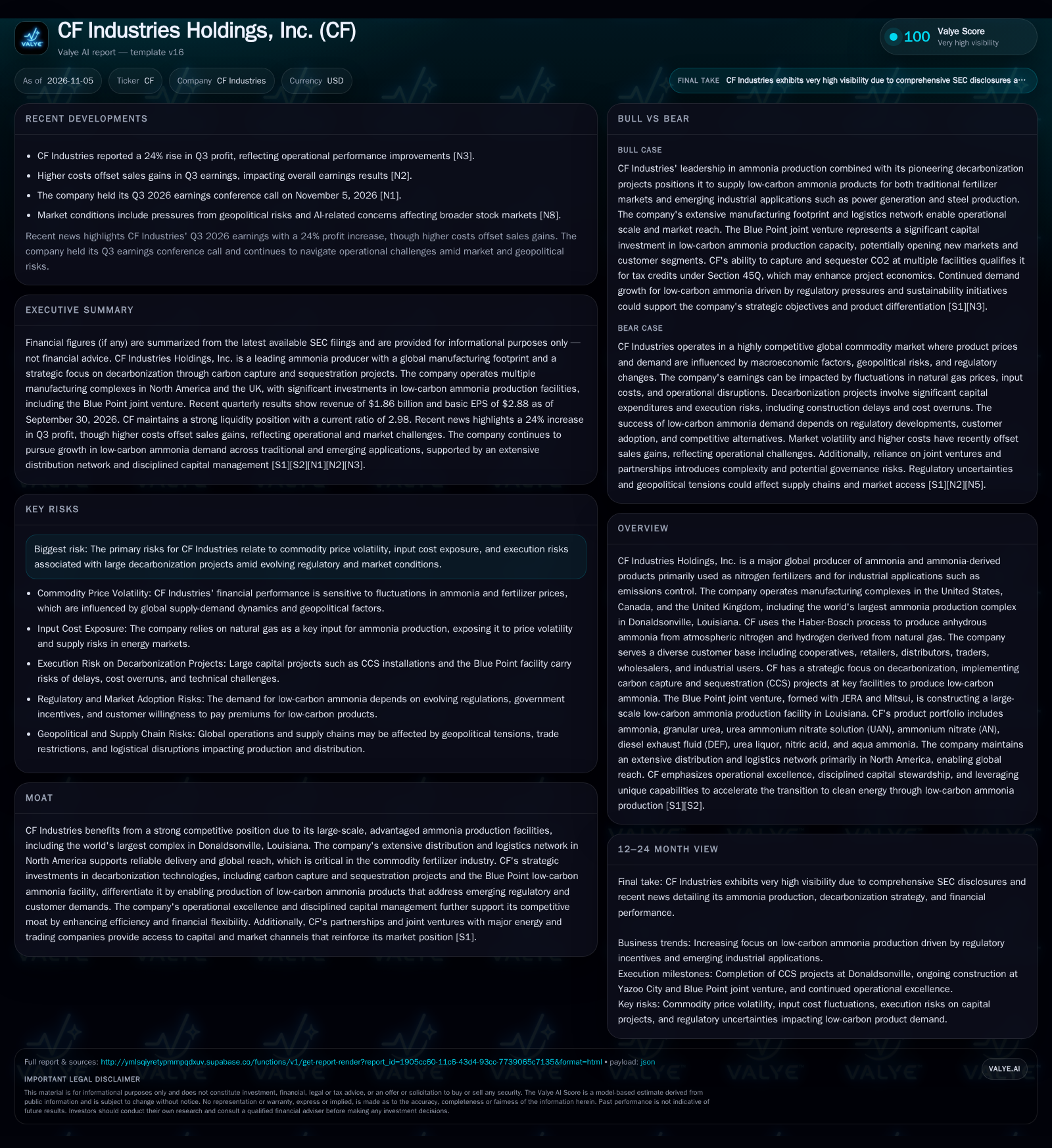
CF Industries is expanding its traditional ammonia and fertilizer business with a strong focus on low-carbon ammonia, leveraging large-scale carbon capture projects, joint ventures like Blue Point, and new industrial market opportunities. While recent profits rose, higher costs offset sales gains, highlighting ongoing margin pressures. The company’s future economics hinge on successful execution of decarbonization projects, regulatory support for clean ammonia, and the evolution of global commodity markets. [S2] [N2] [N3]
CF Industries Holdings, Inc. is at a critical inflection point as it seeks to transition from a traditional commodity fertilizer producer to a leader in low-carbon ammonia. The company’s major carbon capture projects, including the operational Donaldsonville CCS and the under-construction Yazoo City and Blue Point facilities, position it to serve both established fertilizer markets and new industrial applications such as power generation and steelmaking. While Q3 2026 brought a notable profit increase, rising input costs and margin pressures persist. The company’s future will be shaped by the pace of clean ammonia adoption, regulatory incentives, and its ability to execute large-scale decarbonization investments. [S2] [N2] [N3]
How Recent Profit Growth and Decarbonization Projects Reshape the Investment Landscape
CF Industries reported $1.86 billion in revenue and a 24% year-over-year profit increase for Q3 2026, with basic EPS at $2.88. However, higher input costs offset sales gains, highlighting ongoing margin pressures even amid topline growth. [S2] [N2] [N3]
The company has brought online a dehydration and compression unit at its Donaldsonville complex, enabling permanent sequestration of up to 2 million metric tons of CO2 annually. This project qualifies for 45Q tax credits, directly improving the economics of low-carbon ammonia production. [S2]
The Blue Point joint venture, in which CF holds a 40% stake, is under construction and targets a 1.4 million metric ton annual capacity for low-carbon ammonia, with over 95% CO2 capture and production expected to begin in 2029. [S2]
The Shifting Economics of Ammonia: From Commodity Margins to Clean Premiums
CF Industries’ traditional revenue model is built on the production and sale of ammonia and derivatives (urea, UAN, AN, DEF) to both agricultural and industrial users. Pricing is set by global supply-demand dynamics, with margins highly sensitive to natural gas costs—the principal feedstock for ammonia via the Haber-Bosch process.
The company’s fixed-cost base is substantial given the scale and capital intensity of its plants, which supports operating leverage during cyclical upswings but exposes earnings to commodity downturns and input price shocks. Variable costs, primarily natural gas, can swing widely, impacting gross margins.
The strategic pivot to low-carbon ammonia introduces new economics. Carbon capture and sequestration (CCS) projects involve significant upfront capital outlays but may unlock revenue streams from 45Q tax credits and potentially higher realized prices if customers are willing to pay a premium for low-carbon products. The actual magnitude of margin uplift will depend on the regulatory environment, customer adoption, and the scale of demand from new applications such as clean power generation and steelmaking.
As the Blue Point facility and other CCS projects come online, CF’s mix may shift toward products with differentiated pricing—and potentially more stable demand if regulatory mandates for clean ammonia accelerate. However, the capital intensity and execution risk of these projects could dampen free cash flow in the near term, making capital discipline and project management central to the company’s economic story.
Operational Scale, Distribution Reach, and Early Decarbonization: Can CF Sustain an Advantage?
CF Industries operates some of the world’s largest ammonia production complexes, with a robust logistics network across North America and global reach through partnerships and exports. This scale supports cost efficiency and reliable delivery—a key advantage in the commodity fertilizer business.
The company’s early and material investments in carbon capture and low-carbon ammonia differentiate it from many legacy peers, potentially positioning CF as a preferred supplier to customers seeking to decarbonize supply chains—especially in regions like Japan and Europe where regulatory and customer pressures are most acute.
However, barriers to entry in ammonia production are high due to capital requirements, environmental permitting, and logistics infrastructure, but not insurmountable for well-capitalized global competitors or state-backed entrants. Several rivals are also pursuing low-carbon ammonia strategies, and technology advances (such as green hydrogen-based ammonia) could threaten the cost or environmental advantage of CCS-based blue ammonia.
CF’s competitive position will depend on its ability to maintain cost leadership, execute on decarbonization ahead of competitors, and capture market share in new low-carbon segments before alternative technologies or regulatory shifts erode its lead.
What If Clean Ammonia Demand Accelerates and CF Delivers on Execution?
The most favorable scenario for CF Industries is one in which regulatory mandates and customer sustainability commitments drive rapid adoption of low-carbon ammonia in both fertilizer and new industrial markets. This could allow CF to realize premium pricing for blue ammonia, while 45Q tax credits and operational scale improve project returns.
Confirmation of this scenario would come from multi-year offtake agreements for low-carbon ammonia, especially with industrial users in Europe and Asia, and clear regulatory signals (such as mandated decarbonization of steel or power sectors) that expand addressable demand. Additional proof points would include on-time, on-budget delivery of the Blue Point and Yazoo City CCS projects, and evidence that CF’s low-carbon products are displacing higher-emission alternatives.
If realized, this scenario could shift the company’s margin profile, reduce earnings cyclicality, and justify continued capital investment in decarbonization. The key question is whether the market for clean ammonia matures quickly enough—and whether CF’s projects deliver the promised economics.
Commodity Cycles and Gradual Clean Transition: The Most Likely Near-Term Trajectory
Absent a major regulatory or demand inflection, CF is most likely to see a gradual mix shift toward low-carbon ammonia, with traditional fertilizer sales remaining the primary earnings driver through the late 2020s. Margins will continue to ebb and flow with natural gas prices and global fertilizer demand, while incremental contributions from CCS projects and early low-carbon sales begin to emerge.
This scenario would be confirmed by steady, but not explosive, growth in low-carbon ammonia shipments, continued reliance on traditional customers, and project timelines that are met but do not materially accelerate. Financial results would likely show improved resilience from 45Q credits and some premium sales, but with overall earnings still tied to commodity cycles and input costs.
A key falsification would be a significant delay or cost overrun at Blue Point or Yazoo City, or a lack of customer willingness to pay for low-carbon ammonia—either of which would signal that the transition is slower or less profitable than hoped.
Execution Stumbles and Commodity Headwinds: How the Thesis Could Unravel
The adverse scenario for CF Industries involves a confluence of project execution failures, commodity price weakness, and slow adoption of low-carbon ammonia. Construction delays or cost overruns at Blue Point, Yazoo City, or other CCS projects could erode returns and strain the balance sheet, especially if capital spending outpaces cash generation.
Simultaneously, if fertilizer prices fall due to global oversupply or weak demand, and if natural gas costs spike, margins would come under acute pressure—potentially reversing recent profit gains. If regulatory support for clean ammonia is delayed or customer adoption is tepid, the anticipated margin uplift from low-carbon products may not materialize, resulting in stranded capital and underutilized assets.
Evidence for this scenario would include project delays, missed cost targets, negative free cash flow, or persistent margin compression despite capital investment. A lack of substantive offtake contracts for low-carbon ammonia or adverse regulatory developments would further confirm downside risk.
Milestones and Market Forces That Will Shape CF’s Decarbonization Premium
Progress and cost discipline on the Blue Point and Yazoo City CCS projects—delays, overruns, or early completions would materially impact the thesis.
Actual volumes and realized prices for low-carbon ammonia sales, if disclosed, particularly in new industrial applications (power generation, steelmaking, export markets).
Securing multi-year offtake agreements or strategic partnerships for clean ammonia, especially with major industrial customers in Japan, Europe, or North America.
Trends in natural gas input costs and their impact on overall gross margin—continued volatility would test the resilience of both legacy and clean product economics.
Regulatory developments in the U.S., EU, and Asia related to clean ammonia mandates, subsidies, or carbon pricing that could accelerate or stall demand.
Free cash flow trends during peak capital investment periods—sustained negative free cash flow would raise questions about funding and capital allocation.
Competitor progress on alternative low-carbon ammonia technologies (such as green ammonia via electrolysis) and their ability to disrupt or leapfrog CCS-based approaches.
Updates on Section 45Q tax credit eligibility, sequestration performance, and any changes to federal or state incentives impacting project economics.
Disclaimer: This is research-only, informational analysis and not investment advice. It may include AI-generated interpretation and general industry context. Always verify important details using primary sources.

Comments