
DNOW Inc.: Advancing Integration and Digital Growth in Industrial Distribution
With the transformative acquisition of MRC Global and a sharpened focus on digital commerce and supply chain solutions, DNOW is positioned at a critical junction. The company's ability to harness integration synergies, defend margins in a fragmented market, and adapt to cyclical energy and industrial demand will shape its next phase.
DNOW’s acquisition of MRC Global and its digital platform investments mark a strategic bet on scale and operational efficiency. The company’s Q3 2026 results show positive earnings, but the real test is whether integration and digitalization can drive sustainable margin improvement and resilience against sector volatility. Watch for synergy capture, digital adoption, and competitive responses as pivotal thesis drivers.
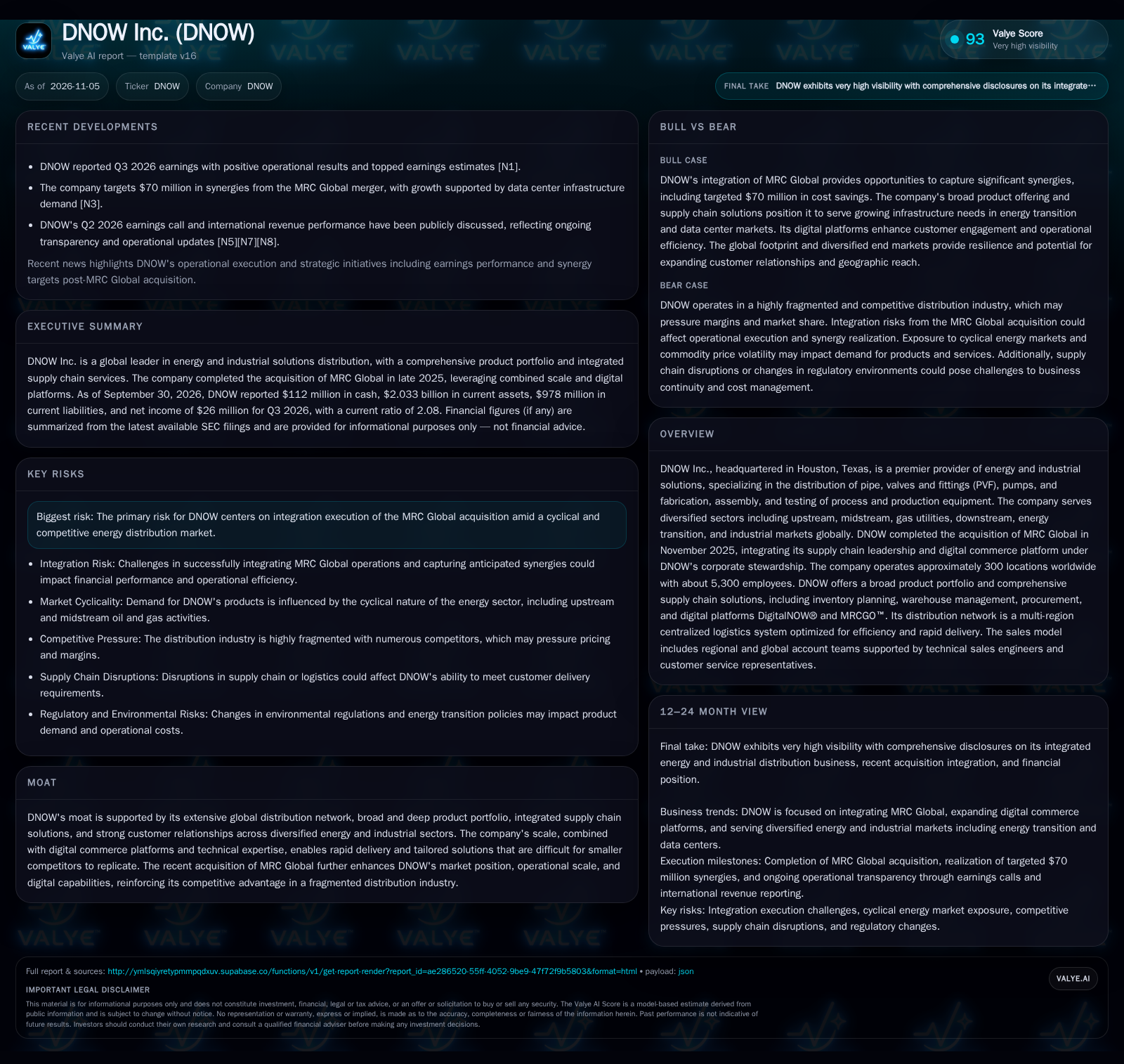
DNOW Inc., a major distributor of pipe, valves, fittings, pumps, and process equipment, is at a strategic inflection point following its acquisition of MRC Global. The integration offers opportunities for scale, cost savings, and digital platform leverage, but also introduces complex risks around execution, margin defense, and market volatility. As DNOW seeks to cement its position in a fragmented and cyclical distribution landscape, the next year will reveal whether its investments in digital commerce and global supply chain efficiency can outpace competitive and macroeconomic headwinds.
Recent Acquisition and Digital Initiatives Highlight DNOW’s Strategy
DNOW completed the acquisition of MRC Global in November 2025, integrating one of the largest PVF distributors and inheriting both scale and the MRCGO™ digital commerce platform [S1] [N3]. This move targets $70 million in cost synergies, a material figure given the company’s scale and the highly competitive nature of the distribution sector [N3]. As of September 30, 2026, DNOW reported $26 million in Q3 net income, $112 million in cash, and a current ratio of 2.08, reflecting ongoing profitability and a relatively conservative liquidity position [S2]. The business now operates approximately 300 locations globally, with a workforce of about 5,300 employees [S1]. The company’s emphasis on digital platforms (DigitalNOW®, MRCGO™) and integrated supply chain solutions underscores a strategic push toward operational efficiency and customer engagement.
Integration and Digital Supply Chain Enhancements Transform Distribution Economics
DNOW’s core economics have historically hinged on high-volume, low-margin distribution of PVF, pumps, and fabricated equipment—businesses where gross margin expansion is difficult without scale or service differentiation. The acquisition of MRC Global is designed to drive both procurement leverage and operational cost reduction, particularly through the rationalization of overlapping facilities, workforce, and logistics. If DNOW successfully captures its targeted $70 million in synergies, this could raise EBITDA margins meaningfully, but integration costs and execution risk are non-trivial [N3].
The company’s digital platforms (DigitalNOW®, MRCGO™) may enable further margin improvement by automating order flows, reducing manual procurement costs, and improving inventory turns. In theory, digital adoption could allow for dynamic pricing, better customer segmentation, and higher wallet share from large industrial accounts. However, true digital transformation in industrial distribution is often slow, with customer adoption and back-end integration representing potential bottlenecks.
Fixed costs are significant due to the extensive physical footprint and inventory requirements, but variable costs scale with volume and service complexity. The business is working-capital intensive, as evidenced by $2.033 billion in current assets against $978 million in current liabilities [S2]. This structure means that cash conversion cycles and inventory discipline are crucial for sustaining profitability and funding organic or inorganic growth.
Maintaining Market Position Through Scale, Service, and Digital Capabilities
DNOW competes in a highly fragmented distribution sector, with numerous regional and global players offering similar PVF, pump, and industrial equipment portfolios. While scale provides some procurement advantage, price competition is fierce and customer switching costs are generally low unless bundled with integrated services or digital procurement platforms.
The integration of MRC Global adds both breadth and depth to DNOW’s product offering and customer base, potentially allowing for cross-selling and improved service coverage. The company’s global logistics network and ability to deliver rapid, tailored solutions may deter smaller competitors, especially for complex industrial and energy projects requiring technical support.
However, digital transformation is a double-edged sword: while platforms like DigitalNOW® and MRCGO™ can foster stickiness, they also lower the barriers for customers to compare prices and switch suppliers. The question is whether DNOW can use its digital and service capabilities to create genuine customer lock-in, or whether it will face further margin erosion as procurement becomes increasingly commoditized.
Potential for Margin Growth and Market Share from Successful Integration
The most favorable scenario is one in which DNOW successfully integrates MRC Global, fully realizing the $70 million in cost synergies and leveraging the combined digital platforms to drive operational efficiency and customer engagement [N3]. In this world, DNOW could see a step-change in EBITDA margins, improved free cash flow, and the ability to reinvest in further digital tools or bolt-on acquisitions. The expanded product catalog and global reach would enable deeper penetration of both legacy and new customer accounts, particularly in energy transition and data center infrastructure segments.
Confirmation of this scenario would come from sequential margin improvement, reduction in SG&A as a percentage of sales, and rising digital order penetration (if disclosed). Evidence of new multi-year customer wins, especially in high-growth sectors, would further validate the strategic logic. Conversely, if integration costs spiral, or if customer attrition accelerates, the upside case would be undermined.
Baseline Outlook: Integration Gains Counterbalanced by Market and Competitive Pressures
The most plausible outcome is that DNOW captures a meaningful—but not full—portion of the targeted synergies, and that digital adoption continues to grow incrementally. The company maintains its position as a leading industrial distributor, benefiting from scale and integrated supply chain capabilities, but faces ongoing challenges from margin compression and end-market cyclicality.
In this scenario, financial results would show stable or modestly rising margins, with periodic volatility driven by energy sector investment cycles and pricing pressure from both established and emerging competitors. The company’s global footprint and customer diversification provide some buffer, but not immunity, from macroeconomic shocks. Confirmation would come from relatively stable gross margins, consistent cash generation, and continued investment in digital and logistics infrastructure.
Risks of Integration Challenges and Market Downturn Impacting Scale Benefits
The adverse scenario is characterized by poor integration execution, with cost overruns, cultural clashes, or IT disruptions hampering the realization of synergies. At the same time, a downturn in energy and industrial investment—potentially triggered by commodity price volatility or regulatory shifts—could drive revenue declines and inventory write-downs.
In this case, DNOW would face margin compression, negative operating leverage, and potentially strained liquidity if working capital is not tightly managed. Signs of this scenario would include rising SG&A as a percentage of sales, declining EBITDA margins, or the need to restructure debt or assets to preserve cash. Persistent customer attrition or loss of large accounts, particularly if digital platforms fail to gain traction, would further pressure the business.
Factors Influencing the Success of DNOW’s Integration and Digital Expansion
Actual synergy realization versus the $70 million cost savings target from the MRC Global integration; quarterly updates or management commentary would help test progress [N3].
Trends in EBITDA and operating margins, especially compared to pre-acquisition levels and industry peers.
Growth rate and penetration of digital platform (DigitalNOW®, MRCGO™) orders, if disclosed, as a measure of customer adoption and process efficiency.
SG&A as a percentage of revenue, which would indicate whether integration is driving sustainable overhead reduction.
Inventory turnover and working capital metrics, particularly in the face of sector cyclicality and supply chain volatility.
Customer retention rates and new contract wins, especially in energy transition, data center, and international segments, if disclosed.
Competitive pricing trends and gross margin stability, which would reveal the balance between scale advantages and ongoing market pressure.
Disclaimer: This is research-only, informational analysis and not investment advice. It may include AI-generated interpretation and general industry context. Always verify important details using primary sources.

Comments