
OFG Bancorp: Dividend Focus, Regional Dynamics, and the Levers of Puerto Rican Banking Profitability
OFG Bancorp’s recent results highlight sustained profitability, a reported cash position, and an emphasis on shareholder returns. The company’s performance reflects both the advantages and the limitations of operating as a leading Puerto Rican financial institution, with exposure to local economic cycles, interest rate volatility, and the nuances of regional banking competition.
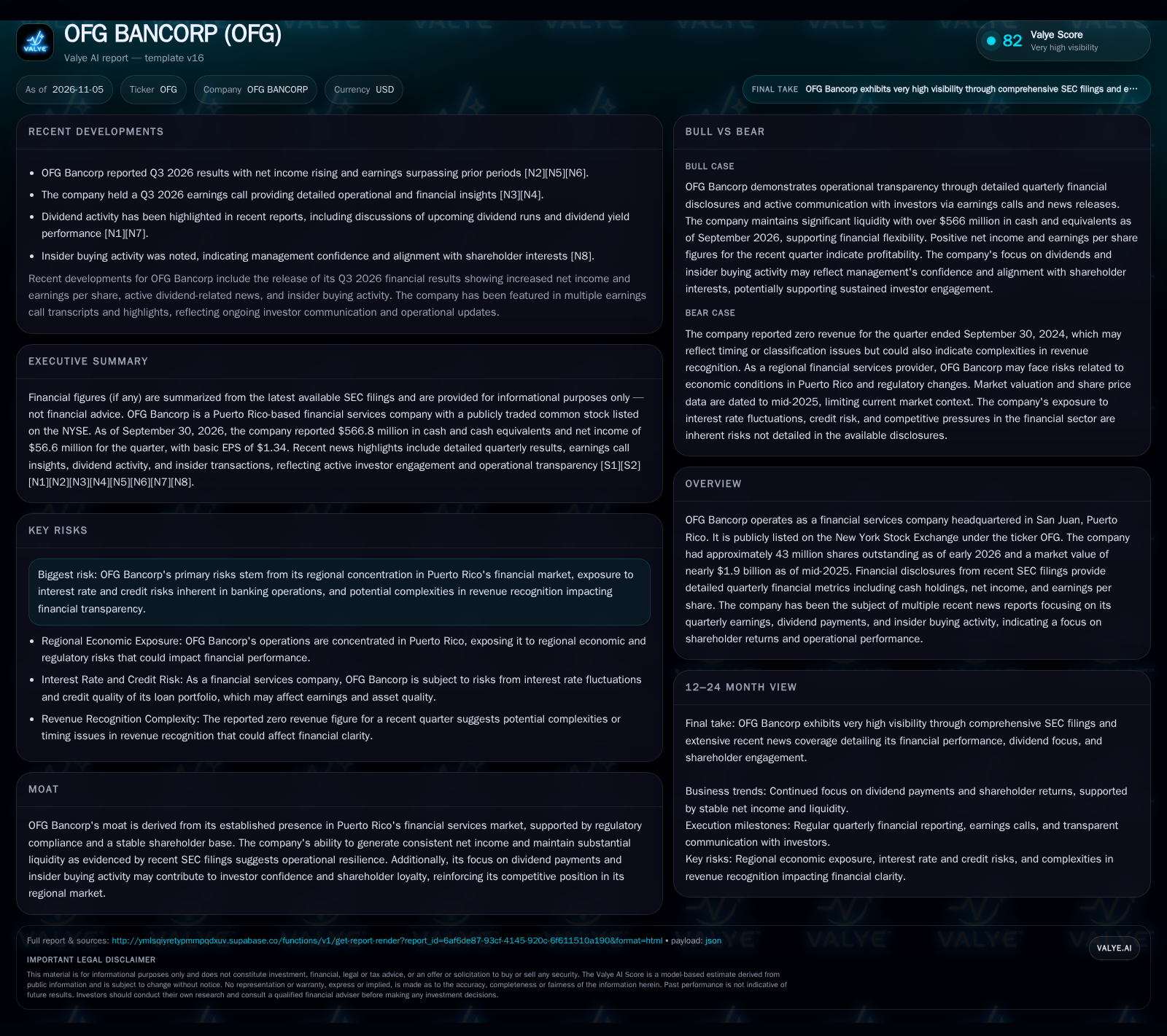
OFG Bancorp reported $56.6 million in net income and $566.8 million in cash and equivalents for Q3 2026, with earnings per share exceeding $1.30. The company’s focus on dividends and insider activity signals a commitment to shareholder returns, but its regional concentration and the intricacies of its reported revenue figures underscore the importance of understanding local economic and regulatory risks. Sustainable profitability will depend on managing interest rate exposure, credit quality, and maintaining operational efficiency in a competitive Puerto Rican banking landscape. [S2] [N2] [N3] [N5] [N6] [N7]
OFG Bancorp’s latest quarterly results reinforce its position as a leading regional financial institution in Puerto Rico, combining notable profitability with substantial liquidity and a clear focus on shareholder returns. The bank’s strategic priorities—underscored by consistent net income, strong cash reserves, and visible dividend activity—reflect both the opportunities and the vulnerabilities inherent in operating within a concentrated market. As Puerto Rico’s economic landscape continues to evolve, OFG’s ability to manage interest rate and credit risks, navigate regulatory complexity, and differentiate itself from both local and international competitors will be central to its long-term value proposition.
Recent Performance: Profitability, Liquidity, and Shareholder Orientation
OFG Bancorp reported a net income of $56.6 million for the quarter ended September 30, 2026, translating to basic earnings per share of $1.34 and diluted EPS of $1.33. The company reported profitability for the period. The company reported cash and liquidity metrics for the period; these figures do not by themselves establish operating runway, investment capacity, financial flexibility, or financing capacity. The cited source reports dividend-related activity; that disclosure alone does not establish dividend-policy continuity, management confidence, or a material constraint on capital flexibility. These developments underscore OFG’s focus on operational transparency and shareholder returns, positioning it as a consistent performer within the Puerto Rican financial services sector. [S2] [N2] [N3] [N5] [N6] [N7]
Earnings Drivers and the Structure of Regional Bank Profitability
OFG Bancorp’s business economics are shaped by the traditional levers of regional banking: net interest margin, fee-based income, and disciplined cost management. As a bank headquartered in Puerto Rico, its core earnings likely derive from the spread between interest earned on loans and investments and the interest paid on deposits and other funding sources. The recent net income figures suggest that OFG has managed to maintain a healthy margin despite the sector’s exposure to interest rate volatility and credit risk.
Operating leverage in this context is driven by the ability to grow earning assets faster than expenses—something that can be challenged by market saturation or subdued economic growth within Puerto Rico.
The cited source reports dividend-related activity; that disclosure alone does not establish dividend-policy continuity, management confidence, or a material constraint on capital flexibility. The reported zero revenue figure for Q3 2024 highlights the potential for accounting or timing issues in revenue recognition, a reminder that headline income figures should be viewed in the context of underlying asset quality, loan growth, and non-interest income sources. [S2]
The interplay between interest rate cycles and loan portfolio composition is particularly critical for OFG Bancorp. Given the regional concentration in Puerto Rico, the bank's exposure to interest rate fluctuations can be amplified by the local economic sensitivity to external shocks and fiscal policy changes. A diversified loan portfolio that balances consumer, commercial, and government-related exposures can mitigate concentration risk, but the effectiveness depends on the prevailing economic drivers and regulatory environment. Furthermore, the bank’s ability to hedge interest rate risk through asset-liability management strategies, including the use of derivatives or adjustable-rate products, will influence net interest margin stability over time.
Positioning in Puerto Rico’s Banking Landscape: Advantages and Pressures
OFG Bancorp’s competitive position is anchored in its established local presence, regulatory compliance, and robust disclosure practices. Its focus on dividends and shareholder engagement may foster investor loyalty and differentiate it from less transparent peers. However, the Puerto Rican banking market is characterized by a handful of entrenched local players and the presence of larger U.S.-based financial institutions, all competing for a finite pool of deposits and loan demand.
OFG’s scale and liquidity provide some insulation against smaller competitors, but it faces ongoing challenges from broader economic cycles, shifts in credit quality, and the potential for regulatory changes specific to Puerto Rico. The company’s ability to defend its net interest margin, maintain asset quality, and offer differentiated customer service will be central to sustaining its market share. The risk of technological disruption from digital-first challengers and the need for ongoing investment in compliance and IT infrastructure are also relevant counterforces.
Technological adaptation and digital transformation represent both a challenge and an opportunity for OFG Bancorp within the Puerto Rican banking sector. Regional banks often face resource constraints compared to larger national institutions when investing in fintech innovations, cybersecurity, and customer experience enhancements. However, a focused strategy that leverages local market knowledge and tailored service offerings can create differentiation. The bank’s investment decisions in technology must balance cost efficiency with the need to meet evolving customer expectations and regulatory requirements, particularly in areas such as digital onboarding, mobile banking, and fraud prevention. Failure to keep pace could erode competitive positioning, while prudent investments may unlock new revenue streams and operational efficiencies.
If Loan Growth and Asset Quality Hold, Enhanced Shareholder Returns Could Follow
A favorable scenario for OFG Bancorp would see Puerto Rico’s economic environment stabilize or improve, supporting higher loan demand and benign credit conditions. If OFG can leverage its liquidity to expand its loan book at attractive spreads, while keeping credit losses in check, earnings growth could accelerate. Sustained profitability would give the company room to further increase dividends or initiate share repurchases, deepening shareholder engagement.
Evidence that would confirm this scenario includes sequential loan growth above peer averages, stable or improving non-performing asset ratios, and positive guidance on net interest margin. A reversal in the zero revenue reporting anomaly, with consistent top-line growth, would also support the upside case.
If OFG Bancorp can successfully capitalize on Puerto Rico’s gradual economic recovery, the bank’s credit underwriting standards and risk appetite will be key determinants of sustainable growth. A disciplined approach that avoids overextension into higher-risk segments while selectively targeting sectors with favorable credit trends could enhance portfolio quality and earnings resilience. Additionally, maintaining strong capital ratios and liquidity buffers would provide flexibility to seize market opportunities without compromising financial stability. The bank’s capacity to optimize fee income through cross-selling and expanding non-interest revenue channels could also contribute to earnings diversification, reducing reliance on net interest margins and cushioning against rate volatility.
Sustained Profitability Amid Regional Constraints and Sectoral Volatility
The most plausible path for OFG Bancorp is continued steady profitability, supported by a conservative balance sheet and prudent capital allocation.
In this scenario, loan growth remains modest but stable, credit quality does not materially deteriorate, and net interest margins compress only gradually if at all. Confirmation would come from consistent quarterly earnings, stable dividend payments, and commentary that emphasizes risk management and operational discipline.
Credit Deterioration or Economic Shock Could Erode Earnings Power
The principal downside risk is a deterioration in Puerto Rico’s macroeconomic environment or a sector-specific credit event. A sharp rise in non-performing loans, declining collateral values, or a regulatory shock could compress net interest margins, increase loan loss provisions, and pressure earnings.
If OFG is unable to deploy its liquidity into profitable lending opportunities, or if interest rates move against its asset-liability profile, profitability could fall below dividend requirements, forcing a rethink of capital return policies. Evidence of this scenario would include a spike in loan loss provisions, a sharp decline in net income, dividend cuts or suspensions, and negative commentary around local economic trends or regulatory headwinds. Persistent reporting anomalies, such as unexplained revenue figures, would also undermine confidence in the company’s financial clarity.
Factors That Will Test OFG Bancorp’s Value Proposition in Puerto Rican Banking
Sequential loan growth rates and the mix of new lending—if disclosed—would provide insight into the sustainability of earnings momentum.
Trends in non-performing assets, delinquency rates, and loan loss provisions are critical to assessing credit quality and downside risk.
Net interest margin trends, especially in the face of shifting interest rates, will signal the company’s pricing power and funding cost management.
Commentary and guidance on local economic conditions in Puerto Rico from quarterly calls would help gauge external risk.
Resolution or clarification of revenue recognition anomalies—particularly the reported zero revenue for Q3 2024—would enhance financial transparency.
Insider buying or selling activity, if publicly disclosed, could indicate management’s view on intrinsic value and near-term prospects.
Comparative performance versus local and U.S.-based peers on cost efficiency and return metrics would help benchmark competitive positioning.
Disclaimer: This is research-only, informational analysis and not investment advice. It may include AI-generated interpretation and general industry context. Always verify important details using primary sources.

Comments